
Can You Retire at 55, 60, or 65? Understanding Every Major U.S. Retirement Income Source
Can you retire at 55, 60, or 65 in the United States? Learn how Social Security, 401(k)s, IRAs, pensions and Medicare fit together, and plan the bridge years with a worked example.
This article was submitted by a member. Views and content are the author’s own and do not represent this site.
Disclosure: this series is published by TTLB Tools, which also builds and operates the TTLB Retirement Planner used in this guide. The basic calculator is free; features such as the U.S. Social Security, 401(k), IRA and Medicare modules, market-swing simulation, tax-rate estimates and stress tests require a paid PRO subscription. The screenshots were captured on November 26, 2026, and all inputs are hypothetical.
Introduction
Imagine leaving your full-time job at 55. You have savings, perhaps a 401(k), and a home that is mostly paid off. You are ready for a different pace of life. But what will pay your bills between the day your paycheck stops and the day your retirement benefits become available?
In the United States, retirement is not a single benefit that begins at one universal age. It is usually a combination of Social Security, employer-sponsored retirement plans, individual retirement accounts, pensions, personal investments, and sometimes part-time work or rental income.
The timing matters. You may stop working at 55, become eligible to claim Social Security at 62, reach full retirement age at 67, and qualify for Medicare at 65. These are separate milestones. This guide explains the major U.S. retirement income sources and how they fit together if you leave full-time employment at 55, 60, or 65.
Later in this guide, a hypothetical 50-year-old is run through a retirement planner with real screenshots. With the same savings and spending, the readiness score is 26% if full-time work ends at 55, 51% at 60, and 77% at 65. The point is not the exact numbers, which depend on every assumption, but how much the work-stop age changes the picture and why the years before Social Security and Medicare deserve their own plan.
Curious what your own number looks like? Try the planner with rough figures first. It takes about two minutes, and you can refine the inputs later: open the planner
In this guide:
How U.S. retirement income works, and what Social Security does and does not do
Employer plans, IRAs and other income, and what changes at 55, 60 and 65
A practical income map and an assumption sheet you can copy
A six-step planner walkthrough with real screenshots, ending in your three numbers: readiness, shortfall, and the age your savings run out
FAQ, sources, and what to read next
How Retirement Income Works in the United States
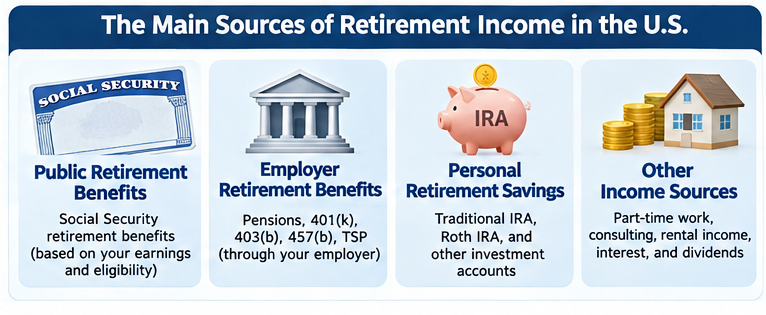
The U.S. retirement system is built around several sources rather than one universal retirement pension. Some benefits are based on your work history, some depend on employer plans, and others come from savings and investments you manage yourself.
| Income category | Common examples | What it does |
|---|---|---|
| Public retirement benefits | Social Security | Government-administered benefit based on covered earnings and eligibility |
| Employer retirement benefits | Traditional pension, 401(k), 403(b), 457(b), TSP | Provides a formula-based benefit or an employer-sponsored savings account |
| Personal retirement savings | Traditional IRA, Roth IRA, taxable investments and cash | Adds flexibility and may fund years before or after public benefits begin |
| Other continuing income | Part-time work, consulting, rental income, interest and dividends | Can supplement cash flow, but may fluctuate |
These categories are not interchangeable. Social Security is a public social-insurance program. A 401(k) is generally an employer-sponsored retirement savings account. An IRA is an individual account. A traditional defined-benefit pension promises a benefit under a plan formula, subject to the plan's terms.
The Federal Reserve's 2024 Survey of Household Economics and Decisionmaking found that 78% of retirees received Social Security income during the previous 12 months, 56% reported pension income, 50% reported interest, dividends, or rental income, and 32% reported wages, salaries, or self-employment income. These categories overlap; the figures are not additive and include some spouse or partner income. The survey illustrates that many households combine multiple sources.
Social Security: The Public Foundation of Retirement Income
Social Security provides monthly retirement benefits based on a worker's covered earnings record and the age at which benefits begin. It should not automatically be treated as a complete replacement for a paycheck. Your personal benefit depends on your earnings history, eligibility, and claiming age.
Eligibility and the 35-Year Earnings Record
In general, a worker needs 40 Social Security credits—typically equivalent to 10 years of covered work—to qualify for retirement benefits on their own record. The Social Security Administration generally uses a worker's highest 35 years of indexed earnings to calculate average indexed monthly earnings. If you stop working before you have 35 years of covered earnings, years without earnings may count as zeros. Even after 35 years, additional higher-earning years may replace earlier lower-earning years.
Leaving work at 55 does not automatically cancel Social Security eligibility, but it can affect the eventual amount. Review your own earnings record and benefit estimates through your personal Social Security account rather than relying on a national average.
Claiming at 62, Full Retirement Age, or 70
You can generally begin Social Security retirement benefits at 62. For people born in 1960 or later, full retirement age is 67. Claiming before full retirement age permanently reduces the monthly benefit compared with the full-retirement-age amount; delaying beyond full retirement age increases the monthly amount up to age 70. For someone born in 1960 or later, claiming at 62 can mean a reduction of up to 30% compared with the full-retirement-age benefit.
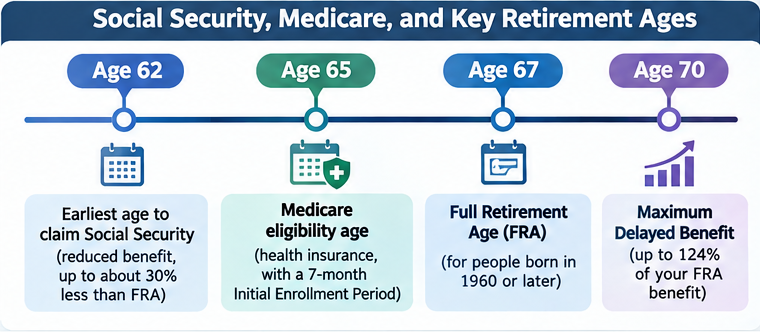
| Milestone | Meaning |
|---|---|
| Stop working at 55 | Your paycheck ends; Social Security does not begin automatically |
| Claim at 62 | Earliest standard age for retirement benefits, with a reduced benefit |
| Medicare at 65 | Generally the age-based Medicare eligibility milestone |
| Full retirement age 67 | Applies to people born in 1960 or later |
| Claim at 70 | Delayed retirement credits stop increasing the retirement benefit after this age |
Your work-stop age and Social Security claiming age are separate decisions. Someone may leave full-time employment at 55, use savings for several years, and claim Social Security later. Another person may continue working part-time after 62 while receiving benefits, subject to the earnings test before full retirement age.
Working While Receiving Social Security
You can work and receive Social Security retirement benefits at the same time. Before full retirement age, the retirement earnings test may temporarily withhold benefits when wages or net self-employment earnings exceed the annual limit. In 2026, the limit is $24,480 for someone below full retirement age all year; $1 in benefits is withheld for every $2 above the limit. In the year full retirement age is reached, the limit is $65,160 for earnings in the months before that age, with $1 withheld for every $3 above the limit. Starting with the month you reach full retirement age, there is no earnings limit under this test.
The earnings test applies to wages and net self-employment earnings, not every form of retirement income. Benefits withheld under the test are reflected in a recalculation at full retirement age. If you plan to consult, freelance, or work part-time, include those earnings in your cash-flow plan.
Public-Sector Pensions: Federal, State, and Local Plans
Some U.S. government employees participate in defined-benefit pension plans. A plan may calculate a benefit using salary, years of service, and retirement age. The formula, vesting requirements, eligibility rules, and payment options depend on the specific plan.
Federal civilian employees covered by the Federal Employees Retirement System (FERS) generally have three components: the FERS Basic Benefit Plan, Social Security, and the Thrift Savings Plan (TSP). State and local employees may participate in different systems. Teachers, public safety employees, municipal workers, and other public employees should consult their own plan documents.
Obtain an official estimate before choosing an early retirement date. Check whether leaving early reduces the benefit, whether you are vested, and whether a survivor option changes the monthly amount.
Employer-Sponsored Retirement Plans
Common employer plans include 401(k) plans, 403(b) plans, 457(b) plans, and the federal Thrift Savings Plan. They do not all have identical rules. Employer plan documents determine matching contributions, vesting, investment options, withdrawals, and distribution choices.
Defined-Contribution Accounts Versus Traditional Pensions
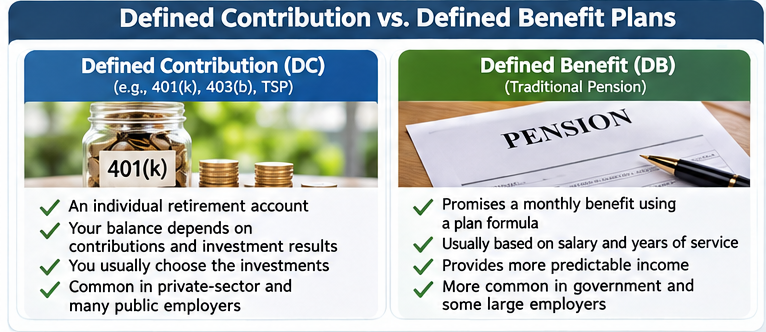
| Feature | Defined-contribution plan | Defined-benefit pension |
|---|---|---|
| Examples | 401(k), 403(b), 457(b), TSP | Traditional employer pension |
| Benefit | Account balance | Formula-based pension payment |
| Investment outcome | Changes with contributions, returns, fees and withdrawals | Benefit generally follows plan formula |
| Main planning issue | How much can the account support? | When can payments begin, and how much will be paid? |
A 401(k) balance is not a guaranteed monthly pension. You must plan how to invest, withdraw, and manage that balance. Some employers match employee contributions. Your own salary-deferral contributions are generally always 100% vested, while employer contributions may follow a vesting schedule. If you leave close to a vesting milestone, some employer contributions may not yet belong to you.
For 2026, the basic employee elective-deferral limit for many 401(k) and 403(b) plans is $24,500 before applicable catch-up contributions. This is a contribution ceiling, not a recommended amount. Your budget, emergency savings, debt, employer match, and retirement timeline all matter.
Individual Retirement Accounts: Traditional and Roth IRAs
Traditional IRA
Traditional IRA contributions may be tax-deductible depending on income, filing status, and workplace-plan coverage. Investment growth is generally tax-deferred, and withdrawals are generally taxable as ordinary income to the extent they represent untaxed contributions and earnings. Withdrawals before age 59½ may trigger a 10% additional tax unless an exception applies.
Roth IRA
Roth IRA contributions are made with after-tax money. Qualified withdrawals are generally tax-free, subject to applicable rules. Original Roth IRA owners generally do not have lifetime required minimum distributions, but the five-year rules, age requirements, and distribution ordering rules still matter.
For 2026, the combined annual contribution limit across Traditional and Roth IRAs is $7,500, or $8,600 for people age 50 or older, subject to eligible compensation and other IRS rules. The limit is shared across both IRA types, not available separately for each.
For early retirees, ask when the money can be accessed, what tax may apply, and how withdrawals interact with other income. A large IRA balance does not automatically mean all of it is freely accessible without tax consequences.
Other Sources of Retirement Income
Part-Time Work, Consulting, or Self-Employment
Consulting, seasonal work, freelancing, or a small business can reduce withdrawals from retirement assets. Do not treat work income as guaranteed unless there is a realistic basis for expecting it to continue. Consider hours, pay, expenses, taxes, and how long you intend to work.
Interest, Dividends, and Investment Distributions
Interest and dividends can contribute to cash flow, but they fluctuate. A dividend is not a guaranteed salary, and a high distribution yield does not necessarily mean an investment is safe. Distinguish investment income from withdrawals of principal. Selling shares to fund expenses is not the same as earning dividends or interest.
Rental Income
Rental income should be estimated after property taxes, insurance, maintenance, vacancies, repairs, management costs, mortgage payments, and changes in local demand. Gross rent is not the amount available to spend.
Spousal and Survivor Benefits
Married households may have more than one Social Security record, employer plan, or pension. Consider both partners' ages, health, retirement timing, and survivor benefits. Do not assume household income will remain unchanged after one spouse dies.
What Changes When You Leave Full-Time Work at 55, 60, or 65?
Leaving at 55: Funding the Years Before Social Security
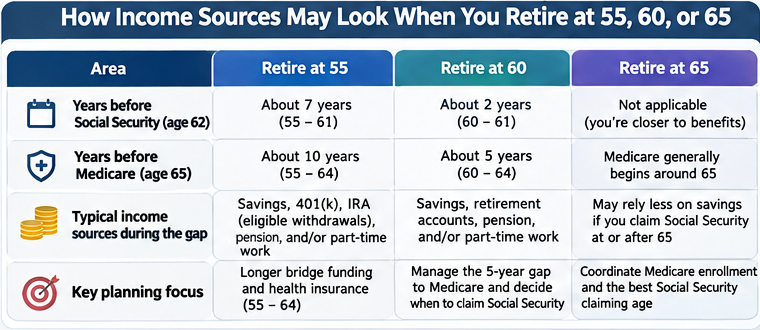
If you leave full-time work at 55, you generally cannot begin Social Security retirement benefits immediately; the earliest standard claiming age is 62. You may need cash, taxable investments, eligible employer-plan distributions, a pension if your plan allows it, or part-time income. The age-55 separation-from-service exception may allow certain distributions from an eligible employer plan without the 10% additional early-distribution tax if separation occurs during or after the calendar year you reach 55 (age 50 for certain qualified public safety employees). It does not apply to every account or distribution, and ordinary income tax may still apply. IRA withdrawals generally do not receive the same age-55 exception.
Health insurance is another major issue. If employer coverage ends before 65, consider a Marketplace plan, COBRA, a spouse's employer plan, or another eligible source. Budget for premiums and out-of-pocket costs.
Leaving at 60: Managing the Five-Year Gap to Medicare
Leaving at 60 shortens the period before Social Security eligibility compared with leaving at 55, but you still need a bridge plan. You must decide how to fund the years before claiming Social Security and cover health insurance before Medicare generally begins at 65. Part-time work may reduce withdrawals; otherwise, accessible savings and eligible account distributions may be needed.
Leaving at 65: Coordinating Medicare and Social Security
Most people first become eligible to enroll in Medicare around 65. The Initial Enrollment Period generally lasts seven months: it begins three months before the month you turn 65 and ends three months after that month. If you have qualifying group health coverage through current employment, different enrollment rules may apply. COBRA or retiree coverage does not necessarily provide the same protection as active-employment coverage for delaying Part B.
Age 65 does not automatically make it best to claim Social Security. You may stop working and delay Social Security, continue working while coordinating employer coverage and Medicare, or use savings while waiting to claim. Medicare is health insurance; Social Security retirement benefits provide income. They solve different problems.
A Practical Retirement Income Map
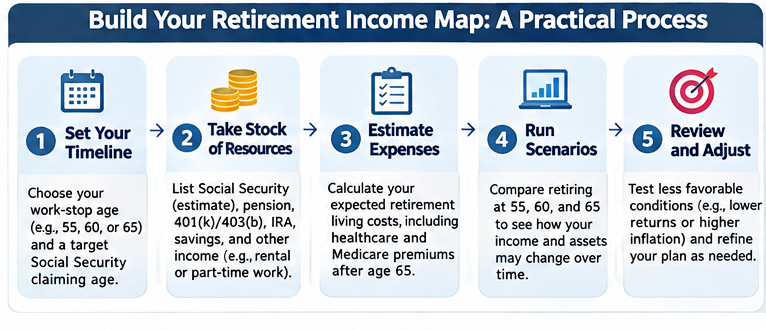
| Stage | Public benefits | Other income | Main planning question |
|---|---|---|---|
| Before Social Security | Usually no retirement benefit yet | Cash, taxable investments, eligible account withdrawals, pension if available, work or rent | Can accessible resources cover living costs and health insurance? |
| After Social Security begins | Social Security and possibly a pension | 401(k), 403(b), IRA, investments, work or rental income | Is cash flow sufficient after taxes and healthcare costs? |
| After Medicare eligibility | Social Security and pension continue | Retirement-account withdrawals and other income | Are premiums, out-of-pocket costs, and long-term expenses included? |
Build Your Own Assumption Sheet
| Item | What to record |
|---|---|
| Current age | Your age today; include spouse age for a household plan |
| Work-stop age | The age you intend to leave full-time employment |
| Social Security claiming age | Your expected benefit start age based on your own estimate |
| Medicare coverage | Usually around 65, subject to eligibility and enrollment rules |
| Work and earnings record | Social Security Statement and expected future covered earnings |
| Employer plans | 401(k), 403(b), 457(b), TSP, or traditional pension details |
| Personal accounts | Traditional IRA, Roth IRA, taxable investments, cash and savings |
| Continuing income | Part-time work, rental income, interest, dividends or spouse income |
| Retirement expenses | Housing, food, transportation, insurance, healthcare, taxes and discretionary spending |
| Withdrawal assumptions | Which accounts will be used, when withdrawals begin, and tax treatment |
| Investment assumptions | Expected return, fees, inflation, and a less favorable scenario |
Use today's dollars when estimating whether a future lifestyle is affordable. If you use future nominal dollars, account for inflation consistently. Do not mix today's expenses with future account balances without adjustment. Avoid counting the same asset twice: if a 401(k) is already included in total retirement assets, do not add it again as separate wealth. Record principal withdrawals as withdrawals, not investment income.
A Simple Example: The 55-Year-Old Who Wants to Leave Full-Time Work
Consider a hypothetical person who is 50 today, wants to stop full-time work at 55, expects to review Social Security at 62, has a full retirement age of 67 (assuming birth in 1960 or later), and plans around Medicare eligibility at 65. This is an illustration of the planning process, not a claim about typical savings or benefits.
| Planning item | Illustrative assumption |
|---|---|
| Current age | 50 |
| Work-stop age | 55 |
| Social Security review age | 62 |
| Full retirement age | 67, assuming birth in 1960 or later |
| Medicare planning age | 65 |
| Work income after 55 | Not assumed unless a specific part-time plan is established |
| Social Security before 62 | $0 from own retirement benefit |
| Retirement assets | Enter actual account statements |
| Pension income | Include only if plan confirms eligibility and amount |
| Health coverage before 65 | Budget separately |
The person should not treat an estimated Social Security amount at 67 as income from age 55 onward. Nor should a 401(k) balance be assumed fully accessible without tax or penalty considerations. Calculate the years from 55 to 62 separately, then the years after Social Security begins, and then the period after Medicare eligibility.
Scenario A: Stop full-time work at 55 and use accessible assets and verified continuing income to bridge the gap.
Scenario B: Continue full-time work longer, or switch to part-time work, to reduce withdrawals and potentially add covered earnings and contributions.
The purpose is not to prove that one choice is always better. It is to understand what each choice costs, what risks it creates, and whether the household can sustain the resulting cash flow.
Use a Retirement Planner to Compare Your Income Scenarios
Knowing the names of your retirement accounts is only the first step. You also need to see how they work together over time. A basic estimate can help you examine current assets, expected expenses, work-stop age, projected asset shortfall, and whether assets may last through your planning horizon.
The examples below use the TTLB Retirement Planner. The basic version shows a readiness score, projected assets and shortfall, an asset-trend chart, a cash-flow chart, scenario adjustments, inflation analysis, and one saved plan. Select the United States as the retirement-planning country and USD as the currency.
Enter your own current age, intended retirement age, retirement assets, cash, monthly savings, expected retirement expenses, and reasonable investment and inflation assumptions. The result is an initial estimate, not a guarantee.
A Worked Example in the Planner: Stopping Work at 55
The inputs below are hypothetical. Dollar amounts are in today's money, and the planner applies inflation for you. The example reuses the 50-year-old from the previous section.
| Item | Input |
|---|---|
| Ages and horizon | Current age 50, stop full-time work at 55, plan to age 90 |
| Assumptions | 5% investment return, 2.5% inflation |
| Savings outside 401(k)/IRA | $150,000 taxable investments plus $50,000 cash |
| Today's budget | $9,000 monthly income, $6,000 spending, $1,000 invested each month |
| Retirement spending | $6,000 per month in today's dollars, assumed to include about $700 for health coverage before 65 |
| Social Security | AIME $7,000, 28 years worked so far, claim at 62 |
| 401(k) | $300,000 balance, $1,500 employee plus $600 employer contribution per month, withdrawals from 60 (the earliest age the planner accepts) |
| Traditional IRA | $100,000 balance, no new contributions, withdrawals from 60 |
| Medicare | Planner default costs from 65 |
The free version shows you the gap. PRO shows you why the gap exists: which module, which year and which assumption moves it. One modeling note up front: the account modules accept withdrawals only from age 60, so in this example the years from 55 to 59 have to be funded from taxable savings and cash. The FAQ lists the planner's other limits.
Step 1: Start without any public benefits or retirement accounts
Enter your age, savings, income, spending and the retirement budget. The basic result appears immediately. The 'Chance of reaching the goal' line and the shaded band on the asset-trend chart come from the PRO market-swing simulation.
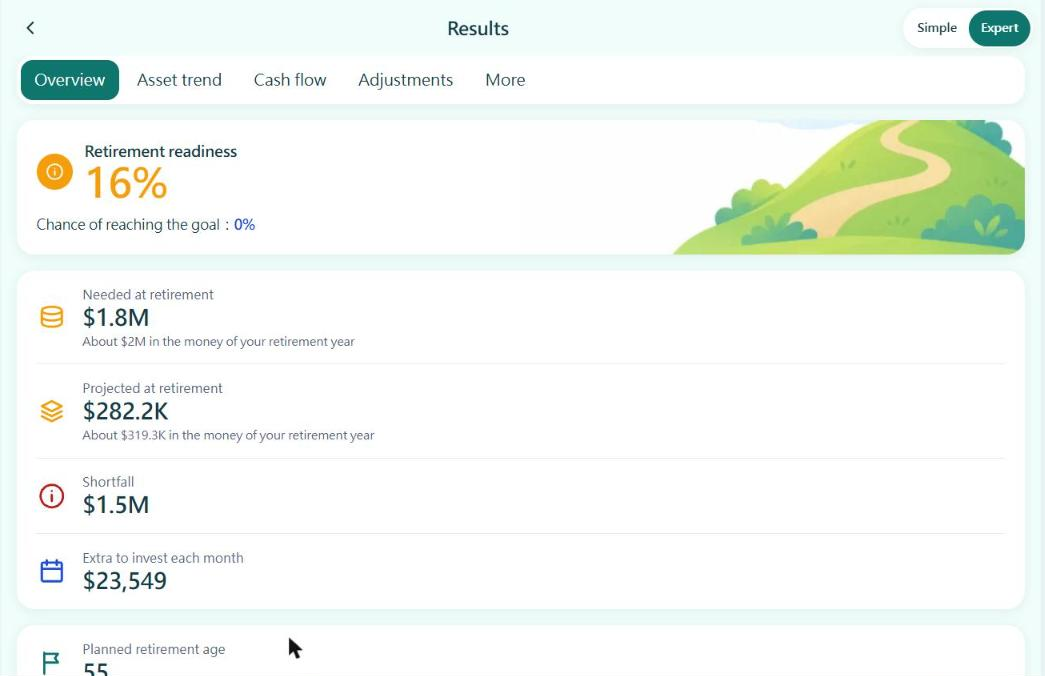
Screenshot 1. Basic result: readiness 16%, about $1.8M needed versus $282.2K projected at 55Source: TTLB Retirement Planner (English interface) · tools.ttbacktest.com/retirement-planner
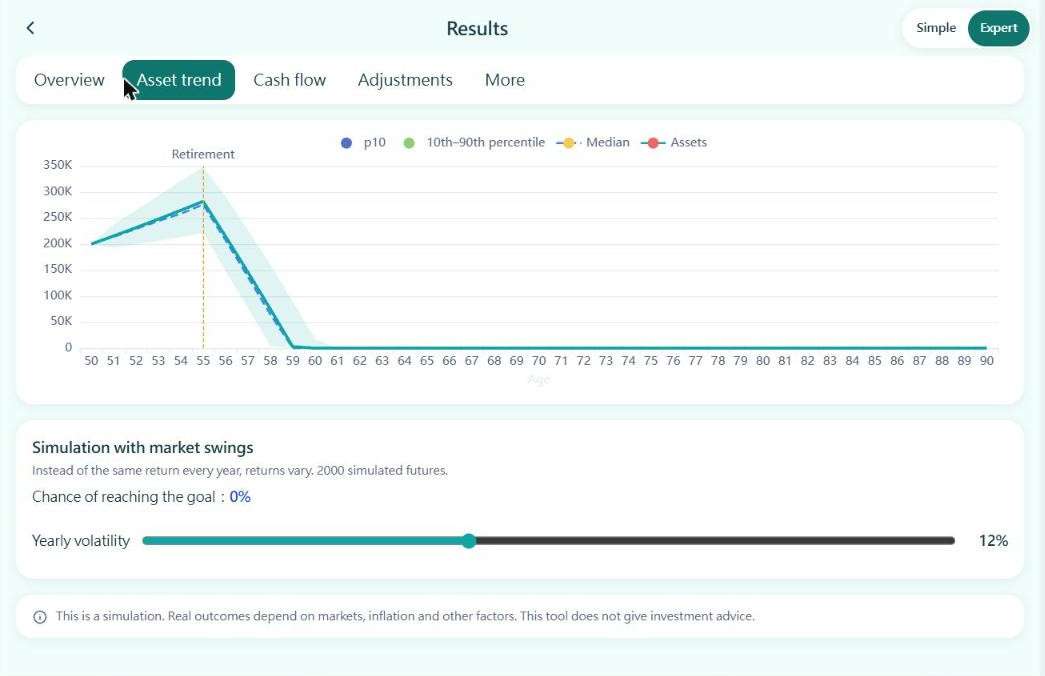
Screenshot 2. Asset trend: savings outside the 401(k) and IRA run out around age 59 (the shaded band is a PRO feature)Source: TTLB Retirement Planner (English interface) · tools.ttbacktest.com/retirement-planner
With only the $200,000 of taxable savings and cash, the plan shows a $1.5M shortfall and the money runs out around 59. That is not the whole picture, because the 401(k), IRA and Social Security are not included yet.
Step 2: Add Social Security, the 401(k), the IRA and Medicare (PRO)
In the retirement step, switch on each U.S. module and enter your own numbers. These modules are PRO features. Social Security is labeled 'Verified' because its bend points and adjustment rates were checked against SSA pages; the account and Medicare modules are labeled 'Estimated'.
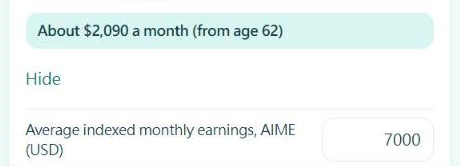
Screenshot 3. [PRO] Social Security: about $2,090 a month from age 62Source: TTLB Retirement Planner (English interface) · tools.ttbacktest.com/retirement-planner
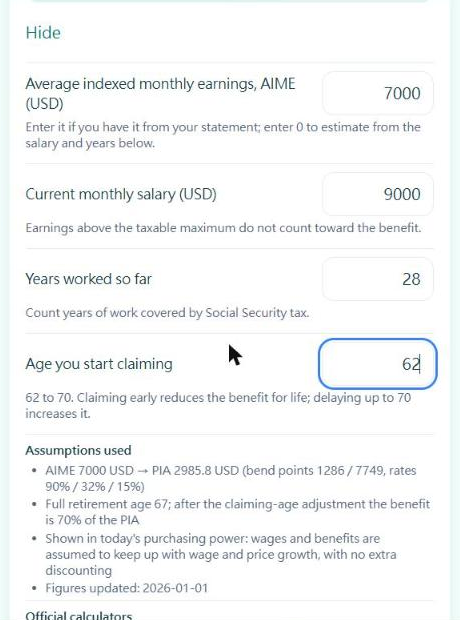
Screenshot 4. [PRO] AIME $7,000 gives a PIA of $2,985.80 (2026 bend points $1,286 and $7,749); claiming at 62 pays 70% of itSource: TTLB Retirement Planner (English interface) · tools.ttbacktest.com/retirement-planner
Claiming at 62 pays 70% of the full-retirement-age amount for someone born in 1960 or later, so the planner's $2,090 is not a number to rely on without your own SSA statement. Enter your AIME or estimate from your earnings record, and compare claiming ages.
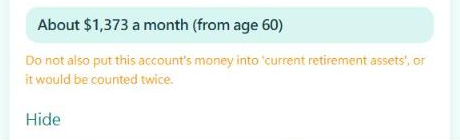
Screenshot 5. [PRO] 401(k): about $1,373 a month from age 60Source: TTLB Retirement Planner (English interface) · tools.ttbacktest.com/retirement-planner
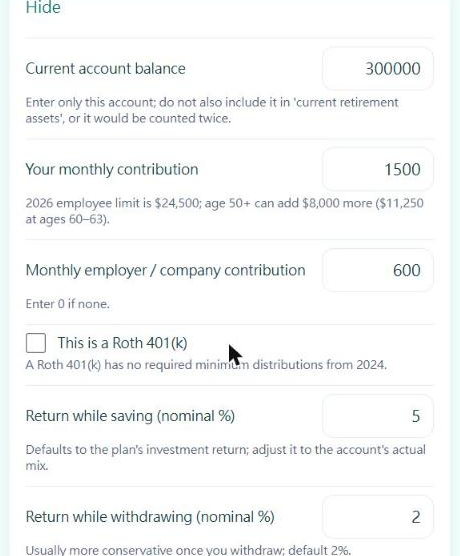
Screenshot 6. [PRO] 401(k) inputs: $300,000 balance with $1,500 employee and $600 employer contributions a monthSource: TTLB Retirement Planner (English interface) · tools.ttbacktest.com/retirement-planner
The planner warns that the 401(k) balance should be entered only in the module, not also in 'current retirement assets', or it would be counted twice. It also notes the 2026 employee limit of $24,500, with extra catch-up room at 50 and older.
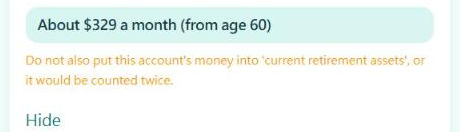
Screenshot 7. [PRO] Traditional IRA: about $329 a month from age 60Source: TTLB Retirement Planner (English interface) · tools.ttbacktest.com/retirement-planner
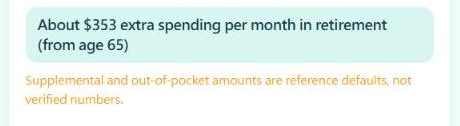
Screenshot 8. [PRO] Medicare: about $353 of extra monthly spending from age 65; supplemental and out-of-pocket amounts are reference defaultsSource: TTLB Retirement Planner (English interface) · tools.ttbacktest.com/retirement-planner
Medicare costs are added to spending from 65 and grow with medical inflation. The Part B premium is checked against the CMS announcement, but supplemental coverage and out-of-pocket costs are reference defaults you should replace with your own plan's numbers.
Step 3: Read the results
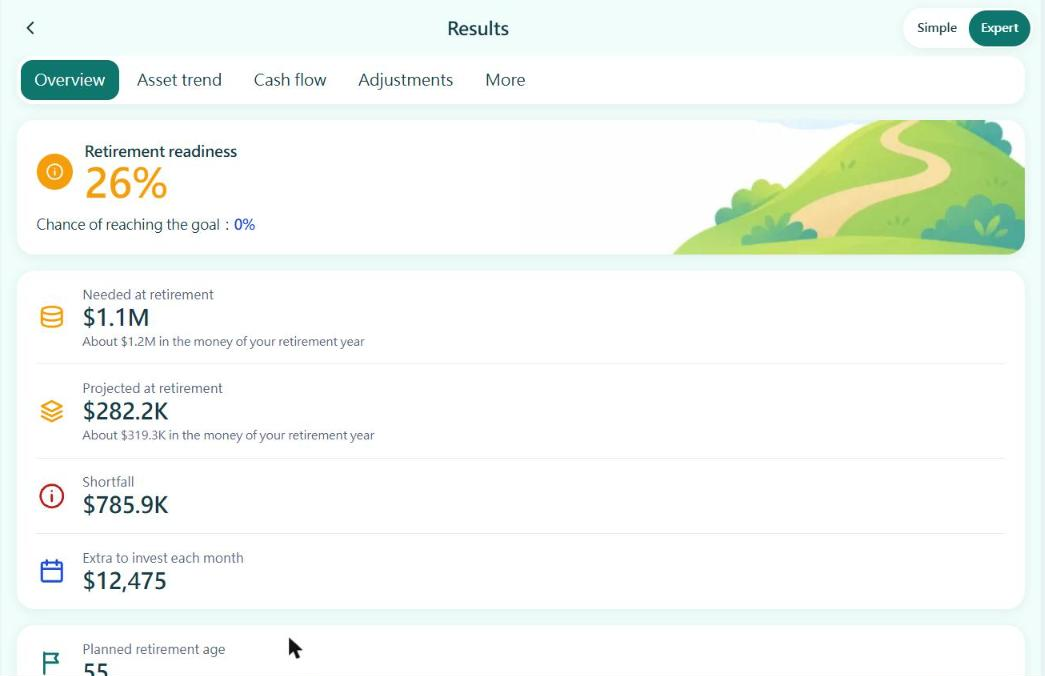
Screenshot 9. With the modules on: readiness 26%, about $1.1M needed, $785.9K shortfall, assets run out at 59Source: TTLB Retirement Planner (English interface) · tools.ttbacktest.com/retirement-planner
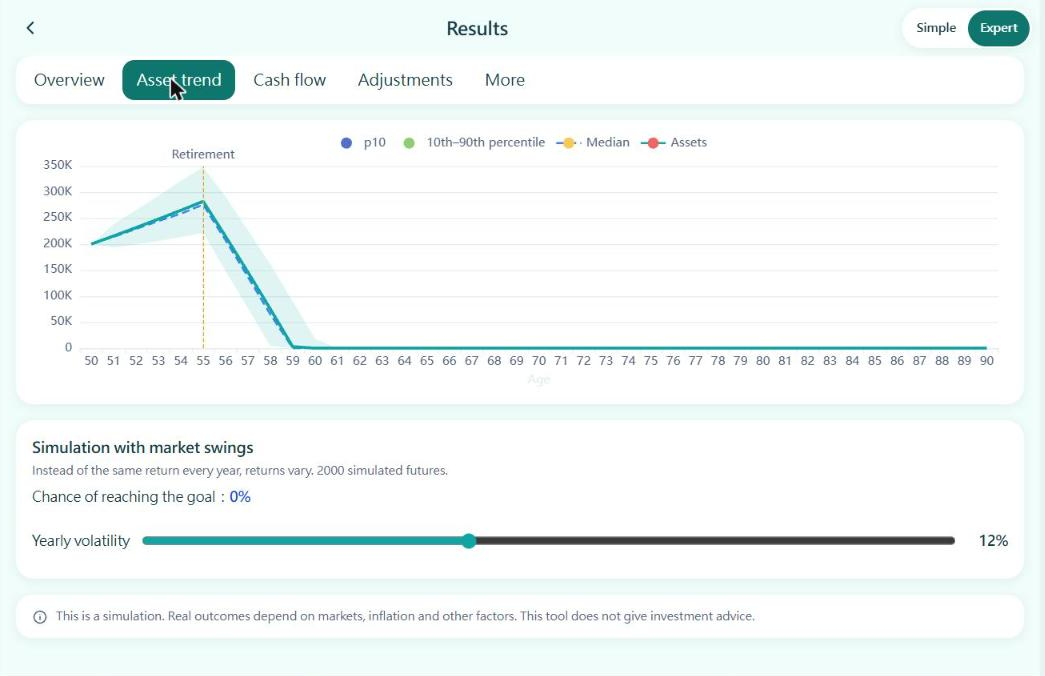
Screenshot 10. Asset trend with the PRO market-swing bandSource: TTLB Retirement Planner (English interface) · tools.ttbacktest.com/retirement-planner
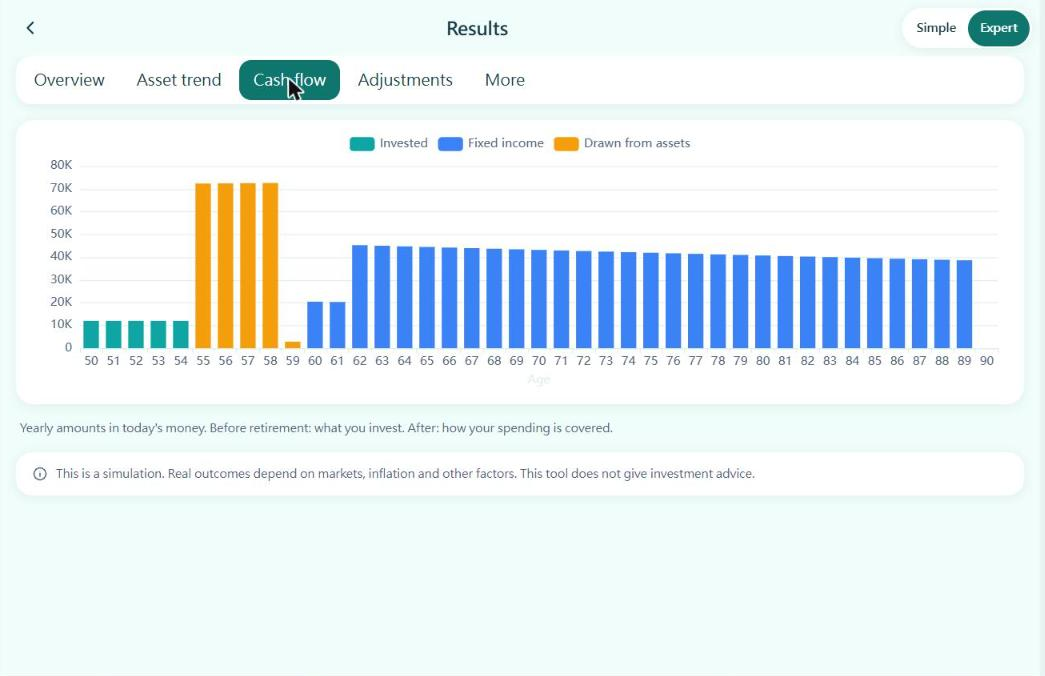
Screenshot 11. Cash flow: assets pay the bills from 55 to 58, fixed income is small at 60-61 and larger from 62Source: TTLB Retirement Planner (English interface) · tools.ttbacktest.com/retirement-planner
Adding the three modules lifts readiness from 16% to 26%, but the plan is still short. The cash-flow chart shows why the bridge years matter: from 55 to 58 the orange bars (withdrawals from taxable savings) carry the whole budget, the money is gone by 59, and income at 60 and 61 comes only from the 401(k) and IRA. Social Security starts at 62, yet the blue bars still sit below the $72,000-a-year spending target. This is the planning gap the earlier sections describe, shown with numbers.
Step 4: Compare adjustments (free)
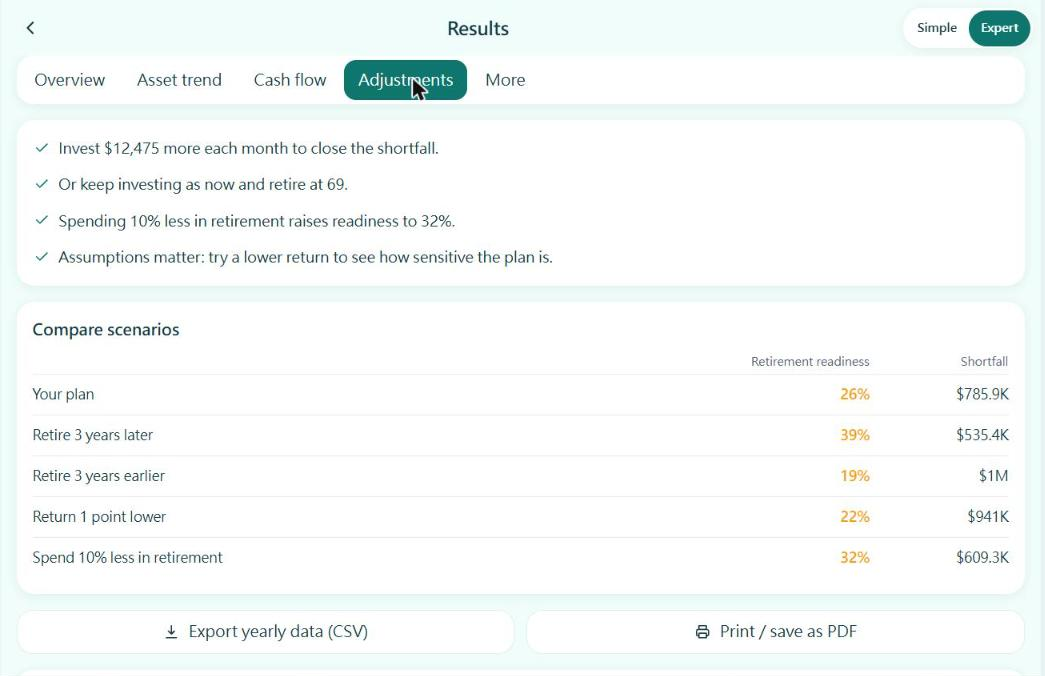
Screenshot 12. Adjustments tab: retiring 3 years later gives 39%, spending 10% less gives 32%, a 1-point lower return gives 22%Source: TTLB Retirement Planner (English interface) · tools.ttbacktest.com/retirement-planner
The Adjustments tab compares your plan with working three years longer, retiring three years earlier, earning a point less, and spending 10% less. Here, three more working years cut the shortfall from $785.9K to $535.4K, and a 10% spending cut brings it to $609.3K. A one-point lower return widens it to $941K, a reminder of how sensitive early retirement is to the return assumption.
Step 5: Estimate the tax drag (PRO)
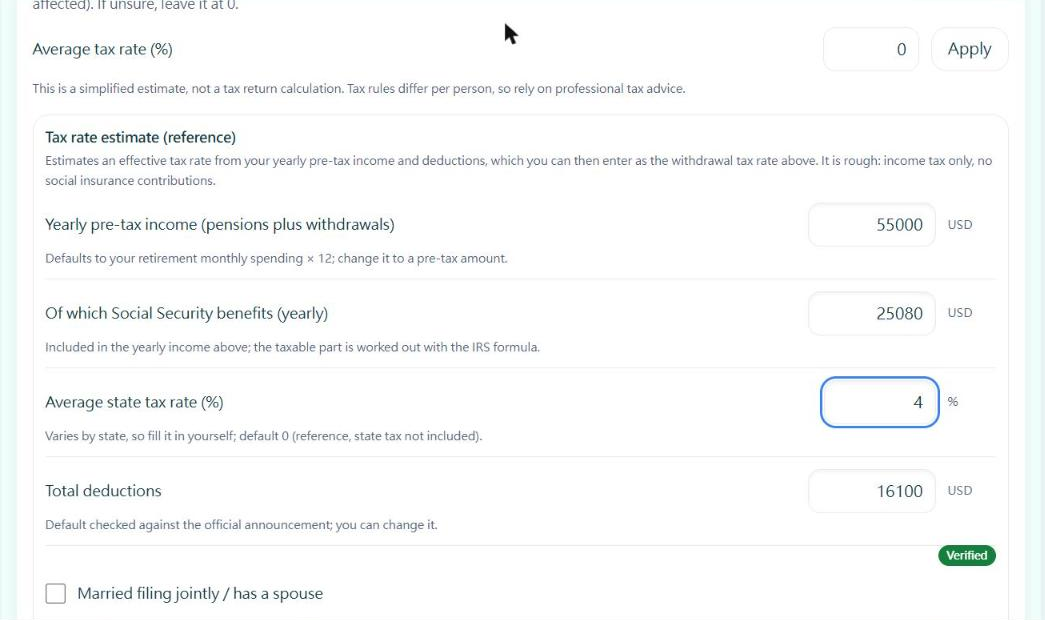
Screenshot 13. [PRO] Tax estimate inputs: $55,000 of pre-tax income, of which $25,080 is Social Security, 4% state rateSource: TTLB Retirement Planner (English interface) · tools.ttbacktest.com/retirement-planner
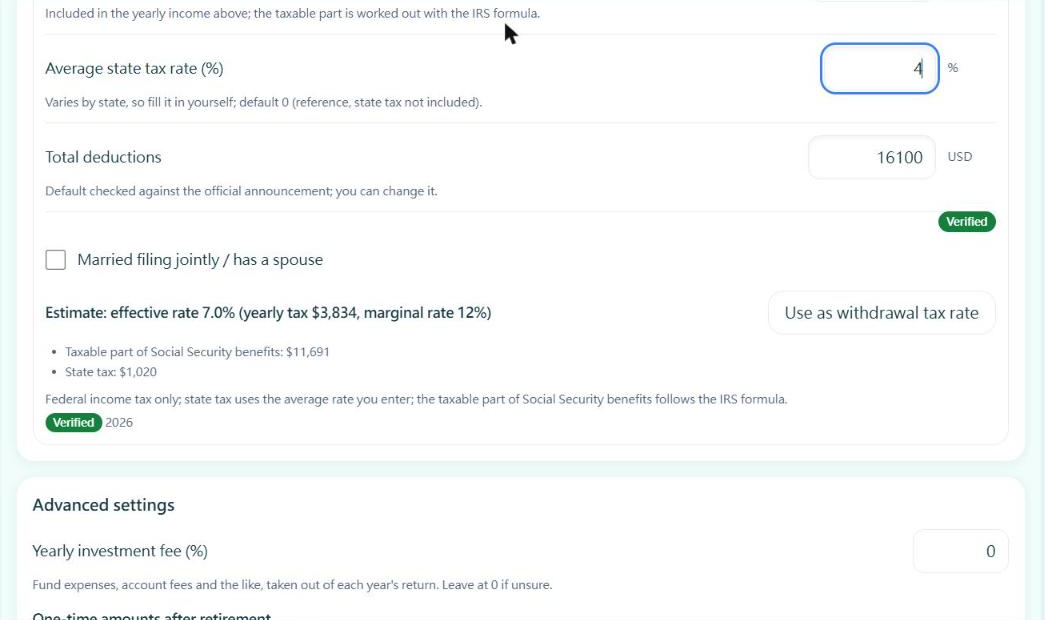
Screenshot 14. [PRO] Result: effective rate 7.0%, about $3,834 federal tax, with $11,691 of Social Security taxableSource: TTLB Retirement Planner (English interface) · tools.ttbacktest.com/retirement-planner
The tax section applies the IRS formula for the taxable part of Social Security benefits and the 2026 standard deduction for a single filer ($16,100, labeled 'Verified'). With $55,000 of income, of which $25,080 is Social Security, about $11,691 of the benefit is taxable and the estimated federal tax is about $3,834 (a 7.0% effective rate). State tax uses the average rate you enter. This is a rough estimate that covers income tax only, not a tax return.
Step 6: Change only the work-stop age
Changing only the retirement age to 55, 60 and 65, with every other input unchanged, gives the following results.
| Work-stop age | Readiness | Chance of reaching the goal | Shortfall | Assets run out |
|---|---|---|---|---|
| 55 | 26% | 0% | $785.9K | Age 59 |
| 60 | 51% | 2% | $357.7K | Age 73 |
| 65 | 77% | 19% | $143.2K | Age 83 |
Inputs are identical except the work-stop age; Social Security is set to claim at 62 in every case. The 'Chance of reaching the goal' figure is from the PRO market-swing simulation.
Three takeaways from this hypothetical example:
Every extra working year helps twice: it adds contributions and shortens the period you must fund from savings. In this case, readiness rises from 26% at 55 to 51% at 60 and 77% at 65.
The bridge from the work-stop age to the first retirement-account withdrawal is where plans fail first. Cash, taxable savings and any part-time income have to cover it.
A plan is only as good as its assumptions. The Adjustments tab shows how a one-point lower return or a 10% spending cut moves the answer.
These numbers belong to an invented household, not to you. Enter your own balances, earnings record and budget in the planner, and replace its estimates with figures from your SSA statement, plan documents and insurance quotes.
Why Multiple Scenarios Matter
A plan that assumes work continues until 65 may look very different from one that assumes full-time work stops at 55. The earlier scenario may require more withdrawals before Social Security begins and a separate health-insurance budget before Medicare eligibility.
The PRO version adds the U.S. Social Security, 401(k)/403(b), IRA and Medicare modules; the market-swing (Monte Carlo) simulation and 'chance of reaching the goal'; tax-rate estimates; withdrawal-strategy comparisons and stress tests; CSV and print export; and up to five saved plans. At the time of writing, PRO is sold as a prepaid term with no automatic renewal, from US$6.50 for one month to US$60 for twelve months (about US$5 a month); check the planner's upgrade page for current prices. These are model-based estimates, not official benefit determinations or guarantees. Actual tax liability depends on filing status, other income, deductions, state taxes, and account-specific rules.
Create a free baseline plan first. Then compare 55, 60, and 65 work-stop scenarios using the same carefully checked household information. If you need to compare several plans, integrate supported pension and account assumptions, or test adverse market conditions, PRO provides a more detailed way to explore those alternatives.
The planner is an estimation tool, not a substitute for an official Social Security benefit statement, an employer plan estimate, or individualized tax, legal, and investment advice.
Frequently Asked Questions
Can I retire at 55 in the United States?
Yes, but Social Security retirement benefits and Medicare will not normally begin immediately. You need a plan for living expenses, accessible savings, health insurance, and any pension or continuing income.
Can I receive Social Security at age 55?
No. The standard earliest age for Social Security retirement benefits is 62. Other Social Security programs have different eligibility rules and should not be confused with retirement benefits.
Is 65 the full retirement age for Social Security?
Not for everyone. For people born in 1960 or later, full retirement age is 67. Age 65 is generally an important Medicare eligibility milestone.
Can I stop working at 60 and delay Social Security until 70?
Yes. But the years before claiming must be funded through savings, retirement accounts, pension income, part-time work, or other resources.
Is a 401(k) a pension?
A 401(k) is generally a defined-contribution plan, not a traditional defined-benefit pension. Its value depends on contributions, investment performance, fees, and withdrawals.
Can I withdraw from my 401(k) before age 59½?
Some distributions may qualify for exceptions to the 10% additional early-distribution tax, including a specific age-55 separation-from-service rule for certain employer plans. Ordinary income tax may still apply; check the plan and IRS rules.
Do I need Medicare if I retire before 65?
Age-based Medicare coverage generally does not begin before 65. Consider Marketplace coverage, COBRA, a spouse's employer plan, or another eligible arrangement.
Does Social Security replace my full salary?
No. Your benefit depends on your earnings record and claiming age. Most households should evaluate Social Security together with pensions, retirement accounts, savings, and other income.
Is the TTLB Retirement Planner free?
The basic calculator is free and includes the readiness result, asset-trend and cash-flow charts, the Adjustments comparison, inflation analysis, and one saved plan. The U.S. Social Security, 401(k), IRA and Medicare modules, market-swing simulation, tax-rate estimates, stress tests and extra plans are PRO features. See the planner's upgrade page for current terms.
Does the planner model the age-55 rule or my exact Social Security benefit?
No. The 401(k) and IRA modules accept withdrawals only from age 60, do not model required minimum distributions, and count income only from the planned retirement age onward. The Social Security module estimates a benefit from an AIME you enter, so it is an estimate rather than an official figure. Use your Social Security statement, plan documents and a tax professional for decisions about specific accounts and claiming ages.
Is my financial information stored on a server?
According to the planner's own notice, your plans and financial data are kept only on your device, and you can choose to back them up to your own Google Drive. The planner does not pull data from the Social Security Administration, employers or financial institutions.
Conclusion: Plan the Years Between Paychecks and Benefits
The most important retirement decision may not be the date you start receiving Social Security. It may be the date you can afford to stop depending on a full-time paycheck.
In the United States, retirement income can come from Social Security, public-sector pensions, employer-sponsored plans, IRAs, personal investments, and continuing work. Each source has different rules, and each may become available at a different time.
If you want to leave full-time work at 55 or 60, focus first on the bridge years: how you will pay for living expenses, healthcare, and taxes before Social Security and Medicare become available. Then examine how income changes when benefits begin.
Start with actual account balances, your earnings record, employer plan documents, and household expenses. Build a basic plan, compare different work-stop and claiming ages, and test what happens when investment returns or inflation are less favorable than expected.
A retirement plan should not rely on one optimistic number. It should show where your money comes from, when it becomes available, how much you may need to withdraw, and what could make the plan fail.
What age are you planning to stop full-time work: 55, 60, or 65? Run your numbers, compare the three, and note how much the answer changes.
About this series
This guide is written and published by TTLB Tools, an independent project that builds free-to-start online tools, including the Retirement Planner used above. The series is general education, not individualized financial, tax or legal advice.
Previous in the series (Article 01): How Much Do You Need to Retire? Pension Income and Withdrawal Rate
More guides in this series will be added to the TTLB Tools Information section.
Official Sources and Further Reading
Social Security Administration — Retirement Benefits
Social Security Administration — Full Retirement Age
Social Security Administration — 2026 COLA and Earnings Test Fact Sheet
Office of Personnel Management — FERS
IRS — 401(k) Contribution Limits
Medicare — Initial Enrollment Period
Federal Reserve — Economic Well-Being of U.S. Households in 2024, Savings and Investments (Table 27)
Comments (0)
No comments yet.
Comments are published first and reviewed afterwards; rule-breaking comments are hidden. Only signed-in members can comment.