Seoul Winter Festival 2026: Lanterns, Lights and Christmas Weekend
Seoul Winter Festival 2026 guide: Gwanghwamun Market Dec 11-Jan 10, Lantern Festival Dec 11-Jan 31, Seoul Plaza rink Dec 18-Feb 9. One, two, and three-evening plans, food, transport, and cold-weather tips.
This article was submitted by a member. Views and content are the author’s own and do not represent this site.
Seoul in December is not one festival but a whole city that changes after dark. From December 11, 2026 to January 31, 2027, the Seoul Winter Festival links Gwanghwamun Square, the Cheonggyecheon stream, Seoul Plaza, and nearby shopping streets into one walkable winter evening. The Gwanghwamun Market runs December 11, 2026 to January 10, 2027. The Seoul Lantern Festival runs December 11, 2026 to January 31, 2027, daily 6:00 p.m. to 11:00 p.m. The Seoul Plaza ice rink runs December 18, 2026 to February 9, 2027. This guide explains what each part is actually like, how to combine them without exhausting yourself, and how to plan a Christmas weekend for couples, families, first-time visitors, and returning travelers. Dates were checked November 14, 2026 against the official festival site and Seoul tourism listings. Opening hours, prices, and details can change, so check the official festival page before you go.
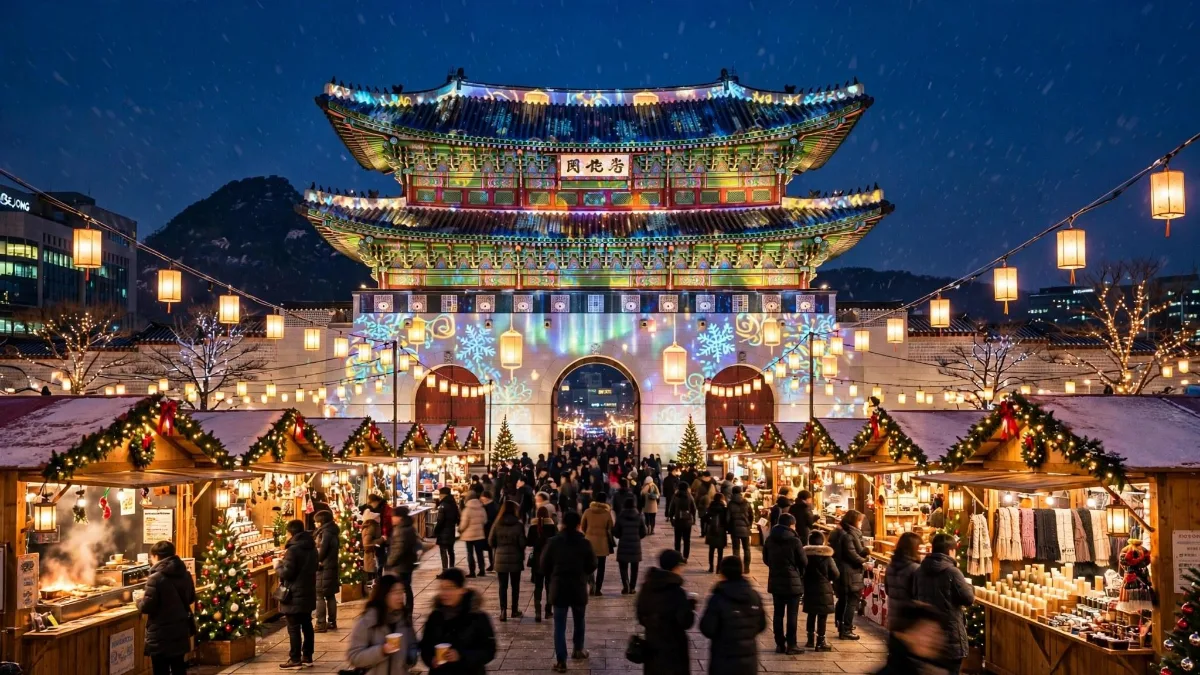
*Gwanghwamun Square at night during the Seoul Winter Festival (AI-generated illustration)*
Why Seoul in December Feels Different
Seoul already rewards walking. In December, that quality becomes the main attraction. The center is compact enough that a visitor can move from a palace gate to a lantern-lit stream, then to a Christmas market, then to an ice rink, all in one evening, without a long taxi ride. That density is why the Seoul Winter Festival works so well for a short trip. You do not need to chase events across the whole city. You need one good base, one warm layer too many, and a plan that leaves room to stop for a hot drink when your hands get cold. The festival is also unusually easy to enjoy without spending much. The lanterns are free. The market is free to enter. The light installations around Gwanghwamun are free. The ice rink is listed at 1,000 won including rentals in official and tourism listings for this season. The point of this guide is not to list every light in Seoul. It is to help you choose the right evening, the right order, and the right pace, so the trip feels festive rather than frantic. Many visitors make the same mistake: they try to see everything on the first night, arrive at the market when it is most crowded, walk the full lantern route in the coldest hour, and leave feeling tired rather than delighted. A better approach is to treat the festival as a series of short, warm, well-spaced evenings. See the market before the peak crowd. Walk the lanterns when the light is best. Skate on a weekday morning if you can. Save one evening for a slower neighborhood, a cafe, or a quiet dinner, rather than another crowded viewpoint.
Dates, Hours, and the Map in Your Head
The 2026 Seoul Winter Festival is listed as running from December 11, 2026 to January 31, 2027, a total of 52 days. That long window means you do not need to arrive on Christmas Day itself. The week before Christmas is often a better balance of atmosphere and crowds than Christmas Eve or Christmas Day, when central areas are busiest. The week after Christmas is also attractive, because the market and lanterns are still running and the city feels calmer. The three anchors have different end dates. The Gwanghwamun Market ends January 10, 2027. The lantern festival runs until January 31, 2027. The Seoul Plaza ice rink runs until February 9, 2027. If your trip is in late January, you can still see lanterns and skate, but do not expect the Christmas market. If your trip is in mid-December, all three are open, and the question is order, not availability. Geographically, Gwanghwamun Square is the central spine. Cheonggyecheon runs just south of it, from Cheonggye Plaza to Samilgyo Bridge. Seoul Plaza is a short walk south, in front of City Hall. Myeongdong is a little further south, walkable or one subway stop away. The core festival can be walked in one evening, with no bus or taxi between main venues. The mistake is to treat that walk as flat and easy in winter. The stream walkway is below street level, with steps. The market is outdoors, with wind across the open square. You will be outside most of the evening, so plan warm indoor breaks. The best base is near Gwanghwamun, Jonggak, Euljiro, City Hall, or Myeongdong, so you can return to the hotel to warm up, change layers, or drop bags without losing an hour to transport.
Gwanghwamun Square: Market, Light, and the Palace Gate
Gwanghwamun Square is where most visitors should start. The square is wide, flat, and easy to navigate, and it gives the clearest sense of the festival: a European-style Christmas market against a Korean palace gate, with modern light installations filling the space between them. Stalls sell seasonal food, hot drinks, gifts, and small crafts. The exact stall mix changes each year, so this guide does not list specific vendors as guaranteed. In general, expect sweet and savory street food, warm drinks, and gift stalls, rather than a full dinner market. Use the market as a tasting walk and first warm-up, not as your only dinner. Arrive in late afternoon while there is still daylight, so you can see the square, gate, and layout before lights take over. Then stay as lights come on, because the change from dusk to full dark is the most photogenic part. The market is listed as opening in late afternoon, with evening hours into the night. Tourism listings give a start around 5:30 p.m., but confirm current hours on the official festival page, because hours can vary by day and weather. The light show on the palace gate, Seoul Light Gwanghwamun, is a projection and lighting program. View it from the middle of the square, where you can see the full facade without a stall roof blocking the lower part. For a clean photo, stand back from the main crowd, use the square as foreground, and wait for the brightest moment. Crowd pattern is predictable. The first hour is busy but manageable. The peak is early evening, when dinner crowds and tour groups overlap. The last hour is quieter, but some stalls may start to close. For a first visit, the sweet spot is the first ninety minutes after lights come on, followed by a warm indoor break, then a return for a final walk if you still have energy. Choose one hot drink, one savory snack, and one sweet item, and save main dinner for a nearby restaurant where you can sit down and warm up properly.
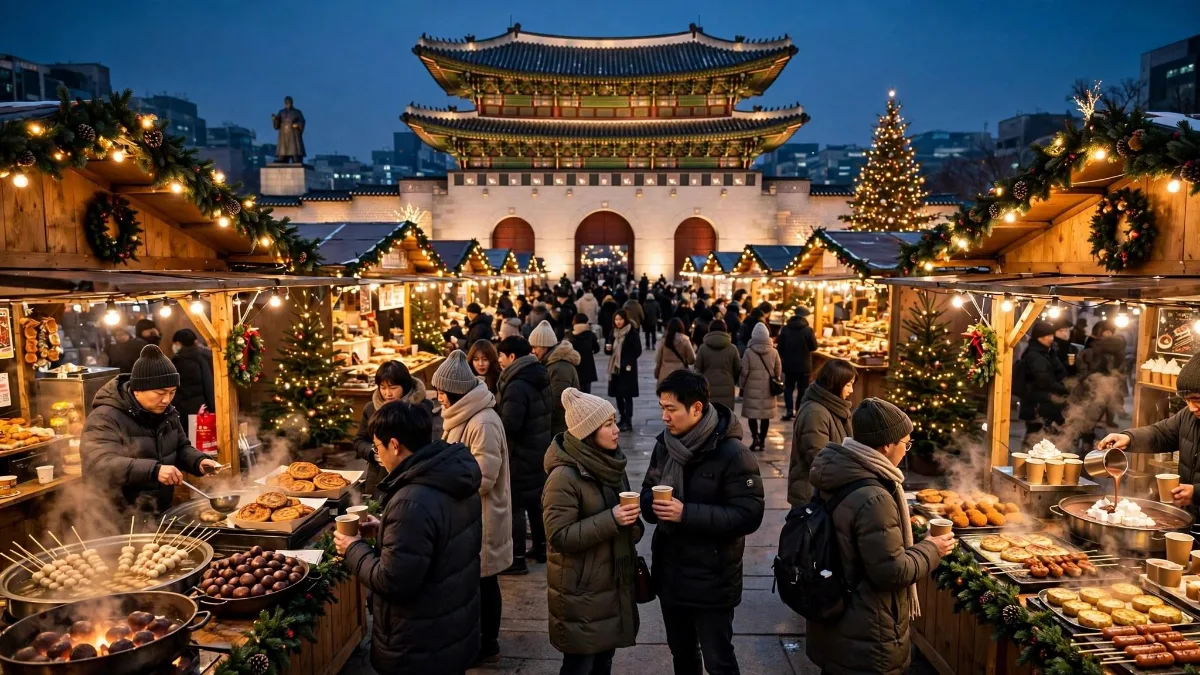
*Gwanghwamun Market stalls and the palace gate in the evening (AI-generated illustration)*
Seoul Lantern Festival: Walking the Cheonggyecheon
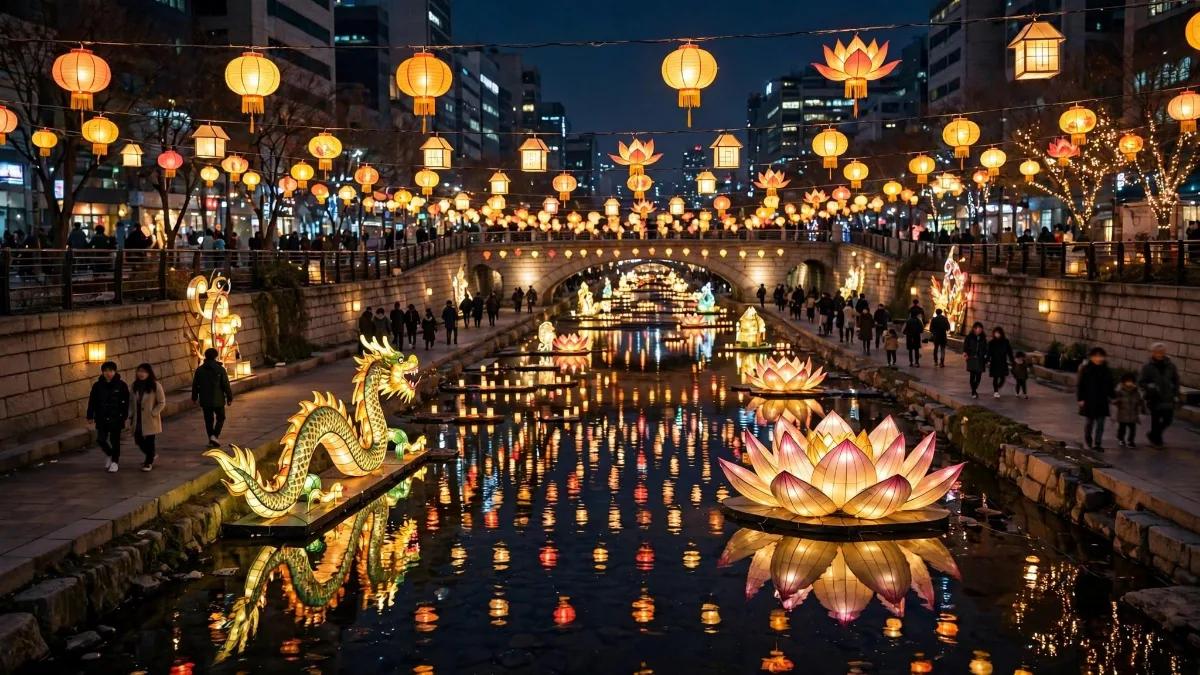
The Seoul Lantern Festival is the most distinctive part of the festival, and the easiest to misunderstand. It is not a single installation. It is a long, linear walk along Cheonggyecheon, from Cheonggye Plaza to Samilgyo Bridge, with lanterns and light sculptures placed along and above the water. The stream is below street level, so the experience is enclosed and intimate, quite different from the open square above. Lanterns include traditional hanji paper lanterns and larger modern light sculptures. Themes change each year, so this guide does not promise specific characters. The consistent appeal is reflection of light on water, contrast between dark stream walls and bright sculptures, and the feeling of walking through a gallery outdoors. The festival is free, no ticket required, listed daily 6:00 p.m. to 11:00 p.m. That long window means you can choose your time. Early evening, just after lights come on, is often best for photography, because the sky still holds a little blue. Later evening is quieter but colder. The full walk is not long in distance, but feels longer in winter because you walk slowly, stop for photos, and stand still in cold. A realistic plan is to walk one direction, not both, and exit at a point close to a subway station, cafe, or hotel. Start at Cheonggye Plaza, walk downstream, exit near Samilgyo Bridge for the full route. If short on time or with children, walk the first third, where installations are densest, then exit. The walkway has steps and ramps, and surfaces can be slippery when wet or icy. Wear shoes with good grip, not smooth fashion boots. Keep your phone in an inside pocket when not taking photos, because cold drains batteries faster and wet hands make it easy to drop a phone. Best photos are from the side of the stream, not from the middle of a bridge, because you can include both lantern and reflection. If you want a photo without a crowd, wait for a gap between groups, rather than pushing to the front. Lanterns are bright enough that you do not need flash, and flash washes out color.
*Lanterns and light sculptures along Cheonggyecheon (AI-generated illustration)*
Seoul Plaza Ice Rink
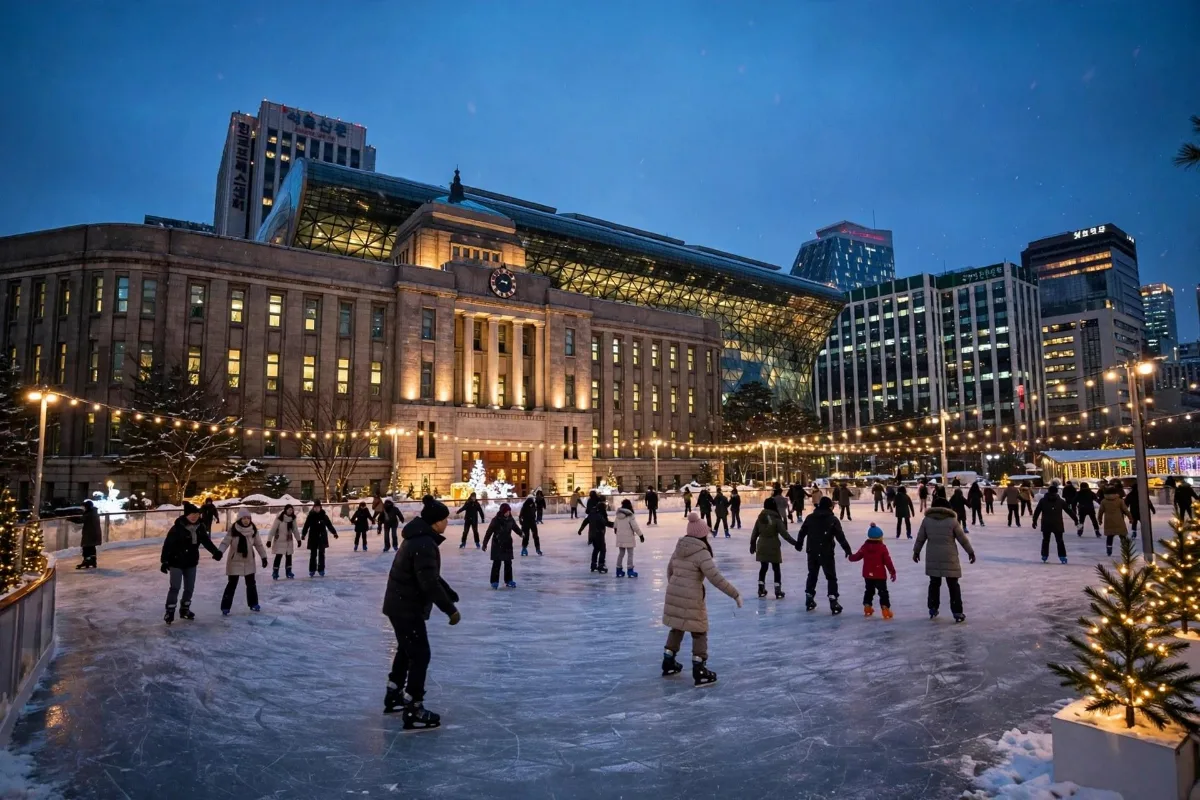
The Seoul Plaza ice rink, in front of Seoul City Hall, is one of the most satisfying winter activities precisely because it is simple. It is an outdoor rink, with the old City Hall building as backdrop, listed December 18, 2026 to February 9, 2027. Tourism listings give the price as 1,000 won including skates, helmet, and knee pads. Confirm price and session rules on the official site before you go, because the rink can change session length, helmet rules, or hours in bad weather. The rink is best for beginners and casual skaters, not serious practice. Ice is busy, sessions are short, and the point is atmosphere, not skating. If you have never skated, go in the morning or early afternoon on a weekday, when it is quieter and you can hold the rail without feeling rushed. If confident, an evening session is more festive, with lights and a larger crowd, but expect to skate slowly and stop often. Dress as if going for a walk, not an indoor rink. Wear gloves, hat, and warm socks. Bring a small bag you can keep close, because there is limited space for belongings. If traveling with children, check minimum age and height rules before you queue, and decide who will skate and who will watch. Watching is also enjoyable, especially from the side where you can see City Hall lit up behind the rink. The rink is a good middle stop between market and lanterns, because it gives you a reason to move, warm up through activity, and then rest. Do not plan to skate more than an hour unless experienced. Cold, tired legs make falls more likely. End while still having fun, get a hot drink, and save energy for the lantern walk.
*Skating at Seoul Plaza in front of City Hall (AI-generated illustration)*
Food, Cafes, and Warm Breaks
Winter in Seoul is a food season as much as a light season. Festival evenings are long, and cold makes warm food and warm rooms part of the plan, not an afterthought. The market offers hot drinks and snacks, but does not replace a proper dinner. A good Christmas weekend includes one sit-down dinner each evening, one cafe break each afternoon, and one late-night snack you actually enjoy, rather than rushed purchases at stalls. The area around Gwanghwamun, Jongno, and Myeongdong is full of options, from noodle shops and soup restaurants to bakeries and cafes. The practical rule is to eat a proper meal before the main evening walk, not after it. If you start hungry, you will buy too much at the market, get cold while standing in queues, and feel tired before the lanterns. If you eat first, you can enjoy the market as a tasting walk, with one drink and one snack, and have more energy. Cafes are also part of the winter strategy. Many cafes are decorated for Christmas, with warm drinks, cakes, and indoor seating that lets you rest without returning to the hotel. A cafe break in late afternoon is the best way to reset between daytime activity and evening festival. Choose a cafe near the festival area, not far away, so the break does not become a long detour. For a specific Christmas food experience, the market and nearby bakeries offer seasonal cakes, pastries, and hot chocolate. Exact items change each year, so this guide does not list a single must-eat item. Instead, choose one sweet item to share, and save room for a proper Korean dinner, such as soup, barbecue, or noodles, where you can sit down and warm up. If you have dietary restrictions, check menus in advance and carry a translation card or saved phrase, because market stalls may not have English allergy information. Cold air makes you feel less thirsty, but walking outdoors for hours still dehydrates you. Carry water, drink regularly, and alternate hot sweet drinks with water.
Myeongdong, Hongdae, and Other Evening Extensions
Gwanghwamun, lanterns, and rink are enough for one evening, but a Christmas weekend has more than one evening. Second and third evenings are the time to add a neighborhood that matches your interests, rather than repeating the same central walk. Myeongdong is the most natural extension. It is a shopping street with festive lights, street food, cosmetics shops, and cafes, close enough to combine in one evening. Use Myeongdong as a shopping and snacking evening, not as a second festival. Go in late afternoon, shop for gifts, eat street food, then walk to lanterns or market if you still have energy. Do not try to do Myeongdong, Gwanghwamun, lanterns, and rink all in one evening. That is too much walking, too much standing, and too little time to enjoy any of it. Hongdae is a different kind of evening. It is younger, louder, more focused on music, cafes, and street performance. It is a good choice for travelers who want a livelier night, or who have already seen the central festival and want a different atmosphere. Hongdae is further from Gwanghwamun, so treat it as a separate evening, with its own dinner and cafe plan, rather than as an add-on after lanterns. Other extensions include Insadong for traditional crafts and tea, Ikseon-dong for small cafes and alleys, and the Han River area for a winter riverside walk. The Han River Christmas Market, listed in tourism guides for December 18 to December 28 this season, is a riverfront market that can work as a daytime or early-evening alternative, but confirm exact dates and location before you go, because riverside markets are more weather-sensitive than the central square. The rule for extensions is simple: one main area per evening, plus one short add-on if you have energy. Two full areas in one evening is the most common cause of a tiring trip.
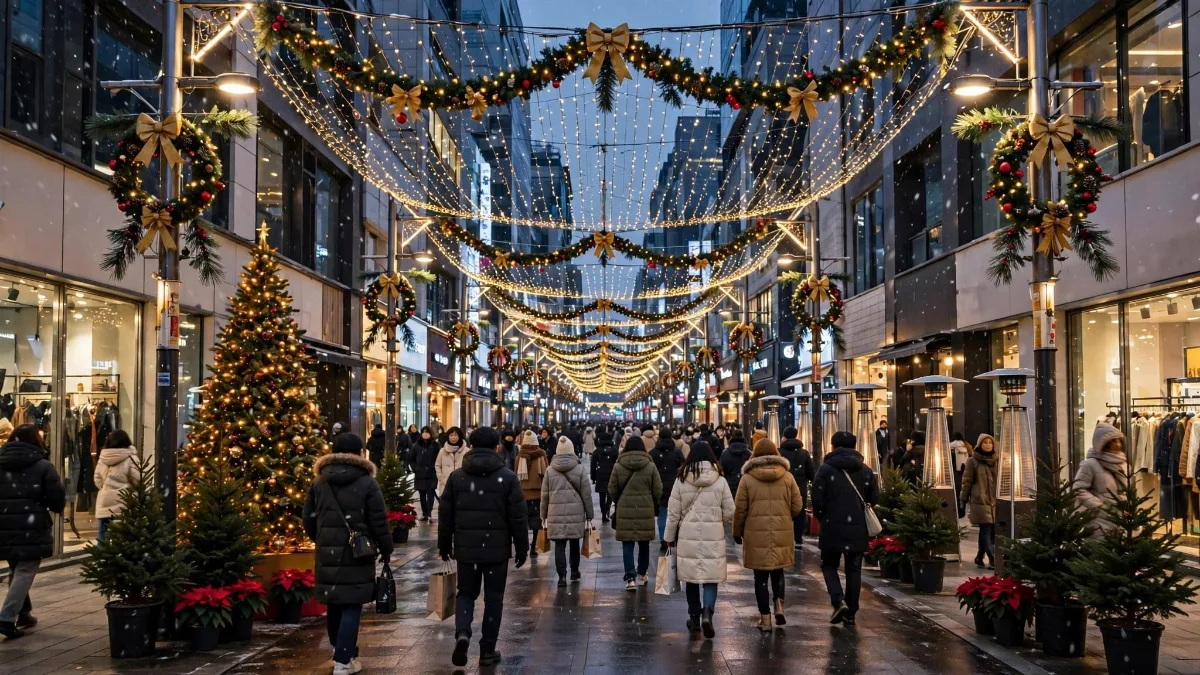
*Myeongdong street decorated for Christmas in the evening (AI-generated illustration)*
Three Ready-to-Use Plans
One-evening plan: for visitors with only one night, or one highlight evening in a longer trip. Start late afternoon at Gwanghwamun Square. Walk the market, choose one hot drink and one snack, watch lights come on. Then walk south to Seoul Plaza and see the rink, even if you do not skate. Then walk to Cheonggye Plaza and walk the first part of the lantern route. Exit near a subway station, and end with a sit-down dinner near your hotel. This takes about three hours outdoors, with one indoor dinner break. It gives you market, lights, rink, and lanterns, without requiring the full lantern walk. Two-evening plan: best balance for a Christmas weekend. First evening, follow the one-evening plan, but stop after market and lanterns, without adding Myeongdong. Second evening, start with a proper dinner, then choose one extension: Myeongdong for shopping and street food, Hongdae for a livelier night, or Insadong for a quieter, traditional evening. End second evening with a cafe or late-night snack, rather than a second full festival walk. Three-evening plan: for a full weekend. First evening, see Gwanghwamun and market. Second evening, walk the full lantern route, from Cheonggye Plaza to Samilgyo Bridge, at slow pace, with a cafe break in the middle. Third evening, skate at Seoul Plaza, have a proper dinner, then return to your favorite spot for a final walk. This works because it separates the three anchors, rather than stacking them. It also leaves room for weather. If one evening is very cold or rainy, swap order, move skating to a better evening, or replace an outdoor walk with an indoor activity, without losing the whole trip.
Cold, Crowds, and Safety
Seoul in December is cold, and the festival is outdoors. The most important packing decision is layering: a base layer that stays warm when you sweat, a mid-layer that insulates, and a windproof outer layer that blocks wind across the open square and stream. Gloves, hat, and scarf make a larger difference than an extra sweater, because hands, ears, and neck lose heat quickly when standing still for photos. Shoes matter more than most visitors expect. Stream walkway, square, and rink area can be slippery, especially with snow, ice, or rain. Choose shoes with good grip, avoid smooth soles. If traveling with older visitors or children, allow extra time for steps, ramps, and crowded crossings, and plan a warm indoor break every 60 to 90 minutes. Crowds are predictable. Weekends are busier than weekdays. Christmas Eve, Christmas Day, and New Year's Eve are busiest, with the Bosingak bell ceremony in Jongno drawing large crowds. If you can choose, visit market and lanterns on a weekday evening, and save weekend for a quieter neighborhood, museum, or cafe day. If you must visit on a peak evening, arrive early, walk the route in one direction, and avoid going back against the flow. Keep your phone charged and warm. Save your hotel address in Korean and English on your phone, and carry a small card with the address in case your phone dies. In crowded areas, keep bags in front and avoid stopping in the middle of a narrow walkway to take photos. If you feel too cold, dizzy, or tired, go indoors immediately. A warm break is not wasted time. It is what makes the next hour enjoyable.
For Couples, Families, and First-Time Visitors
Couples should plan for two kinds of moments: the big, bright viewpoint, and the quiet, warm break. The big viewpoint is the market at dusk, the palace gate with lights, or lanterns reflected in water. The quiet moment is a cafe, small restaurant, or slow walk in a less crowded street. The best couples plan is to see one big viewpoint, then leave the crowd for a warm dinner, rather than trying to see three big viewpoints in one night. Book dinner in advance if visiting on Christmas Eve, Christmas Day, or a weekend, because popular restaurants near the festival fill up early. Families should plan around energy, not sights. Children get cold faster, get tired faster, and need more frequent breaks. The family plan should include one main festival sight per evening, a warm indoor break, and a clear exit route. Lanterns are suitable for children, because the walk is flat, lights are at eye level, and the route can be shortened. The ice rink is also suitable, but only if children meet age and height rules and are comfortable on ice. The market is suitable, but children should stay close in crowds, and parents should decide who carries bags, who holds hands, and where to meet if separated. First-time visitors should not try to see everything. The most common mistake is to add too many neighborhoods to the festival evening. A better plan is to stay in the central belt, use subway for longer moves, and save Hongdae, Gangnam, or a day trip for a different day. If you have only one day, the central festival evening plus one daytime activity, such as a palace, museum, or shopping street, is enough. Returning visitors can use the festival differently. If you have already seen market and lanterns, use this year to see the rink, try a new neighborhood, or visit at a different time of day. Early and late evening feel different, and weekday and weekend crowds feel different. A second visit is a chance to slow down, rather than repeat the same rushed route.
Budget, Transport, and Where to Stay
The festival is unusually budget-friendly, because main sights are free. Lanterns are free. Market is free to enter. Light installations are free. Ice rink is listed at 1,000 won including rentals. That means the main cost of a festival evening is not tickets, but food, transport, and accommodation. A realistic budget includes one sit-down dinner, one or two hot drinks, one or two snacks, and subway fares. Shopping and gifts are extra, and vary most. Set a separate shopping budget before you go, so you do not overspend at the market on impulse purchases. Transport is simple. Subway is the best way to reach the central festival. Gwanghwamun Station, Jonggak Station, Euljiro, and City Hall Station all put you within walking distance. Exact station depends on where you stay and which venue you start with. If starting at market, use Gwanghwamun Station. If starting at lanterns, use Jonggak or Gwanghwamun and walk to Cheonggye Plaza. If starting at rink, use City Hall Station. Taxis are available, but slower in the festival area in the evening, because of traffic and road closures. Walking is often faster than a taxi for short distances. Accommodation should be chosen for walking distance, not luxury. A simple hotel near Gwanghwamun, Myeongdong, or City Hall is more useful than a larger hotel further away. The ability to return for 30 minutes to warm up, change gloves, or drop bags is worth more than a larger room. If staying further out, choose a hotel near a subway line that goes directly to Gwanghwamun or City Hall, without a transfer, so the return trip is simple even when tired and cold.
Photography
The festival is photogenic, but winter photography has specific challenges. First is light. Best time is blue hour, just after sunset, when sky still has color and lights are already on. That window is short, so arrive before sunset, find your viewpoint, and be ready. Second is cold. Batteries drain faster in cold, and hands get stiff. Carry a spare battery or power bank, keep phone in inside pocket, and wear gloves that let you use a touchscreen. Third is crowds. Most crowded viewpoints are market entrance, palace gate from front, and first part of lantern route. Best photos are often a little away from main crowd, where you can include a lantern, a reflection, and a small part of crowd for scale, without a wall of people blocking view. For market, best photo is from middle of square, with palace gate behind stalls. For lanterns, best photo is from side of stream, with lantern and reflection in same frame. For rink, best photo is from side, with City Hall behind skaters, not from middle of rink. Do not use flash for lanterns or light installations, because flash washes out color and disturbs others. Use night mode, hold phone steady, and take several shots, because one will be sharper. If using a camera, bring a small tripod or stable surface, but do not block walkway. Finally, put the camera away for part of the evening. The festival is more enjoyable when you spend some time without a screen, watching lights, listening to market, and feeling cold air. Take photos, then put phone away and enjoy the walk.
Frequently Asked Questions
When does the festival start and end? Listed December 11, 2026 to January 31, 2027. Market ends January 10, 2027, rink runs to February 9, 2027. Check official page before you go. Is the lantern festival free? Yes, along Cheonggyecheon, no ticket required, listed daily 6:00 p.m. to 11:00 p.m. Do I need to book the rink? Check official rink page for session rules, age limits, and booking. Rink can be busy on weekends. How long does the lantern walk take? Full walk is not long in distance, but allow at least an hour if stopping for photos. If short on time, walk the first third and exit. What should I wear? Layers, windproof outer layer, gloves, hat, shoes with good grip. Festival is outdoors, and you will stand still for photos. Is Seoul crowded at Christmas? Yes, Christmas Eve, Christmas Day, and New Year's Eve are busiest. Weekday evenings are quieter. Can I visit with children? Yes, but plan shorter evenings, more breaks, and a clear exit route. Check age and height rules for rink. Where should I stay? Near Gwanghwamun, Myeongdong, or City Hall, so you can walk to festival and return to warm up. What if it rains or snows? Light rain or snow does not usually close festival, but can make surfaces slippery and reduce visibility. Check forecast, wear waterproof layers, and move indoor activities to worst weather. Is the market good for dinner? Market is best for snacks and hot drinks, not as only dinner. Eat a proper dinner before or after market, at a nearby restaurant where you can sit down.
Conclusion
Seoul in December rewards visitors who plan for warmth, pace, and one good evening at a time. The festival is not a race to see every light. It is a chance to walk a beautiful city after dark, to see a palace gate lit up, to walk a stream full of lanterns, to skate in front of City Hall, and to eat and drink through a Christmas market, without spending a fortune. The best Christmas weekend is not the one with most sights. It is the one where you arrive warm, leave before exhausted, and have one or two moments you remember clearly. For most visitors, those moments will be the first sight of the market at dusk, reflection of a lantern in the stream, or a quiet cafe after a cold walk. Plan for those moments, leave room for cold and crowds, and the festival will do the rest. Check official festival page for latest dates and hours before you go, pack for cold, and enjoy Seoul in its most festive season.
References
Official Seoul Winter Festival site (winta.co.kr), festival program listings, checked November 14, 2026. Seoul Tourism Organization listings for Lantern Festival, Gwanghwamun Market, and Seoul Plaza ice rink, checked November 14, 2026. Tourism guides for Christmas in Seoul 2026, checked November 14, 2026. All dates and hours are as listed on those sources on the check date. Opening hours, prices, and details can change. Verify before visiting.
Disclosure and Disclaimer
This is a non-affiliate article. It contains no affiliate links. No commission is earned. Prices, dates, hours, and details are as listed on official and tourism sources on the check date and can change. Verify with the official festival page and venue before visiting.
Comments (0)
No comments yet.
Comments are published first and reviewed afterwards; rule-breaking comments are hidden. Only signed-in members can comment.