Japan Winter Itinerary 2026-27: Tokyo, Kyoto, Sapporo - 3 Routes You Can Actually Finish
Japan in winter is not one trip. Pick one route for five days: Tokyo plus Kamakura and Kawagoe, Kyoto plus Arashiyama and Nara, or Sapporo plus Otaru plus Noboribetsu onsen. Transport, timing, food, where to stay, budget and packing, without invented prices.
This article was submitted by a member. Views and content are the author’s own and do not represent this site.
This article contains commercial links (affiliate or paid) that may earn the author a commission.
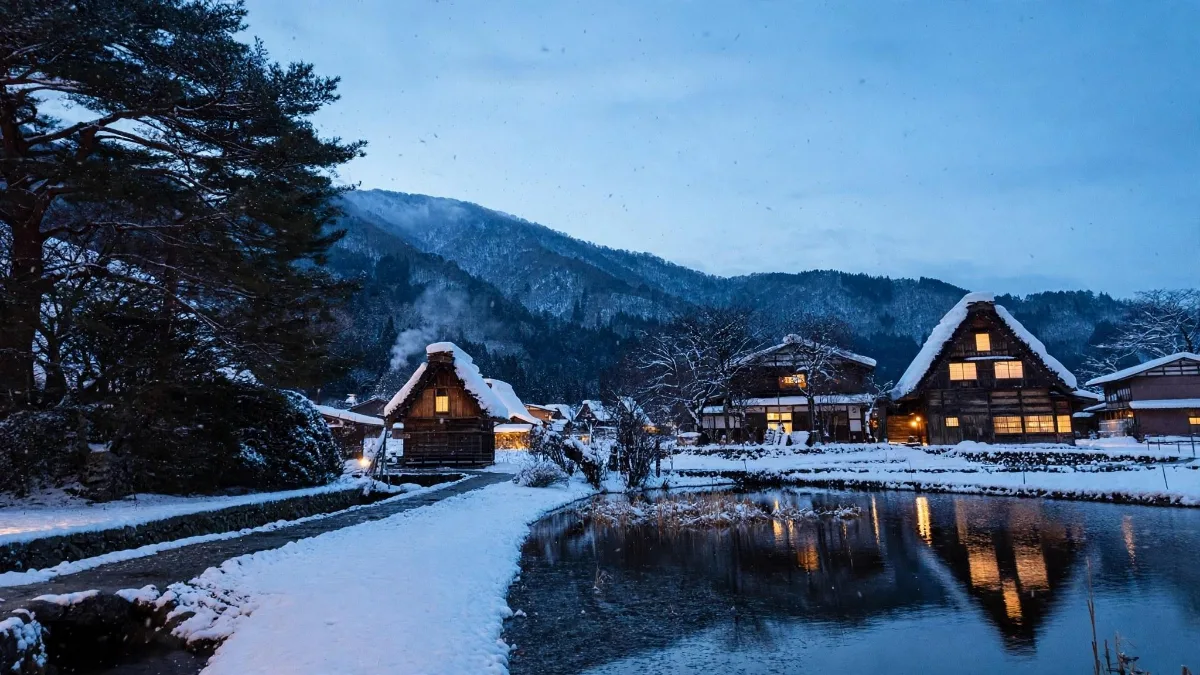
Japan in winter is not one trip. It is three different trips wearing the same season. One is a city winter of illuminations, department-store food halls, temples in cold morning air, and day trips to the sea. One is a culture winter of bamboo groves, tofu lunches, deer in a park, and evenings in Gion when the lanes go quiet. One is a snow winter of giant snow sculptures, a canal at dusk, steaming volcanic valleys, and an outdoor bath while snow falls on your shoulders.
The mistake most first-time winter visitors make is trying to do all three in five days. They end up spending the trip on trains, eating lunch standing up, and seeing every famous place for twenty minutes. This guide does the opposite. It gives you three complete routes, each built around one base and two or three day trips, each with timed days you can actually follow. Pick one route for five days. If you have seven days, you can add a second route or a slow day. If you have only three or four days, pick one route and cut it down, do not add a second city.
Before you pick, answer three questions honestly. First, what do you need to know? You need to know which route fits your energy, your budget, and the people traveling with you, and how you will get from place to place in winter. Second, how should you decide? Decide by walking distance, tolerance for cold, interest in snow versus culture, and how much planning you are willing to do. Third, what will you do after reading? You will choose one route, choose a base, check transport and last trains, book a hotel with a cancellation policy you understand, and pack for the cold. Everything below is written so you can do those steps without opening ten other tabs.
One rule runs through the whole guide. Prices, train times, festival programs, and opening hours change. The two festival dates in this article were confirmed from organizer announcements and are stated with their sources. Everything else that moves — hotel rates, fares, bus timetables, day-use onsen hours — is described as a method for checking, not as a fixed number. If a number in this article does not have a source, treat it as a planning estimate and confirm it on the official site before you pay.
How to Choose: Pick by Energy, Not by Fame
Fame is a bad way to choose a winter route. A famous place can still be the wrong place for your trip. A quieter place that fits your pace will feel better than a famous place you reach exhausted, late, and cold. Use four filters before you book anything. First, walking. How far can everyone in your group walk in one day, in cold air, on ground that may be icy? Tokyo and Kyoto reward walkers. Sapporo rewards a slower pace, with frequent indoor breaks, because the cold drains energy faster than most visitors expect. Kawagoe is the flattest and easiest of the day trips in this guide. Enoshima has slopes and stairs, and it is harder after dark. Arashiyama is a full morning of walking even before you add the river. If anyone in your group has knee trouble, a stroller, or low stamina, weight this filter heavily.
Second, cold tolerance. Tokyo in winter is cold but manageable with a coat. Kyoto is colder in the morning and evening, especially around temples and rivers. Sapporo and Noboribetsu are a different level. Hokkaido can be eight to twelve degrees colder than Tokyo on the same day, and wind makes it feel colder again. If you love snow, that trade is worth it. If you hate being cold, or you are traveling with small children or older parents, Tokyo or Kyoto will feel kinder, and you can still see snow on a day trip if the timing works.
Third, what you actually want to remember. Do you want to remember food? Then Kyoto and Sapporo will reward you more than a checklist of temples. Do you want to remember quiet? Then an early morning at Fushimi Inari, a weekday walk in Kawagoe, or a night in a small onsen town will matter more than a festival crowd. Do you want to remember snow? Then you need to go where snow is reliable, not just possible. That means Hokkaido, or a mountain village in January or February, not a hope that Tokyo will snow on your dates.
Fourth, planning tolerance. Shirakawa-go in light-up season requires advance reservation and a plan for getting in and out. Noboribetsu requires a train and a bus and a check of return times. Kamakura and Kawagoe are forgiving: if you miss one train, another comes soon. If you dislike rigid bookings, pick a forgiving route. If you enjoy planning, the snow routes reward it. Here is the short comparison. Read it, then read the route that matches you, not all three in equal depth.
Route comparison:
| Route | Best for | Duration | Walking | Highlight | Watch out |
|---|---|---|---|---|---|
| Tokyo plus Kamakura plus Kawagoe | first-timers and families | 3 to 4 days | medium walking | sea and old streets | Enoshima slopes and evening crowds |
| Kyoto plus Arashiyama plus Nara | culture, food and temples | 3 to 4 days | medium walking | bamboo grove, deer park and kaiseki | midday crowds and early sunset |
| Sapporo plus Otaru plus Noboribetsu | snow, onsen and festival | 4 to 5 days | low to medium walking | snow festival, canal and onsen | cold, icy sidewalks and bus timing |
If you have five days, pick one row. If you have seven days, you can do one full route plus a slow day, or two routes with a travel day between them. Do not try to do Tokyo, Kyoto, and Sapporo in five days. You will spend two of those days in transit and arrive everywhere tired.
Route 1: Tokyo, Kamakura, and Kawagoe
Tokyo in winter works because it is a city that stays open, warm, and easy to navigate while still feeling seasonal. Illuminations turn on in the evening. Food halls sell winter sets. Temples are quieter in the early morning than in cherry-blossom season. The subway and JR lines run frequently, so a missed train costs minutes, not hours. That reliability matters in winter, when weather can disrupt a long-distance plan. Tokyo is the best route if this is your first trip to Japan, if you are traveling with children, or if you want a trip with many backup options when it rains or gets cold. The trade is that Tokyo is not a snow destination. You may see a light snowfall, but you should not plan a trip around it. If snow is the main reason you are coming, pick Sapporo or add a mountain day trip with a separate plan.
Tokyo Day 1: Shinjuku, Shibuya, and Evening Lights
Start the day outdoors, because winter light is best in the morning and your energy is highest then. Shinjuku Gyoen is a good first stop. It opens in the morning, it is calmer than the station area, and the bare trees and open lawns look clean in cold air. Give it about ninety minutes, not a whole morning. Walk slowly, take photos, then leave before the cold settles into your legs. For lunch, stay near Shinjuku and choose a set meal. A set meal, called a teishoku, is faster than ordering a la carte, easier to read on a menu with pictures, and usually better value than a tourist-oriented single dish. It also keeps you warm and full before an afternoon of walking. Avoid the trap of shopping first. If you buy bags in the morning, you will carry them all day, and you will move slower in the cold.
In the afternoon, go to Shibuya for shopping and the crossing. Shibuya works in the afternoon because you can move between indoor shops and warm cafes, and you do not need to be outside for long stretches. If you want a view of the crossing, use an upper-floor cafe or a station walkway rather than standing outside for a long time. The point is to see it, not to prove you can stand in the wind. Give Shibuya about two to three hours, including a cafe break. In the evening, pick one illumination spot and stay with it. Tokyo has many, and trying to see three in one night means spending the evening on trains. Choose one near your hotel or near dinner. Before dinner, check the last train time from your location to your hotel. Write it down or screenshot it. In winter, the last train matters more than the first train, because you will be tired, cold, and less willing to solve a route problem at night. What to skip on Day 1: do not add Asakusa, Skytree, Ueno, and Shibuya to the same day. Two areas per day is the limit. If you finish early, use the extra time to rest, not to add a third area.
Tokyo Day 2: Asakusa, Skytree or Ueno
Go to Senso-ji in Asakusa in the morning, before the tour groups arrive. The temple approach, Nakamise shopping street, is easiest to enjoy before noon, when you can walk without being pushed along. Give the temple and the street about two hours. Buy souvenirs on the way back, not at the start, so you are not carrying them through the temple. For lunch, stay near Asakusa and try tempura or a soba set meal. Both are filling, warm, and easy to find near the temple. After lunch, choose one afternoon area: Skytree or Ueno. Skytree is better when the sky is clear, because the view is the point. Ueno is better when it rains or when you want museums, because you can stay indoors and move between buildings without long outdoor walks. Do not try to do both in one afternoon. Pick by weather, not by ambition.
Winter sunset in Tokyo is early, around 4:30 p.m. That means outdoor photos should be done by mid-afternoon. If you are at Skytree, go up while there is still daylight, so you see the city in day and night light. If you are in Ueno, finish the museum before closing and walk back through the park while there is still light. Return to the hotel early enough to rest. A tired Day 2 makes Day 3, which is a day trip, harder than it needs to be. Keep cash and an IC card in different places. Many small shops and some temple stalls prefer cash. The IC card covers trains and most convenience stores. If you lose one, you still have the other. Keep a portable battery in your day bag. Cold weather drains phone batteries faster, and you will need your phone for maps, train times, and hotel addresses.
Kamakura and Enoshima Day Trip: Sea, Temple, Sunset
Kamakura is Tokyo's easiest seaside cultural day trip. The classic route is Kita-Kamakura or Kamakura Station, Tsurugaoka Hachimangu, Komachi Street, the Great Buddha, Hasedera, the Enoden coastal train, and Enoshima. The reason this route works is that it moves in one direction, from inland temples to the sea, so you are not backtracking. Do it in that order. Do not start with shopping on Komachi Street, walk it first, buy on the way back. Getting there is straightforward. From Tokyo Station, take the JR Yokosuka Line to Kamakura Station. The official Tokyo travel guide, GO TOKYO, lists this as about 53 minutes. An alternative is JR to Ofuna, then the Shonan Monorail to Shonan-Enoshima, then the Enoden to Kamakura. The monorail option is more interesting if you like trains, but the direct JR route is simpler for a first visit. If you are staying near Shinjuku or Shibuya, the Shonan-Shinjuku Line also reaches Kamakura. Check the timetable on the day, because the exact train and platform depend on the hour.
Before you go, check train times and tickets for the journey from Tokyo to Kamakura.
Once you arrive, walk Komachi Street first, then Tsurugaoka Hachimangu. The shrine is quieter in the morning and the approach is easier to photograph before noon. From there, go to the Great Buddha and Hasedera. Both are best in morning light, and both are within walking distance of each other. Give the Great Buddha and Hasedera about two hours combined, including the walk between them. For lunch, eat near Hasedera. Seafood donburi or a soba set meal are both good, and eating near Hasedera puts you close to the Enoden station for the next leg. The Enoden is the point of the afternoon. It is a small, slow coastal railway that runs between Kamakura and Fujisawa, past Enoshima. Ride it from Hase toward Enoshima. Sit on the sea side if you can. The ride is short, about twenty to twenty-five minutes from Hase to Enoshima, but the sea view is the reason to take it.
Get off at Enoshima Station, then walk to the island. Enoshima has slopes, stairs, and an escalator system that helps if you are tired. Use the escalator if your legs are tired. Watch the sunset from the island, but do not stay after dark unless you have a clear plan for getting back. Winter sunset is around 4:30 p.m. Arrive on the island by 4 p.m. if you want the light. After sunset, the slopes get dark and cold quickly. Check the last train before sunset, not after. The return is Enoden back to Kamakura or Fujisawa, then JR back to Tokyo. If you finish at Enoshima, the Odakyu Enoshima-Kamakura Freepass is an option from Shinjuku, but confirm the current price on the Odakyu site before you buy, because pass prices change. For a JR-based day, a regular IC card is simpler. Who this day suits: first-timers who want sea and temples in one day, families who can walk at a moderate pace, and photographers who want morning temple light and evening sea light. Who it does not suit: travelers who cannot handle slopes or stairs, or who want a slow, single-place day. If that is you, skip Enoshima and spend the afternoon in Kamakura town, then return to Tokyo early.
Kawagoe Day Trip: The Easiest Day Trip
Kawagoe is the easiest day trip in this guide, and that is its strength. From Ikebukuro, it is about thirty minutes to Kawagoe by train. The old warehouse street, Kurazukuri Street, is flat. Rest spots are frequent. Shops are close together. You can do it in half a day and still be back in Tokyo for dinner. That makes Kawagoe the best choice for older travelers, families with small children, and anyone who wants a low-effort day after two busy Tokyo days. Walk Kurazukuri Street first, then the Toki no Kane bell tower, then Kashiya Yokocho candy alley. The bell rings on the hour, and it is worth hearing once. Candy alley is good for children, and it is also a good place to buy small, cheap souvenirs without spending much time. For lunch, try unagi rice, which is Kawagoe's signature. If the unagi restaurant has a ticket system, get a ticket first, then walk the old street while you wait.
Kawagoe is also the best rainy-day backup in the Tokyo route. If it rains, you can still walk the street, duck into shops, and eat indoors. Kamakura in rain is harder, because much of it is outdoors. Enoshima in rain is harder still. If the forecast shows rain on your Kamakura day and sun on your Kawagoe day, swap them. Flexibility is part of winter planning, not a failure of planning. Who Kawagoe suits: older travelers, families, anyone with low stamina, and anyone who wants a calm, flat, food-focused half day. Who it does not suit: travelers who want dramatic scenery or a full-day hike. Kawagoe is charming, not dramatic. If you want drama, Kamakura and Enoshima give it to you. If you want ease, Kawagoe gives it to you.
Where to Stay on the Tokyo Route
Base in one place for the whole route. Moving hotels every night costs time, energy, and packing effort, and in winter it costs warmth too. For the Tokyo route, stay near a major JR station with direct lines to Kamakura and Ikebukuro. Shinjuku, Shibuya, and Tokyo Station all work, but they feel different. Shinjuku is the most practical base. It has direct JR lines, many hotel choices, late-night food, and easy access to the airport bus. The trade is that the station is large and confusing on the first day. Allow extra time to find your platform. Shibuya is better if you want shopping and nightlife close to the hotel, but the station area is crowded and the hotel prices can be higher for the same room size. Tokyo Station is best if you are arriving by Shinkansen or want a quieter, more business-like base, but the nightlife and food options are more limited late at night. For room choice, prioritize a room with space for luggage, a heater you can control, and a bathroom you can use comfortably after a cold day. A small room that is warm and close to the station beats a large room that is far away and cold to reach. If you are traveling with children, ask about bed setup and whether the hotel can provide extra bedding. Do not assume a Western-style double bed will fit two adults and a child.
When you are ready to compare areas, search hotels near Shinjuku, Shibuya, or Tokyo Station.
Route 2: Kyoto, Arashiyama, and Nara
Kyoto in winter is quieter, colder, and more beautiful than most visitors expect. The crowds thin compared to spring and autumn. The temples feel larger when you are not sharing them with a tour group. The food gets warmer: tofu, yudofu, soba, and kaiseki. The light is lower and softer, which suits photography. Kyoto is the best route if you care about culture, food, and atmosphere more than snow, and if you are willing to start early to beat the midday crowds. The trade is that Kyoto is not a snow route either, though it can snow lightly. The main winter challenge is not snow but cold mornings, early sunset, and crowds at noon at the most famous temples. The solution is timing. Go early, eat lunch away from the temple gate, and return to the hotel before you get cold and tired. Do not try to do Arashiyama and Nara on the same day. Each is a half-day to full-day trip on its own, and combining them means rushing both.
Kyoto Day 1: Fushimi Inari, Kiyomizu-dera, Gion
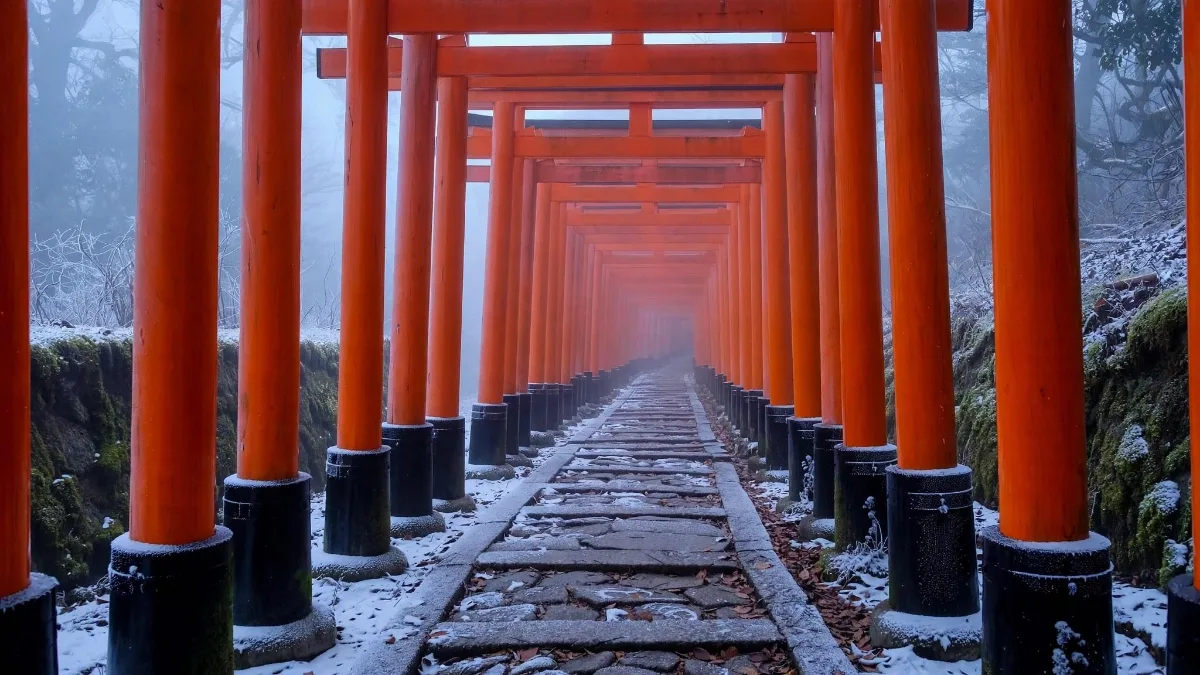
Start early at Fushimi Inari. The torii gates are most beautiful in the morning, when the light is low and the crowds are thin. Walk partway up, not the full mountain, if you are short on time or energy. The lower section gives you the gate tunnel effect without a long climb. Give it about ninety minutes. If you want photos without people, go before 9 a.m. and walk a little higher than the first gate section, where most visitors stop. For lunch, eat near Kiyomizu-dera, but not at the gate. The restaurants at the gate are crowded and often rushed. Walk a few minutes away, find a set meal, and sit down. Tofu set meals are a Kyoto signature, and they are lighter than a heavy tourist lunch, which helps if you are walking all day. Kiyomizu-dera itself is crowded by noon, so if you can, visit it in the morning after Fushimi Inari, not in the afternoon.
In the evening, walk in Gion. Gion at dusk is beautiful, but it is also a residential neighborhood. Keep your voice low, do not block lanes, and do not photograph people without permission. The point of Gion is atmosphere, not a show. For dinner, try kaiseki or a tofu set meal. Kaiseki is worth doing once if your budget allows, because it is a full seasonal meal, not just a dish. Book it in advance. Do not walk in hoping for a table at a famous kaiseki restaurant in winter, when many places are small and fully booked. Kyoto's buses can be slow in winter traffic. If you are moving between Fushimi Inari and Kiyomizu-dera, check whether the train or a taxi is faster than the bus at that hour. A taxi for a short hop can save thirty minutes and keep you warm, and it is often worth it for a group of three or four.
Kyoto Day 2: Arashiyama and Sagano
Go to Arashiyama early. The bamboo grove is quiet before 9 a.m. After 10 a.m., it becomes a line of people taking the same photo. If you want the quiet version, go early, walk the grove once, then go to Tenryu-ji temple and the river. Tenryu-ji garden is beautiful in winter, and the river walk is good in the afternoon light. Give Arashiyama a full morning, not a quick stop. For lunch, eat near Arashiyama Station. The area has set meals, soba, and tofu dishes. Eat before you are starving, because the restaurants near the station fill up at noon. In the afternoon, consider the Sagano Romantic Train if it is operating. Check the seasonal schedule on the official site before you go, because it does not run every day in winter. If it is not running, walk the river and the Sagano area instead. Do not treat the train as the only reason to go to Arashiyama. The grove, temple, and river are enough. Return early. Arashiyama gets dark fast in winter, and the walk back to the station feels longer in the cold.
Who Arashiyama suits: travelers who like walking, gardens, and quiet mornings, and photographers who are willing to get up early. Who it does not suit: travelers who dislike crowds and cannot go early, or who want a short, low-walking day. If that is you, skip the bamboo grove at midday and visit Tenryu-ji and the river instead, where the crowd is thinner.
Nara Day Trip: Deer, Todai-ji, Park
From Kyoto, Nara is about an hour by train. It is a half-day to full-day trip, not a two-hour add-on. The main sights are Nara Park, Todai-ji temple, and the deer. Feed the deer with crackers sold on site. Do not bring your own food, and do not tease the deer. The deer are friendly, but they are still animals, and they will follow food. Keep your bag closed, hold crackers with a flat hand, and step back if a deer gets pushy. Todai-ji Great Buddha Hall is huge, and the Great Buddha inside is impressive even if you have seen many temples. Give it about an hour, including the walk from the park. For lunch, try Kakinoha sushi, which is sushi wrapped in persimmon leaf, or soba. Both are Nara signatures, and both are easy to eat as a set meal. Nara Park is best in the morning, when the deer are active and the park is quiet. Return to Kyoto in the afternoon, so you are not traveling in the dark. Do not combine Nara with Arashiyama on the same day. That combination is the most common Kyoto mistake. Each deserves its own day, or at least its own half day with a clear start and end.
Where to Stay on the Kyoto Route
Stay in central Kyoto, near Kyoto Station or near the Karasuma subway line. Kyoto Station is the most practical base for day trips to Nara and Arashiyama, because it connects to JR and subway. The area around Karasuma and Shijo is better if you want food, shopping, and evening walks close to the hotel. The trade is that Karasuma is more expensive for the same room size, and Kyoto Station hotels can feel business-like. For winter, prioritize a hotel with a good heater, a bath or onsen, and a room where you can dry clothes. You will get damp from rain or snow, and a room where you can hang a coat and dry gloves matters more than a view. If you are booking a ryokan with a kaiseki dinner, check the dinner time, the bath time, and whether the bath is private or shared. A ryokan dinner is an experience, but it also locks you into a schedule. If you want flexibility, book a hotel with breakfast only and eat dinner where you like.
When you are ready to compare areas, search hotels near Kyoto Station or along the Karasuma line.
Route 3: Sapporo, Otaru, and Noboribetsu
Sapporo is the snow route. It is the only route in this guide where snow is the point, not a possibility. The city is built for winter, with underground shopping streets, heated walkways in places, and food that suits cold weather: soup curry, miso ramen, crab, and Jingisukan lamb. The Snow Festival fills Odori Park with giant snow sculptures. Otaru Canal looks different in daylight and at dusk. Noboribetsu Hell Valley steams in snow. If you want to remember snow, this is the route. The trade is cold and logistics. Sapporo is much colder than Tokyo, and sidewalks can be icy. Buses can be delayed by snow. Day trips need a check of return times. This route requires more planning than Tokyo or Kyoto, and it rewards slower days with indoor breaks. If you dislike cold, or you are traveling with people who cannot walk on ice, pick Tokyo or Kyoto. If you love snow, the extra planning is worth it.
Sapporo Day 1: Odori Park and the Snow Festival
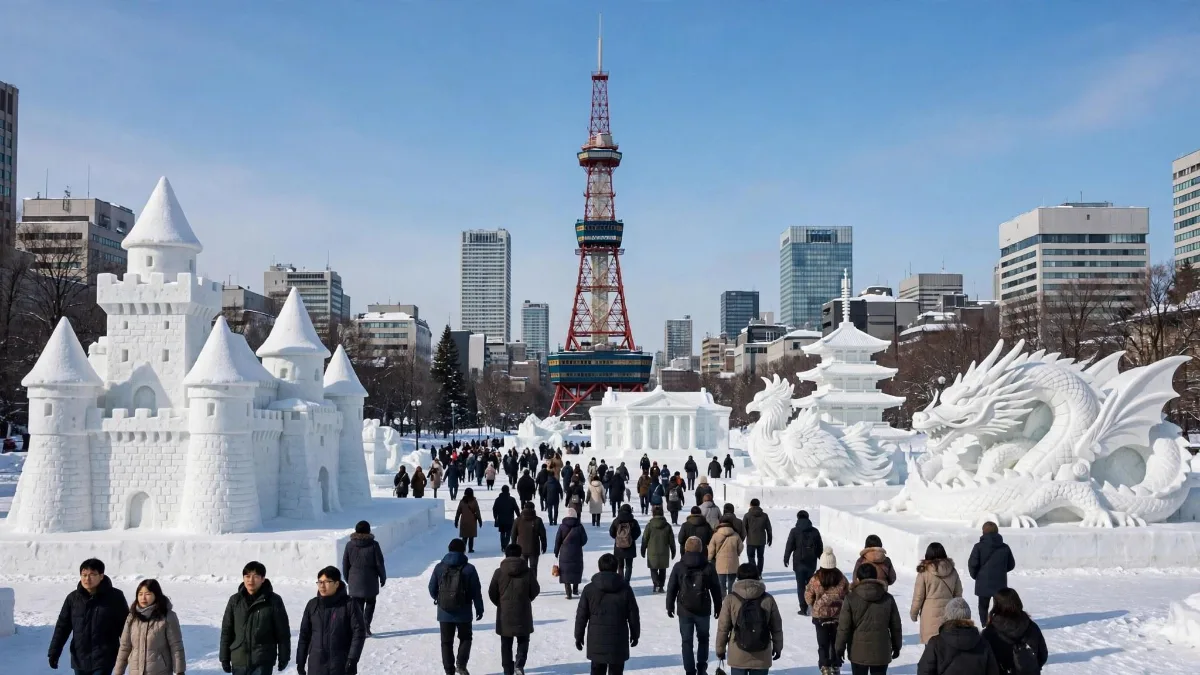
Winter in Sapporo centers on Odori Park. The park runs east to west through the city, and the Snow Festival uses it as its main site. The 77th Sapporo Snow Festival runs from February 4 to February 11, 2027, at three sites: Odori Park, Susukino, and Tsudome. This date was confirmed by the festival organizer and published on the official site, snowfes.com. The Odori site is the main site, with large snow sculptures along the park. The detailed program, sculpture themes, and per-site opening hours are published closer to February, so check the official site in January before you go. Do not rely on last year's hours. Walk the snow sculptures in the morning, when the light is clear and the crowd is thinner. Give Odori Park at least two hours, not a quick walk. The sculptures are large, and the point is to see them from different angles, not to rush past them. For lunch, eat soup curry. Soup curry is a Sapporo signature, and it is the right food for a cold day: hot, filling, and easy to find near Odori. After lunch, warm up in a cafe or an underground shopping street. Do not try to stay outside all day.
In the evening, go to Susukino for ramen and illuminations. Susukino is the ice sculpture site of the festival, and it feels different from Odori at night. The ramen alley is busy in the evening, and it is a good place to eat after a cold day. Wear shoes with grip. Sidewalks are slippery, especially in the evening when melted snow refreezes. Do not walk with your hands in your pockets. If you fall, you need your hands to catch yourself. This is not a joke. It is the most practical safety advice for Sapporo. If you are visiting outside the festival dates, Odori Park is still worth visiting, but it will not have the snow sculptures. Plan your dates around the festival if the sculptures are the reason you are coming.
Sapporo Day 2: Otaru Canal Day Trip
Otaru is about an hour by train from Sapporo. It is a day trip, not an overnight stay, unless you specifically want a quiet evening there. The main sights are the canal, Sakaimachi Street, and the glass shops. Walk the canal in daylight, then again at dusk when the lamps turn on. The two views are different, and both are worth seeing. Give the canal about an hour in daylight, then walk Sakaimachi Street, then return to the canal at dusk. For lunch, eat seafood donburi. Otaru is a port town, and the seafood is fresh. Eat a set meal, not a single expensive dish, if you want value. Buy glass souvenirs on Sakaimachi Street, but buy at the end, not at the start, so you are not carrying fragile glass all day. Compare prices between shops. Return before dark, or plan a clear return train. Otaru is safe, but the walk back to the station in the cold and dark feels longer than it is. If you want to see the canal at dusk, time it so you see the lamps, take photos, then walk to the station. Do not stay for a late dinner in Otaru unless you have checked the return train time.
Before you go, check train times from Sapporo to Otaru and the last return train.
Noboribetsu Onsen Day: Hell Valley and Bathing
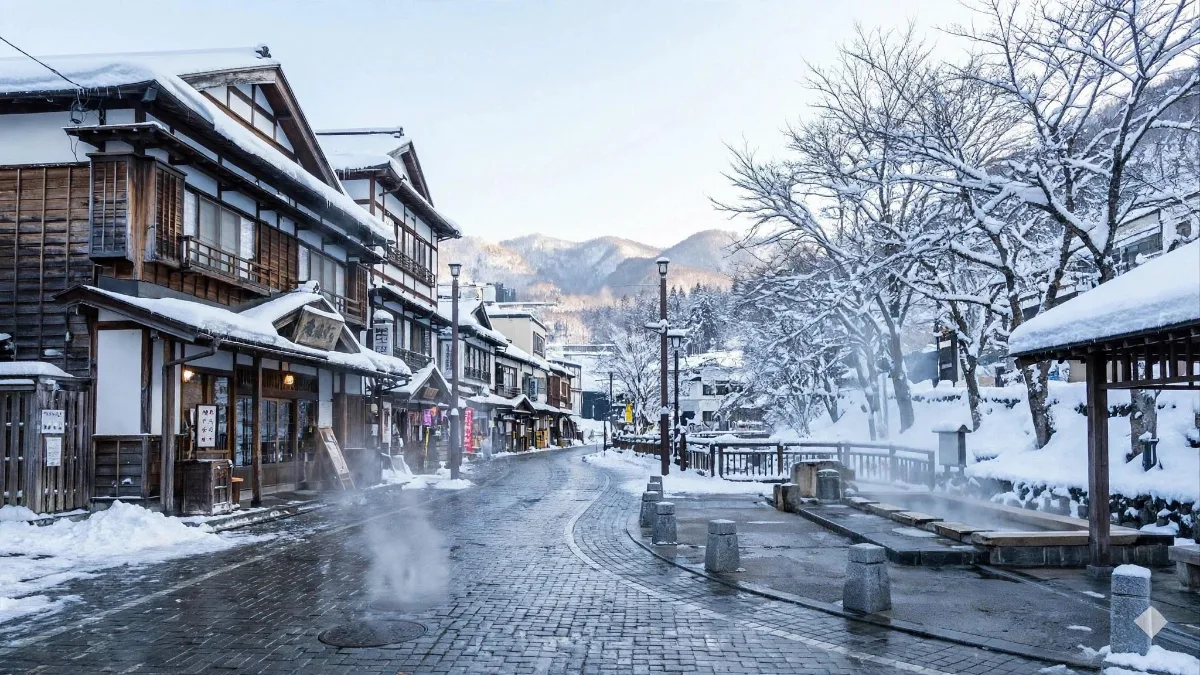
From Sapporo, take the train and bus to Noboribetsu. The practical route is JR limited express from Sapporo Station to Noboribetsu Station, about one hour and ten minutes, then a Donan Bus to Noboribetsu Onsen bus terminal, about fifteen minutes. The Japan National Tourism Organization lists the total from Sapporo as about one and a half hours by express bus or train. A direct highway bus from Sapporo to Noboribetsu Onsen is also an option, but it runs less frequently, so check the timetable before you rely on it. Do not assume you can catch a direct bus at any hour. For the return, check the last bus and last train before you leave Sapporo in the morning, not after you arrive in Noboribetsu. Walk Jigokudani Hell Valley in the morning. It is a volcanic crater with steam, hot water, and a smell of sulfur. In snow, it looks otherworldly. The walk is about fifteen minutes from the bus terminal to the valley, and the valley walk itself is about thirty to forty minutes. Wear shoes with grip. The path can be slippery, especially near the steam vents where water freezes. Do not walk off the path. The ground is hot and unstable in places.
In the afternoon, take an onsen bath. Follow the etiquette: wash your body before entering, do not put soap in the bath, do not put a towel in the water, do not stay too long, and do not drink alcohol before bathing. Drink water after the bath. If you have a tattoo, check the facility's policy before you book. Policies vary by facility. Some places allow tattoos, some do not, and some offer private baths where the policy is different. Private baths are good for families and for people with tattoos, but they need to be booked in advance and they cost more than a shared bath. Who Noboribetsu suits: travelers who want a volcanic landscape and an onsen in one day, and who are comfortable with a train and bus transfer. Who it does not suit: travelers who dislike sulfur smell, who cannot walk on slippery paths, or who want a single-place day with no transfers.
Where to Stay on the Sapporo Route
Stay in central Sapporo, near Sapporo Station or Odori. Sapporo Station is best for day trips to Otaru and Noboribetsu, because it is the train hub. Odori is best for the Snow Festival, because you can walk to the sculptures. The trade is that Odori hotels fill up faster during the festival, and prices rise. If you are coming for the festival, book early. The old advice to book two to three months ahead for February is not a guarantee, but it is a useful rule. For festival dates, check availability as soon as you know your dates, and book a room with a cancellation policy you understand. For winter, prioritize a hotel with a good heater, a bath, and a place to dry shoes and gloves. You will come back wet from snow. A room with a heater you can control and space to hang a coat matters more than a view. If you are staying in a ryokan in Noboribetsu, check the dinner time, bath time, and whether the bath is private or shared.
During Snow Festival dates, rooms near Odori and Sapporo Station fill early, so compare availability as soon as your dates are fixed.
Search Sapporo hotels for Snow Festival dates
Once you have chosen a route, check flights into the city you will use as your base.
Optional Extension: Shirakawa-go Light-Up
Shirakawa-go is not part of the three main routes, and it should not be treated as a day trip from Tokyo or Sapporo. It is a thatched-roof village in Gifu, best combined with Takayama or Kanazawa, not with a single onsen day. If you want to see it in winter, plan it as a separate two-day extension, not as an add-on to a busy day. The reason it needs its own plan is the light-up. The 41st Shirakawa-go Winter Light-Up takes place on four evenings in January 2027: January 11, January 17, January 24, and January 31, from 5:30 p.m. to 7:30 p.m., in the Ogimachi area. Entry is by advance reservation only, and no tickets are sold on the day. The Shirakawa-go Tourist Association published this detail, and it is explicit: if you turn up without a reservation, you will not be admitted during the light-up. The village accommodation is allocated by ballot, and parking and bus options are sold in rounds. Check the official site, shirakawa-go.gr.jp, for the current sales round before you plan around a light-up date.
If you want both onsen and Shirakawa-go, plan two days. Day one: travel to a nearby onsen town such as Gero, take an onsen bath in the afternoon, stay overnight. Day two: take the morning bus to Shirakawa-go, walk the village, see the light-up if you have a reservation, and return by bus. Check the return bus times before you go to the village. Snow can delay buses by two hours or more. Do not try to do onsen and Shirakawa-go in one day. Two days is the correct pace. Who Shirakawa-go suits: travelers who have already done Tokyo or Kyoto and want a quiet, snowy village, and who are willing to book in advance. Who it does not suit: travelers who dislike rigid bookings, who have only three days, or who want a flexible, walk-in trip.
If you add this extension, look up local tours and transport to Shirakawa-go before you lock the dates.
Search Shirakawa-go tours and transport
Food: What to Eat in Winter, and How to Choose
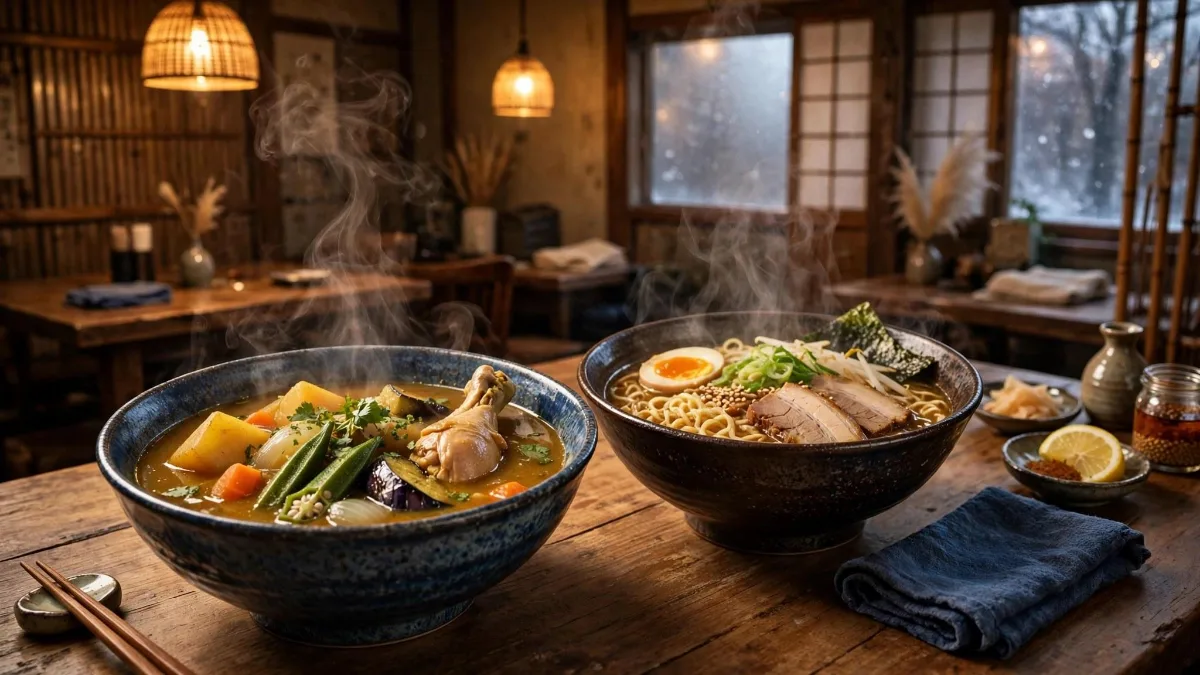
Winter food in Japan is not just about taste. It is about staying warm, staying full, and not wasting time in a line. Use three rules. First, eat a set meal for lunch. Set meals are faster, cheaper, and more filling than ordering a la carte in a tourist spot. Second, save one special dinner for the trip, not every dinner. One kaiseki dinner in Kyoto, one crab dinner in Sapporo, or one unagi lunch in Kawagoe is enough. Third, eat near where you are, not where the guidebook says the best restaurant is. A good meal near your hotel after a cold day beats a famous meal that requires a long, cold walk. In Tokyo, try monjayaki, tempura, and ramen. Monjayaki is a Tokyo savory pancake, best eaten hot from the grill. Tempura is better in winter, when the oil feels warming. Ramen is a good late-night option after illuminations. In Kyoto, try tofu, yudofu, and kaiseki. Tofu in Kyoto is lighter and more refined than in other cities, and yudofu, hot tofu in broth, is a winter dish. Kaiseki is a full seasonal meal, and it is worth doing once.
In Sapporo, try soup curry, crab, miso ramen, and Jingisukan lamb. Soup curry is the most useful Sapporo dish, because it is hot, filling, and easy to find. Miso ramen is a good evening meal after the Snow Festival. Jingisukan is grilled lamb, best for a group that wants to share. In Kawagoe, try sweet potato sweets and unagi. Sweet potato sweets are Kawagoe's signature, and they are cheap and easy to carry. Unagi is more expensive, so treat it as a lunch, not as a snack. In Kamakura, try seafood donburi. It is fresh, filling, and easy to find near Hasedera. In Nara, try Kakinoha sushi or soba. Both are light, easy to eat, and distinct to Nara. What to avoid: do not eat lunch at the gate of a tourist spot. The restaurants at the gate are crowded, rushed, and often more expensive for the same food. Walk five minutes away and you will find a quieter, better-value option. Do not eat a heavy lunch before a long walk. A heavy lunch makes you slow and cold. Eat a set meal, walk, then have a snack in the afternoon if you are hungry. Do not skip dinner to save money. A warm dinner is part of staying healthy in winter.
Budget: How to Estimate Without Inventing Prices
This guide does not give you fixed hotel prices, because hotel prices change by date, room type, and booking time. Giving you a fixed number would be misleading. Instead, use a formula you can fill in with live prices when you book. Daily cost equals Transport plus Food plus Tickets plus Souvenirs plus Accommodation share. Transport means the train and bus fares for that day. For a Tokyo day, that is subway and JR. For a Kamakura day, that is JR plus Enoden. For a Sapporo day, that is subway and JR. For a Noboribetsu day, that is JR plus bus. Check the fare in your route app or on the operator's site on the day, not from an old blog post. Food means lunch set meal, dinner, and snacks. Tickets means temple entry, museum entry, and any day-use onsen fee. Souvenirs means what you plan to spend, not what you end up spending. Accommodation share means the nightly hotel rate divided by the number of people sharing the room.
To use the formula, do three steps. First, list the days of your route and the transport for each day. Second, look up the live hotel rate for your dates and write it down. Third, add a buffer of about ten to twenty percent for weather delays, a taxi when you are cold, and a warm drink you did not plan. The buffer is not waste. It is what keeps a snow delay from ruining your budget. Saving tips that actually work: eat set meals for lunch. Buy souvenirs on the way back, not at the start, so you do not buy twice. Do one special dinner only, not every night. Use a single IC card for transport, so you do not waste time buying tickets. If you are considering a rail pass, calculate first. A Japan Rail Pass for one day is usually not worth it for a single day trip. A regional pass can be worth it if you are doing multiple long trips in the same region. Do not buy a pass because it sounds like a good deal. Buy it because the math works for your route. Cancellation is part of budget. When you book a hotel, check the cancellation policy before you pay. Read the free cancellation deadline, the fee after that deadline, and whether the rate is refundable or non-refundable. In winter, snow and transport delays can change your plan. A room with free cancellation up to a few days before check-in is often worth a slightly higher rate, because it gives you flexibility.
Packing, Weather, and Handling Disruption
Pack for layers, not for a single heavy coat. Base layer, warm middle layer, windproof outer layer. The base layer should wick moisture. The middle layer should insulate. The outer layer should block wind and light rain or snow. For Hokkaido, bring a down jacket, not just a coat. For Tokyo and Kyoto, a warm coat is usually enough, but bring a windproof layer for evenings. Shoes matter more than jackets. Bring waterproof boots with grip. Sneakers with flat soles are dangerous on ice. Heels are dangerous on snow. If you are going to Sapporo or Noboribetsu, bring shoes with a tread you can feel with your hand. If you do not have grip shoes, buy a pair of ice grips or removable spikes before you go. They are cheap, light, and they prevent falls.
Other essentials: gloves, hat, heat packs, portable battery, cash, IC card, small backpack, umbrella, spare socks. Gloves and hat are not optional in Sapporo. Heat packs, called kairo in Japan, are sold in convenience stores and drugstores. Put one in each pocket. Portable battery is essential, because cold drains phone batteries faster. Cash is essential, because many small shops, temple stalls, and rural buses prefer cash. Keep cash and IC card separately. Small backpack is better than a large suitcase for day trips, because you can carry it on trains and buses without blocking the aisle. Weather: winter sunset is early, around 4:30 p.m. in most of Japan. That means outdoor photos should be done by mid-afternoon, and day trips should be timed to return before dark. Roads can be slippery, especially in the evening when melted snow refreezes. Rural shops often close early. Check opening hours before you go to a rural shop or museum.
If a train or bus is delayed or canceled by snow, do three things. First, check the operator's official site or app, not a random social media post. Second, contact your hotel and tell them you may be late for check-in or dinner. Third, decide whether to wait, take a taxi for a short hop, or change the plan. Do not try to walk a long distance in a snowstorm to reach a bus stop. Safety is more important than a reservation. If you need to cancel a hotel night, check the cancellation policy you read when you booked. If the cancellation is due to a transport disruption, contact the hotel as soon as you know, and keep a screenshot of the disruption notice. Common mistakes, and how to avoid them: trying to do three routes in five days. Shopping first and carrying bags all day. Not checking the last train. Eating lunch at the gate of a tourist spot. Having no cash in a rural shop. Walking with hands in pockets on ice. Booking a non-refundable room without reading the cancellation policy. Turning up to Shirakawa-go light-up without a reservation.
Pre-Trip Checklist
Use this checklist before you book, and again before you leave.
- Which route did you pick, and why does it fit your group?
- How many days, and which days are travel days versus slow days?
- Have you checked train times and last trains for each day trip?
- Have you checked the festival dates if you are coming for a festival?
- Have you booked a hotel with a cancellation policy you understand?
- Have you checked onsen tattoo policy if it applies to you?
- Do you have cash, IC card, and portable battery?
- Do you have gloves, hat, heat packs, and grip shoes?
- Do you have a souvenir budget, so you do not overspend?
- Do you have a lunch plan for each day, not just a dinner plan?
- Do you have a rainy-day backup for each day trip?
- Do you have the hotel address and phone number saved offline?
If you cannot answer a question, do not book yet. Answer it first. A trip that is planned in the right order feels calm. A trip that is booked in the wrong order feels rushed.
Frequently Asked Questions
How many routes should I pick for one trip?
Pick one route for five days. Two routes need at least seven days, with a travel day between them. Three routes in five days is not a trip, it is transit. If you have ten days, add rest days, not more cities. Winter travel is tiring, and rest days make the trip better.
Which route is best for first-timers?
Tokyo plus Kamakura and Kawagoe. It has the most transport options, the most backup plans, and the easiest day trips. You can make a mistake and still recover. Kyoto is also good for first-timers who care about culture, but it requires earlier starts to beat crowds. Sapporo is best for travelers who specifically want snow and are comfortable with cold and planning.
Which route is best for older travelers or families with small children?
Kawagoe is the easiest day trip in this guide, because it is flat, short, and full of rest spots. For a full route, Tokyo is easiest, because the transport is frequent and the hotels are used to families. Kyoto is good if the group can walk at a moderate pace and start early. Sapporo is harder for older travelers and small children, because of ice and cold. If you pick Sapporo with older parents or small children, plan shorter outdoor blocks, more indoor breaks, and a hotel near the station.
When should I check the last train?
Before you leave the hotel in the morning, and again in the evening before dinner. The last train is not a detail to check after dinner. Check it in the morning, screenshot it, and check again in the evening in case the timetable changed due to weather.
Can I do Shirakawa-go as a day trip from Tokyo?
No. Shirakawa-go is in Gifu, and it needs a separate two-day plan with Takayama or Kanazawa. Do not try to do it as a day trip from Tokyo or Sapporo. If you want to see the light-up, you need an advance reservation, and you need a plan for getting in and out. Without a reservation, you will not be admitted during the light-up.
Do I need to book Shirakawa-go light-up in advance?
Yes. The 2027 light-up runs on January 11, 17, 24, and 31, from 5:30 p.m. to 7:30 p.m., and entry is by advance reservation only. No tickets are sold on the day. Check the Shirakawa-go Tourist Association site for the current sales round, because parking and bus options are sold in rounds.
When is the Sapporo Snow Festival in 2027?
February 4 to February 11, 2027, at Odori Park, Susukino, and Tsudome. The dates were confirmed by the festival organizer and published on the official site, snowfes.com. Per-site opening hours and sculpture themes are published closer to February, so check the official site in January.
How do I get to Kamakura from Tokyo?
Take the JR Yokosuka Line from Tokyo Station to Kamakura Station, about 53 minutes according to the official Tokyo travel guide. An alternative is JR to Ofuna, then the Shonan Monorail to Shonan-Enoshima, then the Enoden to Kamakura. Check the timetable on the day, because the exact train depends on the hour.
How do I get to Noboribetsu from Sapporo?
Take the JR limited express from Sapporo Station to Noboribetsu Station, about one hour and ten minutes, then a Donan Bus to Noboribetsu Onsen bus terminal, about fifteen minutes. A direct highway bus is also an option, but it runs less frequently. Check the last bus and last train before you leave Sapporo in the morning.
What is the best way to save money on this trip?
Eat set meals for lunch, buy souvenirs on the way back, do one special dinner only, and calculate whether a rail pass actually saves money for your route. Do not save money by skipping dinner or by booking a non-refundable room you may not be able to use. Those are false savings.
Should I buy a Japan Rail Pass?
Calculate first. A Japan Rail Pass is worth it if you are doing multiple long-distance Shinkansen trips in a short period. For a single day trip to Kamakura or Nara, a single ticket or IC card is usually cheaper. For a Sapporo plus Otaru plus Noboribetsu route, a regional Hokkaido pass may be worth checking, but only if the math works for your exact days. Do not buy a pass because it sounds like a good deal.
What should I pack for winter in Japan?
Base layer, warm middle layer, windproof outer layer, waterproof boots with grip, gloves, hat, heat packs, portable battery, cash, IC card, small backpack, umbrella, spare socks. For Hokkaido, bring a down jacket. For Tokyo and Kyoto, a warm coat plus a windproof layer is usually enough. Pack light for day trips. A small backpack beats a large suitcase on trains and buses.
How do I handle onsen etiquette as a first-timer?
Wash your body before entering. Do not put soap in the bath. Do not put a towel in the water. Do not stay too long. Do not drink alcohol before bathing. Drink water after. If you have a tattoo, check the facility's policy before you book. If you are unsure, ask the front desk. They are used to first-timers asking.
Can I use a tattoo in a Japanese onsen?
It depends on the facility. Some places allow tattoos, some do not, and some offer private baths where the policy is different. Do not assume. Check the facility's site or ask before you book. A private bath is a good option for families and for people with tattoos, but it needs to be booked in advance.
What should I do if my train or bus is canceled by snow?
Check the operator's official site or app, contact your hotel, and decide whether to wait, take a taxi for a short hop, or change the plan. Do not walk a long distance in a snowstorm to reach a bus stop. Keep a screenshot of the disruption notice if you need to contact the hotel about a cancellation.
Is it safe to walk in Sapporo in winter?
Yes, if you wear grip shoes, walk slowly, and keep your hands free. Do not walk with hands in pockets. Use handrails on stairs. Avoid shortcuts across icy parking lots. If you fall, get up slowly and check for injury before you keep walking. If you are unsure about a path, take a longer, gritted route.
Can I visit Kyoto and Nara in one day?
You can, but you should not. Each deserves a half-day to full-day. If you try to do both, you will rush both. Pick one. Pick Arashiyama if you want bamboo and river. Pick Nara if you want deer and a single great temple. If you have two days, do one each.
What if it rains on my Kamakura day?
Swap it with Kawagoe if you can. Kawagoe is the best rainy-day backup, because it has many indoor shops and a flat street. Kamakura in rain is harder, because much of it is outdoors. Enoshima in rain is harder still. Check the forecast the night before and swap the days if you need to.
What if I get tired in the middle of the day?
Shorten the day. Go back to the hotel, rest, and eat dinner near the hotel. Travel is not an exam. A short, calm day is better than a long, exhausted day that ruins the next day. Build a rest hour into each day, even if you do not use it. The rest hour is what keeps the trip sustainable.
What is the one decision that matters most?
Pick one route. Everything else — hotel, transport, food, packing — gets easier once you have picked one route. If you try to keep all three routes open, you will keep all three sets of worries open too. Pick one, book it, and let the other two wait for the next trip.
Conclusion
Japan in winter is best when you pick one route and finish it well. First-timers pick Tokyo. Culture lovers pick Kyoto. Snow lovers pick Sapporo. Flexibility matters more than perfection. If you are tired, shorten the day. If you are hungry, eat first. If it rains, go indoors. If a bus is delayed, change the plan and keep yourself safe. The point of this guide is not to give you a list of places. It is to give you a way to decide, a way to move, and a way to recover when winter changes the plan. Choose one route, choose a base, check transport and last trains, book a room with a cancellation policy you understand, and pack for the cold. Then go, walk slowly, eat warm food, and leave one day a little empty. That empty day is often the one you remember.
References
Sapporo Snow Festival official site, 77th festival outline: https://www.snowfes.com/english/ — 2027 dates Feb 4-11, sites Odori Park, Susukino, Tsudome
Shirakawa-go Tourist Association, 41st Winter Light-Up notice: https://shirakawa-go.gr.jp/ — 2027 dates Jan 11, 17, 24, 31, 17:30-19:30, advance reservation only, no same-day tickets
Japan National Tourism Organization, Noboribetsu Hell Valley: https://www.japan.travel/en/spot/ — bus from Noboribetsu Station to Noboribetsu Onsen bus terminal; Sapporo about 1.5 hours by express bus or train
GO TOKYO, Kamakura access: https://www.gotokyo.org/en/ — Tokyo Station to Kamakura Station about 53 minutes by JR; Ofuna plus Shonan Monorail plus Enoden option
Research / verification date: 2026-11-12
Some links in this article are Trip.com affiliate links. If you book through them, we may earn a commission at no extra cost to you. The images in this article are AI-generated illustrations (AI 生成示意圖).
Prices, availability, transport times, opening hours, festival programs, and cancellation terms change. Always confirm on the official site before you travel or book. If a detail in this article is marked to be confirmed, treat it as unconfirmed until you check the official source.
Sources and notes
Trip.com affiliate links via Trip.com Partners (Time Traveler Lab Tools). Images are AI-generated illustrations.
Verified on:2026-11-12
Comments (0)
No comments yet.
Comments are published first and reviewed afterwards; rule-breaking comments are hidden. Only signed-in members can comment.