Japan Car Rental Guide for Taiwan Travelers: License, CDW/NOC, Traffic Rules, ETC, Fuel & Return
First time renting a car in Japan? This verified guide covers the Japanese translation of a Taiwan driver's license, CDW and NOC insurance, driving on the left, ETC and tolls, fuel, parking, snow driving and what to do after an accident.
This article was submitted by a member. Views and content are the author’s own and do not represent this site.
This article contains commercial links (affiliate or paid) that may earn the author a commission.
Disclosure: this article contains affiliate links. If you book through them, we may earn a commission at no extra cost to you. This guide was written for travelers who hold a Taiwan driver's license; requirements for licenses from other countries differ (for example, an International Driving Permit may be required), so confirm with the rental company and the authority that issued your license before you go.
The biggest advantage of driving in Japan is that you can plan your sightseeing freely, without being tied to train and bus timetables. This is especially true for Hokkaido, Tohoku, Hokuriku, Kyushu and Okinawa, where a rental car often makes the trip far more flexible.
However, driving habits in Japan are not the same as in Taiwan. Besides driving on the left and sitting on the right side of the car, you also have to deal with license paperwork, rental insurance, ETC, expressway tolls, parking rules, how to refuel, snow driving and accident handling.
If you only know how to book a car but not what to do after you pick it up, you may run into unexpected trouble during the trip.
This article walks you step by step through the whole process of renting a car and driving in Japan, starting from preparation before departure, and covers the details people often overlook and how to deal with them in practice.
Is renting a car in Japan really right for you? Judge your itinerary first
Many people decide to go to Japan and immediately think about renting a car, assuming that having a car means freedom. In fact, you should ask the opposite question first: does your itinerary really need a car?
Which parts of Japan are especially good for driving?
Hokkaido is the classic example. Attractions are far apart, public transport is infrequent and routes are limited. From Sapporo to Furano, Biei and Asahikawa, a bus can only take you to so many places in a day; with a car you can stop at flower fields, farms and lakes at your own pace.
Tohoku is the same. Natural scenery, hot spring areas and rural sights are scattered, such as Oirase Stream in Aomori, Nyuto Onsen in Akita and the snow monsters (juhyo) of Zao in Yamagata. Without a car it is hard to connect them.
Hokuriku (Kanazawa, Toyama and Fukui) and its surroundings are also suited to driving. You can use buses within Kanazawa city, but to reach Shirakawa-go, Gokayama and the Tateyama Kurobe area, having a car is much faster.
Kyushu is a typical multi-city destination. From Fukuoka to Yufuin, Beppu, Aso and Takachiho the distances are long, and the hot springs and nature are in the mountains, so the advantages of self-driving are obvious.
Okinawa goes without saying. Sights are scattered and bus connections are limited; driving from Naha to the Churaumi Aquarium and Kouri Island is the most practical way.
Which itineraries do not necessarily need a car?
If your trip is centered on big cities such as Tokyo and Osaka, and the main sights are along rail lines, you do not necessarily need a car for the whole trip. Parking in central Tokyo is expensive, roads are narrow and traffic is heavy, so driving can actually be slower than taking the train. Kyoto is similar: parking is hard to find in the city and the old streets are small, so buses and walking are easier.
If you are not used to right-hand-drive cars and driving on the left, do not start with a full self-drive trip. Practice for half a day in the suburbs or on the outskirts of a city first, then decide whether to continue.
When comparing a rental car with public transport, do not look only at the daily rental price. Add up the rental fee, insurance, fuel, expressway tolls and parking, then compare the total with rail and bus costs. The more people you travel with, the easier it is to split the cost of driving. For 2 people, trains may be cheaper. For 4 to 5 people, driving is often the better deal.
| Item | Rental car | Public transport |
|---|---|---|
| Flexibility | High | Limited by timetables |
| Access to sights | Good for remote areas | Depends on routes |
| Cost | Several expenses to consider | Depends on number of rides |
| Group size | Easier to split among several people | Also convenient for solo and two travelers |
| Driving burden | You have to drive | None |
| Moving luggage | Relatively easy | You carry it yourself |
The conclusion is simple: the more remote the itinerary, the more people and the more luggage, the better value self-driving is. The more urban the itinerary and the fewer the people, the smaller the advantage of a car.
👉 Book a car rental in Japan on Trip.com
Car rental eligibility and license documents: what Taiwan travelers must check before departure
This is the part of the whole article where you can least afford a mistake. If your documents do not qualify, the rental company can refuse to hand over the car on the spot.
Can I drive in Japan with only a Taiwan driver's license?
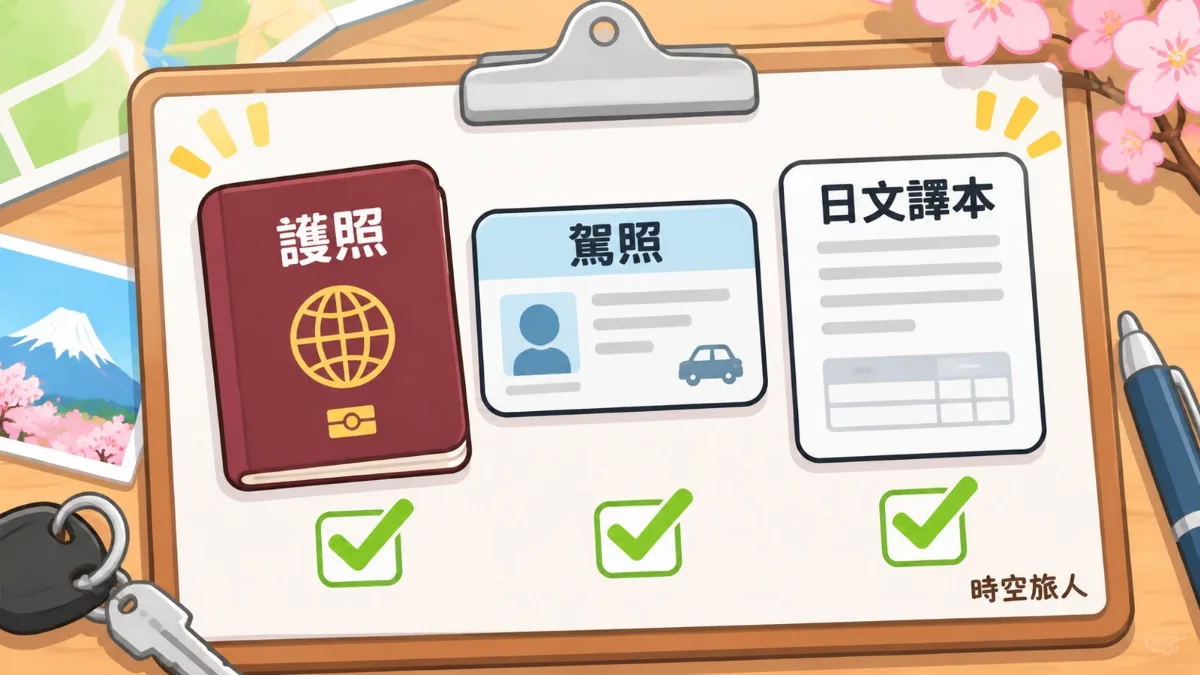
No. You need all three of these: your original Taiwan driver's license, a Japanese translation that meets Japanese requirements, and your passport. None can be missing. At the rental counter in Japan, the driver must show the original passport, the original Taiwan driver's license and the original official Japanese translation at the same time.
Many people ask whether an international driving permit works. The answer: an International Driving Permit (IDP) issued in Taiwan cannot replace the Japanese translation. Taiwan's system is the "Japanese translation of the driver's license", not what people generally think of as an international driving permit. Do not bring the wrong document and find out at the counter that you cannot rent.
How do I apply for the Japanese translation of a Taiwan driver's license?
Verified: you can apply at any Motor Vehicles Office or Motor Vehicles Station (監理所 / 監理站) in Taiwan, regardless of where your household registration is. On weekdays, take a number and go to the general driver's license counter; after the documents are checked and the fee is paid, you can collect the paper translation on the spot in about 5 to 10 minutes. The fee is NT$100 per copy. You can also apply online through the Motor Vehicles Service Website.
If you only find out in Japan that you did not get one, having JAF issue a translation now costs 6,000 yen, which is much more expensive. So be sure to get it done in Taiwan first.
When applying, bring your original Taiwan driver's license, ID card and the fee. Before departure, check that the translation has no typos, that your license has not expired and that the spelling of your name matches your passport.
What documents do I need to bring when renting a car in Japan? Pre-departure checklist:
- Passport
- Original Taiwan driver's license
- Japanese translation that meets Japanese requirements
- Car rental reservation confirmation
- Credit card, preferably the driver's own credit card
- Any other documents required by the rental company
A credit card is important. Many rental companies require the driver to hold a credit card in their own name for a pre-authorization, and cash may not be accepted as a substitute. If your credit limit is too low, or you use someone else's card, you may get stuck at pickup.
What restrictions apply to drivers and additional drivers?
If different travel companions will take turns driving, they must be registered as additional drivers in advance. Additional drivers must also bring their license, translation and passport and must meet the same eligibility requirements. Registering additional drivers is generally free, but it must be done at the rental office when you pick up the car.
If an unregistered driver has an accident, the insurance does not pay. This is an exclusion explicitly written in the official terms of companies such as Toyota, not just a verbal warning. Do not think "it's only a short stretch, nobody will know"; if something happens, it becomes a serious problem.
There are also age and driving-experience limits. Rules differ by rental company, and some companies impose extra restrictions on drivers under 21 or with less than 1 year of driving experience. Before booking, check the official terms of the company you choose.
What if your documents turn out to be invalid on the day of pick-up?
The answer is realistic: the rental company can refuse to hand over the car, and finding an alternative on the spot is very difficult. Airport rental offices do not always have spare cars, and changing to trains or buses at the last minute means re-planning the whole itinerary. So do not wait until you arrive in Japan to check your documents; go through everything one week before departure.
How to choose a rental car in Japan: car type, space and rental company comparison
When choosing a common rental car type in Japan, do not look only at appearance; look at luggage.
Kei car (軽自動車): small, fuel efficient and easy to park, suitable for 1 to 2 people with little luggage who only travel in the city and nearby suburbs. The downside is low power, so expressways and mountain roads are harder, and the trunk can hardly fit a 29-inch suitcase.
Small car / compact car: suitable for 2 people with 1 to 2 suitcases and the most common choice. Fuel efficient, easy to park and reasonably priced.
Mid-size sedan: suitable for 3 to 4 people, with more luggage space than a compact and more comfortable on long drives.
SUV: suitable for mountain roads, snow and a lot of luggage. The high ground clearance and good visibility are great, but fuel consumption and parking fees are somewhat higher.
Minivan or 8-seater: suitable for 5 to 7 people, or 4 people with a lot of luggage. Many Japanese minivans have sliding doors that make getting in and out easy, which is ideal with elders and children.
What should you rent for different numbers of people and luggage? Remember one principle: do not look only at the number of passengers; also consider the suitcases.
- 1 to 2 travelers: a compact car is enough, but if you have two 29-inch suitcases, go straight to a mid-size sedan
- 3 to 4 travelers: a mid-size sedan or SUV; do not squeeze into a compact car
- 5 travelers: a minivan, not a sedan
- 6 to 7 travelers: an 8-seater, and count the luggage too; rent two cars if necessary
- A lot of luggage or oversized suitcases: rent one size larger rather than finding out at the counter that things do not fit
To compare Japanese rental companies, look at locations, car types, service, one-way drop-off, opening hours and insurance plans. Common ones include Toyota Rent a Car, Nippon Rent-A-Car, Times CAR RENTAL, Orix Rent-A-Car, Nissan Rent a Car and Budget Rent a Car. Do not just look for the cheapest; look at whether the locations, one-way drop-off fees, insurance plans and opening hours fit your itinerary.
What is the difference between booking platforms and rental company websites?
The advantage of a platform is easy price comparison across several companies at once. The advantage of the company website is that the terms are clearer, with cancellation rules, insurance details and pick-up locations described more completely. We recommend checking both and not looking only at the lowest price. The lowest price often excludes insurance, an ETC card and one-way drop-off fees, which can make it more expensive in the end.
Details that are easy to overlook when booking:
Pick-up and return times, airport shuttle, car model and class are not guaranteed to be identical, automatic transmission confirmation, ETC equipment, navigation language, winter equipment, one-way drop-off and child seats.
A special reminder: almost all rental cars in Japan are automatic, but you should still confirm when booking. "Car model not guaranteed to be identical" means you book an "equivalent class", and what you get at the counter may be a different car of the same class, possibly with a different color and equipment.
Child seats must be chosen when you book. Japanese law requires child seats for children under 6, and without a seat the rental company may legally refuse to rent. Do not wait until you are at the counter to ask for one.
👉 Compare car rental options in Japan on Trip.com
Choosing car rental insurance in Japan: what is the difference between CDW and NOC?
This chapter is one of the most important knowledge chapters of the article. It is not enough to just write "we recommend full coverage".
What does basic insurance for car rental in Japan include?
Common coverage includes bodily injury liability, property damage liability, vehicle damage and passenger-related protection. But the coverage limits and deductibles differ for every rental company. The actual coverage items and amounts must be confirmed against the rental company's terms.
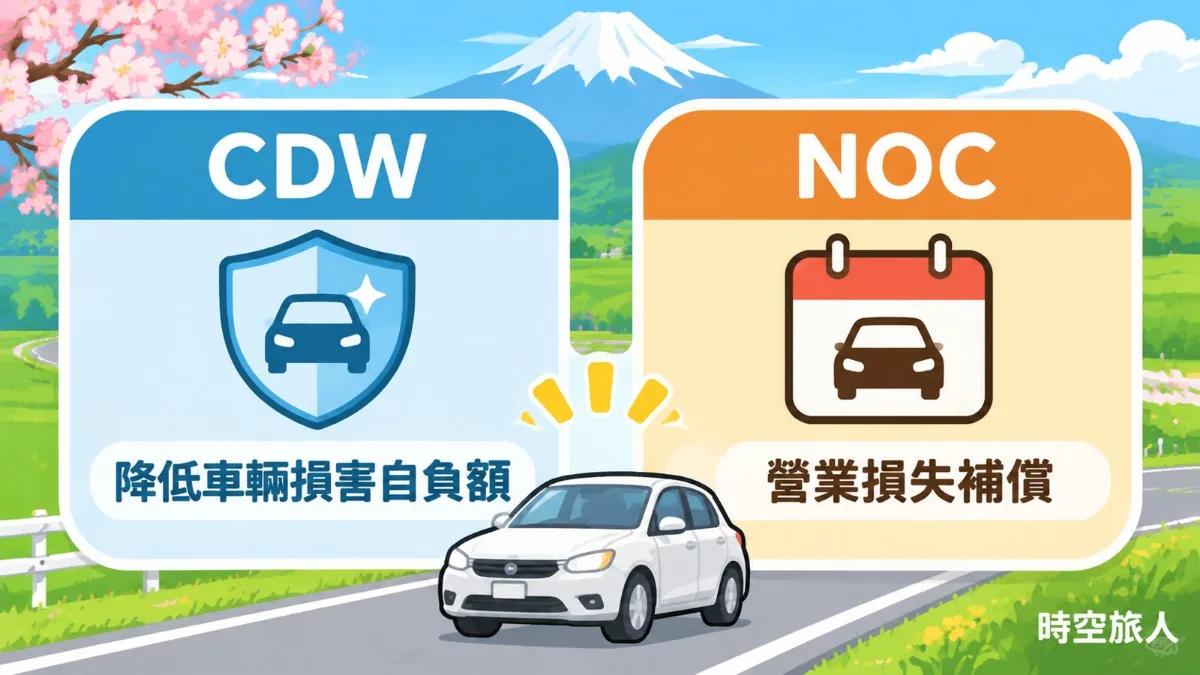
What is CDW (Collision Damage Waiver)?
CDW is used to reduce the deductible you owe for vehicle damage in an accident. It is not insurance in the traditional sense; it is more like a "waiver system". With CDW, the vehicle-damage deductible you have to pay in an accident is reduced or waived, but that does not mean every cost is waived.
Taking Toyota as an example, CDW costs about 1,100–2,200 yen per 24 hours, depending on the car type. Prices differ by company and by vehicle type.
What is NOC (Non-Operation Charge)?
NOC is the term that first-time renters most often misunderstand.
NOC is defined as compensation for business loss when a vehicle cannot be rented out normally because of an accident or damage. In other words, if you wreck the car, the rental company has to repair it, and during the repair the car cannot be rented to anyone else; the party at fault compensates for that loss.
Why might you still have to pay NOC after buying CDW? Because CDW waives the vehicle-damage deductible, while NOC is a business loss; the two are separate.
According to Toyota's official terms, NOC is 20,000 yen if the car can be driven back to the designated store and 50,000 yen if it cannot. If you add the NOC full-coverage plan, it costs roughly another 550 yen per 24 hours, and the NOC can be waived if the conditions are met. Amounts differ by company, so check the official terms of the company you book with.
Differences between CDW, NOC and complete coverage plans:
| Item | Main purpose | What to watch for |
|---|---|---|
| Basic coverage | Basic compensation for accidents | May have a deductible |
| CDW | Reduces the vehicle-damage deductible | Does not mean every cost is waived |
| NOC coverage plan | Waives the NOC if conditions are met | Depends on the rental company's terms |
| Other additional coverage | Supplements specific risks | Confirm the coverage scope and exclusions |
Which situations may not be covered?
For example: driving by an unauthorized person, drunk driving, breach of the rental contract, failing to report to the police or notify the rental company as required, leaving the accident scene without permission, and using the vehicle in ways not covered by the terms.
According to Toyota's official terms, situations that are not paid include driving by someone other than the applicant at departure and driving without a license. Specific exclusions must follow each rental company's official terms and cannot be generalized.
Should you buy additional rental insurance?
Do not use scare tactics; analyze by trip. The longer the trip, the less driving experience you have, the more mountainous the route and the more it is winter, the more we recommend buying full coverage. If it is your first time driving a right-hand-drive car, on snow, and on mountain roads, the value of insurance is very high. If you only drive for 1 day on flat roads in Okinawa and have plenty of driving experience, you can think again, but we still recommend at least CDW + NOC coverage.
Picking up the car in Japan: do not rush off once you get the keys
The process at the rental office after you arrive: show your documents, confirm the reservation, confirm the driver's details, confirm the insurance plan, confirm the fuel policy, confirm the return time and place, and confirm any additional charges.
Take your time. Do not agree to everything just because you are in a hurry. The insurance plan, fuel policy and return location are the three things most likely to go wrong.
What you must check when picking up the car: body scratches, bumpers, doors, windows and mirrors, wheels and tires, windshield, interior equipment, fuel level, mileage, and the spare tire or tire repair kit.
We recommend taking photos or videos of the whole car, the interior and the dashboard, and confirming that existing damage is recorded on the pick-up sheet. If you find a scratch that is not recorded, tell the staff on the spot and ask them to add it; do not think "a small scratch doesn't matter". At return, this record is what they compare against.
What equipment is inside a rental car in Japan?
Shifter, turn signals, wipers, lights, handbrake and electronic parking brake, rear-view camera, automatic parking, lane departure warning, automatic emergency braking and the ETC on-board unit.
The turn signal and wiper controls on Japanese cars are the opposite of those in Taiwan. In Taiwan the turn signal is on the left; in a Japanese right-hand-drive car the turn signal is on the right and the wipers are on the left. Many people get in, try to signal a turn and end up turning on the wipers. It is not a joke; almost every Taiwanese traveler makes this mistake. After pick-up, practice in the parking lot for 5 minutes: try turning, signaling and using the wipers.
How do I set up the car navigation in Japan?
You can search by Japanese address, phone number, MapCode or attraction name. MapCode is very commonly used in Japan: a string of numbers represents one location, which is more convenient than typing a Japanese address. Look up the MapCodes of the places you want to visit before departure and save them on your phone.
Differences between Google Maps and the built-in navigation: Google Maps is convenient for finding sights and checking traffic, but the built-in navigation is more stable when mobile signal is poor in the mountains. We recommend using both: Google Maps to look up routes and the built-in navigation for actual driving.
How to avoid being guided onto narrow roads: rural Japan has many small roads, and navigation may take you along narrow mountain roads to save time. If you are a beginner, it is better to take the main road and spend 10 more minutes than to take a small road. When setting up navigation, you can choose "prioritize expressways and main roads".
Final check before leaving the rental office: driver's seat position, mirrors, seat, lights, wipers, shifter and navigation settings. Get familiar with the car in a safe place, and do not get on an expressway right away.
👉 Check car rental and ETC rental in Japan on Trip.com
The biggest traffic rule differences between Japan and Taiwan
This chapter is one of the most practical cores of the article.
Japan drives on the left, with right-hand-drive cars. The direction of the lanes is exactly the opposite of Taiwan. The driver's seat is on the right, and the use of turn signals and wipers is also reversed. When turning, watch for pedestrians and bicycles when turning left, and for oncoming straight traffic when turning right. When entering parking lots and gas stations, pay special attention to direction so that you do not enter the wrong way.
How do I read traffic signals and road signs in Japan?
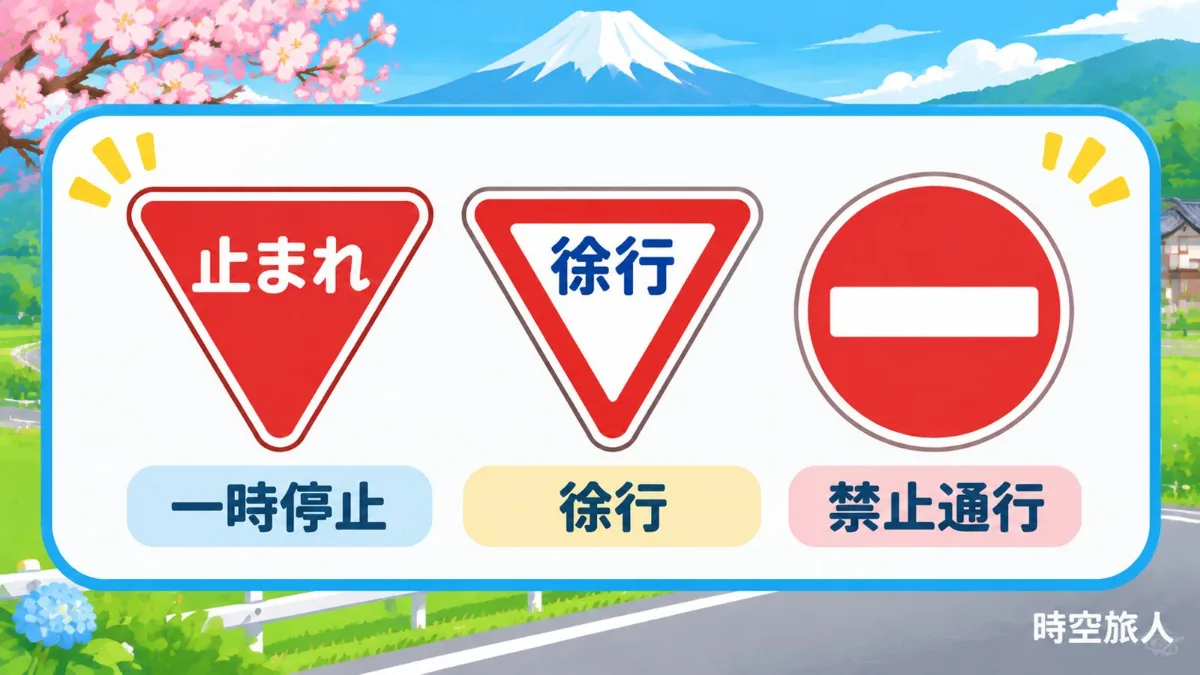
Common signs: 一時停止 (stop), 徐行 (slow down), 通行止め (no passage), 駐車禁止 (no parking), 駐停車禁止 (no stopping or parking), 指定方向外進入禁止 (no entry except in the designated direction), one-way street, speed limit signs, and height and weight limits.
Intersection rules for left and right turns in Japan: when turning left, watch for pedestrians and bicycles; when turning right, watch for oncoming straight traffic; check the road markings for the right-turn waiting position; turn only when the arrow signal is lit; and take special care around crosswalks and turning vehicles. At Japanese intersections, pedestrians really do have priority; it is not just a suggestion.
How is a Japanese STOP sign different from Taiwan's?
The Japanese 一時停止 sign means you must come to a complete stop, check left and right for oncoming traffic, make sure there are no pedestrians or bicycles, and only then start again. It is not slowing down and rolling through; you really have to stop. Look at the road markings for the stopping position, and do not stop on the crosswalk. Failing to stop at a 一時停止 costs 2 points and a 7,000-yen fine. Many Taiwanese travelers get tickets in Japan because they did not come to a complete stop at a 一時停止.
Right of way for pedestrians and bicycles: crosswalks, how bicycles use the road, schools and residential areas, blind spots when turning, and care at night and in the rain. There are many bicycles in Japan and they are not slow; always look twice when turning to make sure no bicycle is coming from a blind spot.
Common violations and rules that are easy to overlook: speeding, running red lights, not stopping as required, using a phone, drunk driving, not wearing a seat belt, not using a child seat as required, and improper parking and temporary stopping.
Verified drunk-driving penalties: driving under the influence of alcohol (酒氣帶駕駛) is punishable by up to 3 years in prison or a fine of up to 500,000 yen; driving while intoxicated (酒醉駕駛) is punishable by up to 5 years in prison or a fine of up to 1,000,000 yen. Passengers in the same car and people who provide alcohol to the driver can also be punished. Do not have a "one drink is fine" attitude; Japan's standard is stricter than Taiwan's.
Laws and penalties should be confirmed against official sources such as Japan's National Police Agency.
How to drive on Japanese expressways: ETC, tolls and rest areas
Differences between expressways and ordinary roads in Japan: toll roads, entrances and exits, interchanges, lane layout, speed limits, traffic flow and following distance. The speed limit on Japanese expressways is usually 80 to 100 km/h; do not drive with Taiwanese expressway habits.
What is ETC? Do you have to have it when renting a car?
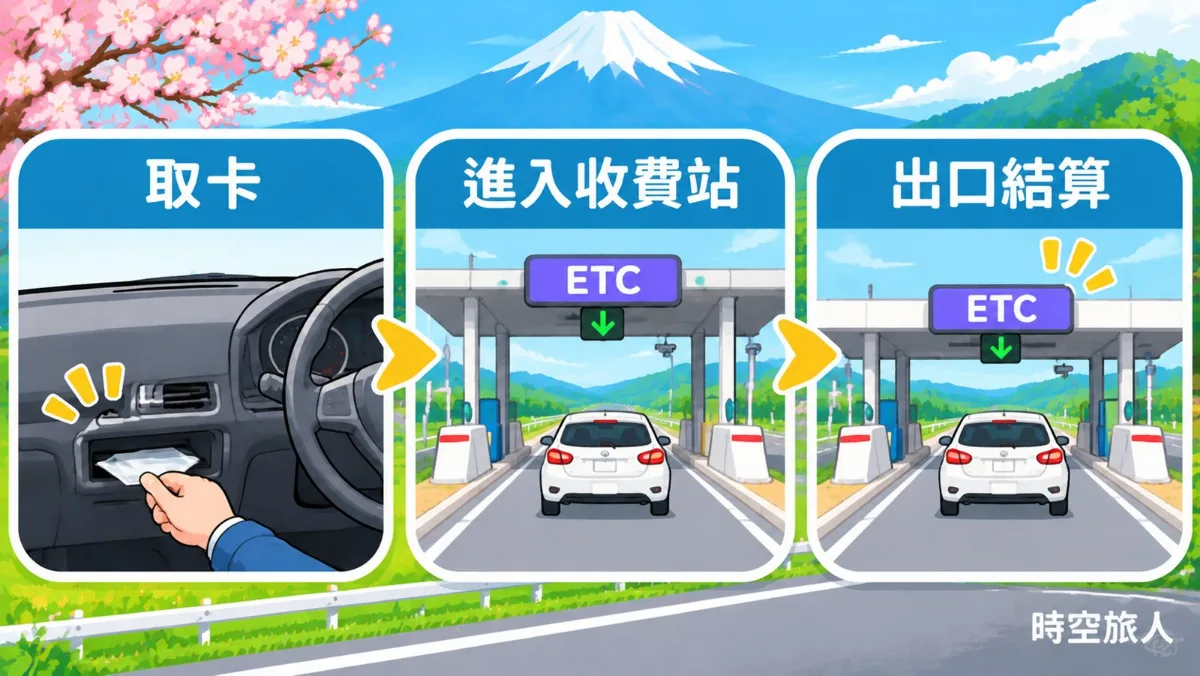
ETC is an electronic toll collection system. The car has an ETC on-board unit; insert an ETC card and you can pass through toll gates directly without stopping to pay cash. You can borrow an ETC card when renting a car. For Toyota, an ETC card costs 550 yen per rental, and the tolls are settled together when you return the car. Other companies charge about 330–550 yen, depending on the company.
You can still use expressways without an ETC card, but you have to use the manned toll lanes, stop and pay cash, which is slower. Note: from 2026, some toll gates have been converted to ETC-only with no manned booth. Before using an expressway, always check whether your route has ETC-only toll gates; if you do not have an ETC card, do not try to push through.
Toll payment methods on Japanese expressways: ETC lanes, regular manned lanes, and cash or other payment methods. Tolls are calculated by section, and costs vary a lot between sections. On a long drive the tolls often cost more than the fuel, so include this in your budget first.
Expressway discounts and passes in Japan: verified and corrected
The nationwide Japan Expressway Pass (JEP) and the Chubu version CEP have been discontinued; do not trust old blog posts saying you can still buy them. The only ones still on sale are the 4 regional versions: Hokkaido HEP, Tohoku TEP, Kyushu KEP, and San'in-Setouchi-Shikoku SEP. All must be arranged together with a designated rental car, and you must hold a foreign passport and meet the eligibility conditions. If your route is not in these 4 regions, do not count on a pass to save money; just pay with ETC.
What is the difference between SA and PA rest areas on Japanese expressways?
An SA is a Service Area. It is large, with toilets, restaurants, souvenirs, a gas station and local specialty products. A PA is a Parking Area. It is small, with only toilets and vending machines. The rest areas themselves have sightseeing value, and the food and souvenirs at many SAs are local limited items worth stopping to see.
Expressway driving tips: keep a safe following distance, do not occupy the passing lane for long, avoid fatigued driving, watch out for large vehicles, watch for tunnels and mountain sections, and pay attention to roadwork and weather information. Japanese expressways have many tunnels; turn on your lights before entering a tunnel and do not change lanes inside it.
Refueling in Japan: fuel types, gas station operation and payment
Fuel types in Japan:
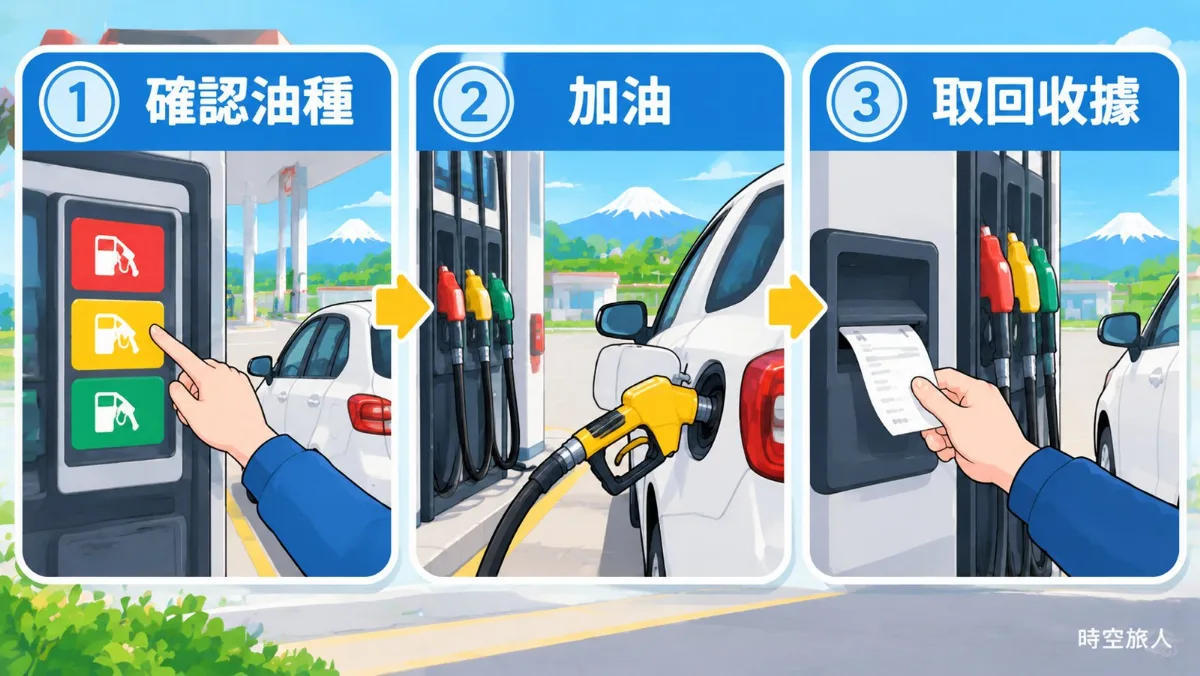
- レギュラー Regular, red nozzle: ordinary unleaded gasoline; the vast majority of rental cars use this
- ハイオク High Octane, yellow nozzle: premium unleaded gasoline, only needed for luxury or high-performance cars
- 軽油 Diesel, green nozzle: diesel, used only by diesel cars
A special reminder: the Japanese kanji 「軽油」 is definitely NOT fuel for light cars (kei cars). Putting the wrong fuel in can damage the vehicle, and the rental company will demand compensation. When you pick up the car, always ask which fuel the car takes and write the fuel type in a note on your phone.
Self-service and full-service refueling in Japan: Self Service means you refuel yourself, and Full Service means an attendant refuels for you. Self-service is a bit cheaper, and with full service someone fills up for you. For your first drive, we recommend using full service, which is less likely to go wrong. If you use self-service, the process is: confirm which side the fuel tank is on, park the car, select the correct fuel type, choose an amount or full tank, pay, refuel, and take the receipt.
Actual gas station operation in Japan, in order: confirm which side the fuel tank is on, park the car, select the correct fuel type, choose an amount or full tank, pay, refuel, and take the receipt.
Problems you may run into when refueling in Japan: not knowing which side the fuel cap is on, selecting the wrong fuel type, a credit card that cannot be used, a pump interface you cannot read, no gas station in remote areas, and a station that has already closed when you need fuel.
To find which side the fuel cap is on, look at the fuel pump icon on the dashboard; the arrow points to the side of the fuel cap. There are not many gas stations in remote areas, so if you see a gas station when the tank is half full, fill up first; do not wait until the warning light comes on.
Where should you refuel before returning the car?
Whether you need to return the car with a full tank depends on the rental contract. Most require a full tank. To find the nearest gas station, search for 「ガソリンスタンド」 in your navigation or ask the rental company. Whether you need to keep the receipt depends on the rental company, but we recommend keeping it and showing it to the staff at return. If the fuel level is insufficient at return, the rental company will charge for the fuel, usually at a higher price than refueling yourself.
Parking in Japan: parking lots, fee systems and the risk of violations
Common parking types in Japan: coin parking lots such as Times, mechanical parking, shopping mall parking, hotel parking, private off-street lots and tourist attraction parking.
How do Japanese parking lots charge?
Hourly fees, fixed-period fees after entry, a daily maximum, night discounts, rates for specific dates and holidays, and vehicle size limits.
A special explanation of the "maximum fee" (最大料金) and the conditions under which it applies. The maximum fee is the highest charge for a day, but you cannot assume it applies to every time period. At some parking lots the maximum fee applies only on weekdays and not on holidays. At others it applies only to a certain period within 24 hours, and beyond that the fee is recalculated. Always read the sign before parking.
How do you pay at parking lots in Japan?
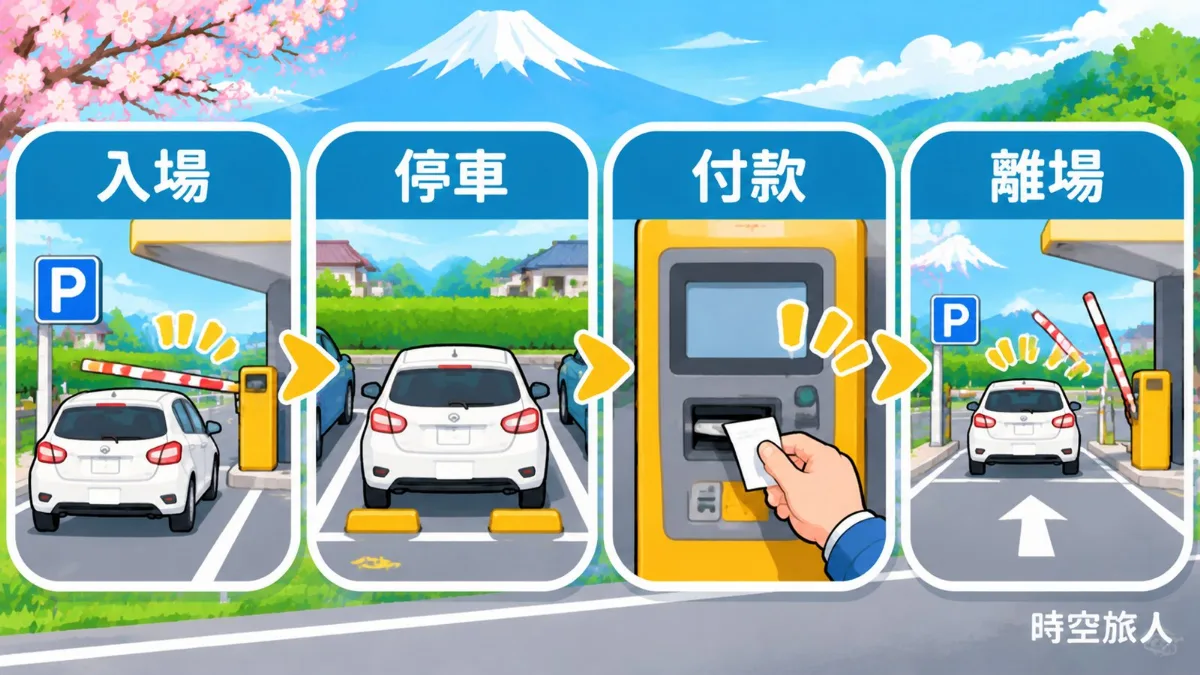
Pay-machine operation, license-plate-recognition lots, wheel-lock lots, credit cards and cash, and the payment process before leaving. Wheel-lock lots are very common in Japan: when you park, a lock holds your wheels, and before leaving you must first pay at the pay machine; once it unlocks you can drive away. Do not drive off without paying; the wheel lock can damage the car.
Parking precautions in Japan: do not park on the roadside arbitrarily, watch the height and vehicle size limits of the parking lot, check whether there is a maximum parking time, take care at night entrances and exits, and do not block residents' or shops' entrances.
How to avoid high parking fees at tourist attractions? Compare official lots, private lots and hotel parking plans, and check parking information around your destination first. At many tourist attractions the weekend rate of private lots is 2 to 3 times that of the official lot. Look it up in advance; parking a bit farther away and walking 5 minutes is actually better value.
Winter driving and special road conditions in Japan
This chapter needs to go deeper, because winter driving in Hokkaido, Tohoku and Hokuriku is very different from Taiwan.
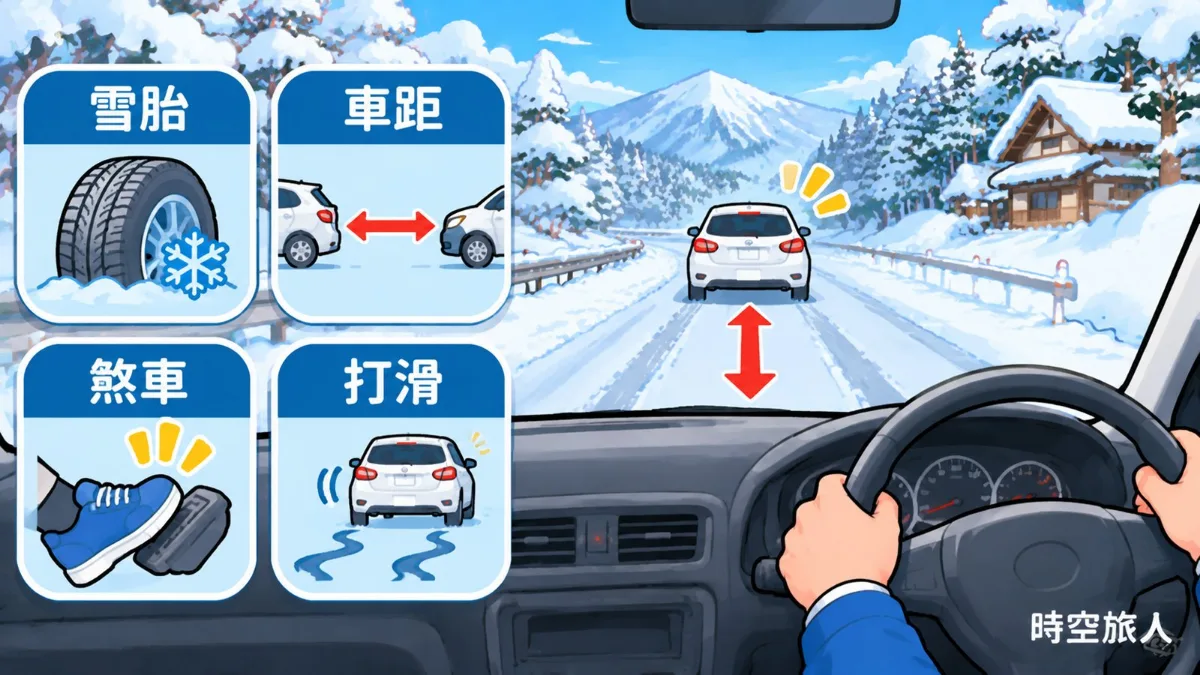
For winter rentals, snow tires are essential. Snow tires are called スタッドレスタイヤ in Japanese. They differ from regular tires in tread pattern and rubber compound and keep their grip at low temperatures. How to confirm the equipment when renting: always ask the rental company whether the car has snow tires, whether snow tires are included in the rental fee, and whether you need to pay extra. Book winter rentals early; the number of cars with snow tires is limited and you may not be able to rent one if you book late.
Basic snow driving techniques: reduce speed, increase following distance, avoid sudden braking, avoid sudden acceleration, turn slowly, how to drive uphill and downhill, and the risk of black ice and icy roads.
Black ice is the most dangerous. The road looks merely wet, but it has actually frozen, and braking is completely ineffective. Be especially careful on bridges, at tunnel entrances and exits and in shaded places.
What are the dangers of driving in snow? Blowing snow and whiteout, poor visibility, icy roads, snow covering lane markings, road shoulders buried under snow, skidding, and getting stuck in snow. A whiteout is when blowing snow turns everything ahead white and you cannot see the road at all; when it happens, do not push on, but find a safe place to stop and wait for visibility to return.
Does four-wheel drive (4WD) mean you will not skid?
No. The advantage of 4WD is that it is stronger when starting off and climbing hills, but braking distance and tire grip still matter. A 4WD car can still skid on snow, and braking still slides. Do not drive fast just because you have 4WD.
Precautions for mountain and country roads in Japan: narrow roads, passing spaces, sharp and blind curves, wild animals, poor lighting at night, unstable mobile signal in the mountains and seasonal road closures. In the mountains of Hokkaido and Tohoku, some roads close in winter, so always check road information before departure.
What if a road is closed or the weather is bad? Check road traffic information, use an alternative route, postpone the trip, and contact the rental company. Do not push through a closed road; take an alternative route or simply postpone the trip. Safety matters more than the itinerary.
Details and special situations that self-drivers in Japan often overlook
What should you do when meeting another car on a narrow road in Japan? Avoid blindly driving into narrow lanes, judge whether there is room to pass, give way properly when passing, and avoid letting a wheel fall into the shoulder or a ditch. The ditches in rural Japan are deep, and once a wheel falls in it is very hard to get out. When you see a narrow road, stop and look first, and enter only after confirming there is space to pass.
Driving in residential areas and near schools: children and pedestrians, school start and finish times, low speed in residential areas, blind spots, and avoiding honking and noise. Roads in Japanese residential areas are very narrow and children may suddenly run out, so always go slowly.
Railroad crossing precautions in Japan: stop and check, watch the warning signals and the barriers, never stop on the crossing, and know the emergency steps if the car breaks down. At Japanese railroad crossings, always stop and check left and right before crossing. Stopping on a crossing is extremely dangerous.
What to do when an ambulance, fire truck or police car comes? Yield to emergency vehicles and avoid obstructing rescue. When you hear a siren, pull over to the left and stop first, and let the emergency vehicle pass.
Can you eat in the car while driving in Japan? Consider driving safety, garbage disposal, rest areas and local customs. Distinguish legal requirements from general etiquette; do not mistake a habit for a law. Eating while driving is not illegal, but distracted driving is dangerous. We recommend eating at a rest area.
What costs do self-drivers in Japan often overlook? One-way drop-off fee, ETC card rental fee, snow tire fee, child seat fee, extended rental fee, cleaning and special handling fees, parking fees, and expressway tolls. Added together, these often cost more than the rental fee itself, so you must include them in your budget.
What to do in case of an accident or breakdown with a rental car in Japan
This chapter must be written as an actual response procedure, not just "contact the rental company".
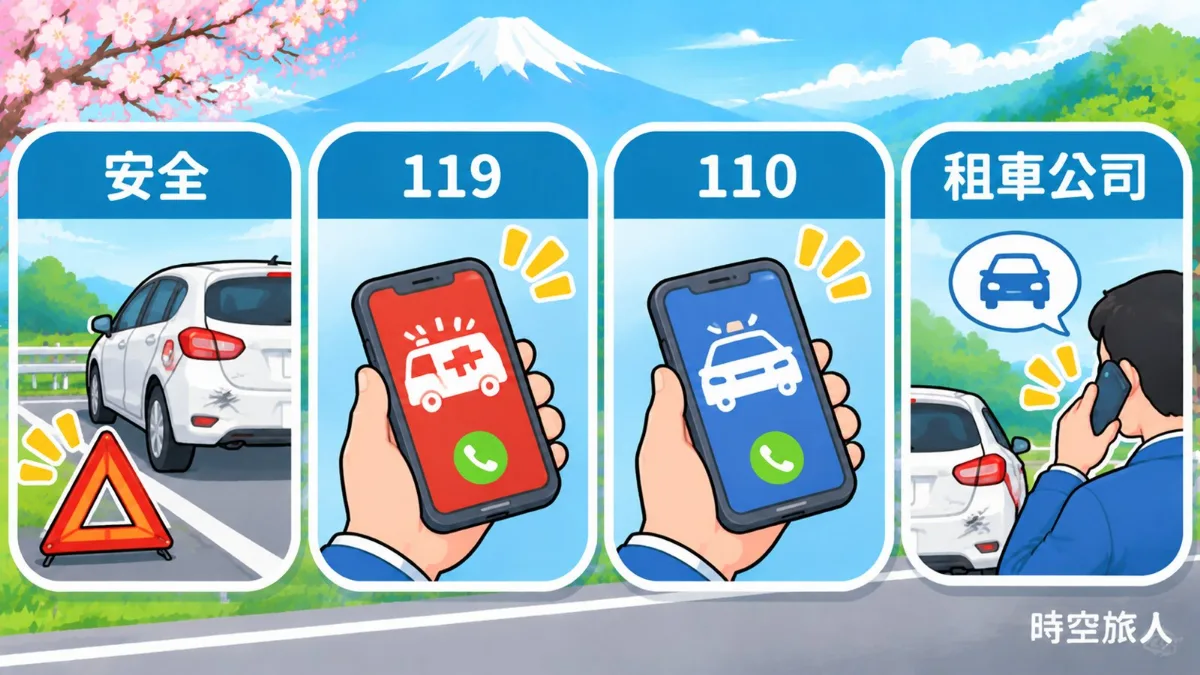
Handling in the first moments after a traffic accident:
- Make sure you and other people are safe
- Where it is safe to do so, avoid secondary accidents
- Call 119 for help if necessary
- Call 110 to report to the police
- Contact the rental company and its accident support hotline
- Record the scene and the other party's information
- Follow the instructions of the rental company and the police
A special reminder: even in a minor collision, you cannot settle privately and not report it. Whether you are covered by insurance may depend on the accident-reporting procedure. If you settle privately, the insurance may not pay.
Emergency numbers commonly used in Japan accidents: 110 is the police, 119 is the fire department and ambulance. How to choose between different emergencies: if someone is injured and an ambulance is needed, call 119. If you need the police to handle the accident or you need an accident certificate, call 110.
What information should you record after an accident? Accident time, accident location, the other party's contact details, license plate number, vehicle damage, photos of the scene, police handling information and the rental company's case number.
What if the car breaks down or has a flat tire? Do not keep driving at risk, stop safely, know how to use the vehicle's emergency equipment, contact the rental company, and use roadside assistance if necessary.
What if there is an earthquake, typhoon or sudden disaster? Choose where to park, avoid parking on bridges and high-risk places, watch for tsunami warnings and evacuation information, check road closures and follow local government instructions.
Returning a rental car in Japan: avoid extra charges and disputes
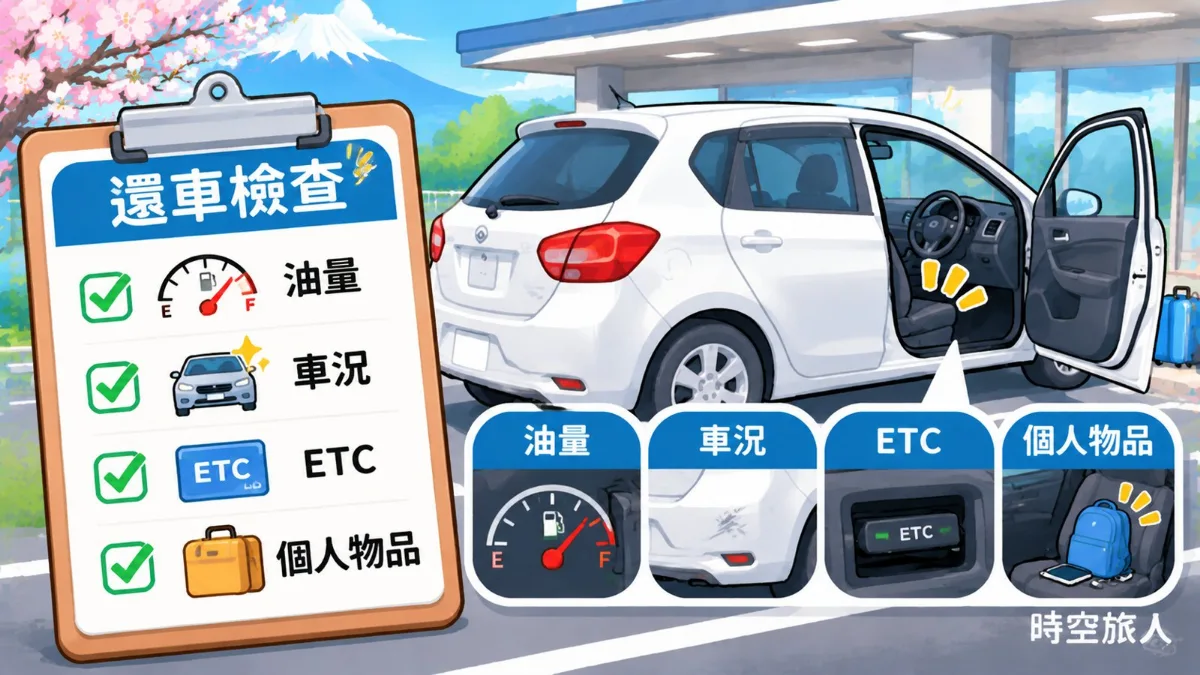
What should you prepare before returning the car? Confirm the return time, confirm the return location, confirm the fuel level, clear your belongings, check the interior, confirm the ETC card has been taken out, and confirm the navigation and on-board devices.
Full-tank return versus insufficient fuel: the full-tank policy, the location of the nearest gas station, keeping the receipt, and how the fee is calculated when the tank is not full. We recommend refueling 30 minutes before returning the car, keeping the receipt after refueling and showing it to the staff at return.
How do you check the car's condition when returning it? Body exterior, wheels, interior, fuel level, mileage, vehicle accessories and existing damage. Take photos for the record, just as you did at pick-up.
What fees may arise from returning late? Extended rental fees, additional insurance fees and other possible penalty fees, and how to contact the company if you are late. If you know you will be late, call the rental company early and ask whether you can extend; do not simply return late.
What should you watch for with one-way drop-off? One-way drop-off fee, opening hours of the location, whether the return location can be entered directly at the airport, how to get from the return location afterward and a buffer between your flight time and the return time. Leave at least a 1-hour buffer for one-way return, plus shuttle time if you return at an airport.
How much does a self-drive trip in Japan cost? A complete budget example
You cannot just list the daily rental price; you must calculate the real cost of the whole self-drive trip.
Components of car rental costs in Japan: base rental fee, insurance and coverage plans, ETC card, snow tires, child seat, one-way drop-off fee, fuel, expressway tolls and parking.
Budget comparisons for different lengths of trip: design a 3-day, a 5-day and a 7-day self-drive. How to split costs for different group sizes: compare transport costs for 2, 4 and 5 travelers.
How to reduce self-drive costs in Japan: compare rental prices early, avoid unnecessary one-way drop-offs, evaluate regional expressway passes for your route (note: the nationwide JEP has been discontinued; only 4 regional versions remain), avoid renting for long periods in the city, check hotel parking fees in advance, choose a car type that fits the amount of luggage, and avoid looking only at the lowest rental price while ignoring coverage and extra charges.
👉 Estimate your Japan car rental cost on Trip.com
Pre-departure checklist for self-driving in Japan
Before departure:
- ☐ Confirm driver eligibility and related documents
- ☐ Confirm the car rental reservation
- ☐ Confirm rental insurance
- ☐ Confirm the car type and luggage space
- ☐ Confirm whether you need ETC
- ☐ Confirm whether you need snow tires
- ☐ Confirm hotel parking information
- ☐ Plan your itinerary and routes in advance
At pick-up:
- ☐ Confirm driver registration
- ☐ Check the body for damage
- ☐ Take photos of the car
- ☐ Confirm fuel level and fuel type
- ☐ Get familiar with the turn signals and wipers
- ☐ Confirm navigation
- ☐ Confirm ETC equipment
- ☐ Confirm emergency contact information
On the road:
- ☐ Drive on the left
- ☐ Watch speed limits and 一時停止 signs
- ☐ Watch for pedestrians and bicycles
- ☐ Follow parking rules
- ☐ Keep a safe following distance
- ☐ Avoid fatigued driving
- ☐ Watch the fuel level and the weather
- ☐ Keep important receipts
At return:
- ☐ Fill the tank as required
- ☐ Clear your personal belongings out of the car
- ☐ Take out the ETC card
- ☐ Confirm the condition of the car
- ☐ Return on time
- ☐ Confirm the fee settlement
- ☐ Keep the return record
Japan car rental FAQ
1. Do Taiwanese travelers need an international driving permit to rent a car in Japan?
A: What applies to Taiwanese travelers is the original Taiwan driver's license plus the Japanese translation, not an ordinary international driving permit. An international driving permit issued in Taiwan cannot be used in Japan.
2. Where do I get the Japanese translation of my Taiwan driver's license?
A: At any Motor Vehicles Office or Station in Taiwan, at the counter, for NT$100 per copy; you can collect it on the spot in about 5–10 minutes, or apply online. Having JAF issue one in Japan costs 6,000 yen, so we recommend getting it done in Taiwan first.
3. What documents do I need to bring to rent a car in Japan?
A: Passport, original Taiwan driver's license, Japanese translation, rental reservation confirmation and the driver's own credit card.
4. Do I have to buy insurance when renting a car in Japan?
A: Basic coverage is usually included in the rental fee, but the deductible and NOC depend on whether you add a CDW / NOC coverage plan.
5. What is the difference between CDW and NOC?
A: CDW reduces the vehicle-damage deductible, while NOC is compensation for the business loss while the vehicle cannot be rented out; the two are separate. For Toyota, NOC is 20,000 yen if the car can be driven back and 50,000 yen if it cannot.
6. Can two people take turns driving a rental car in Japan?
A: Yes, but the second driver must be registered as an additional driver in advance, and both must meet the eligibility requirements. If an unregistered driver has an accident, the insurance does not pay.
7. Do I have to rent an ETC card when renting a car in Japan?
A: Not necessarily, but expressways are much more convenient with an ETC card. From 2026, some toll gates are ETC-only, which is troublesome without a card.
8. Can I use expressways without an ETC card?
A: Yes, by using the manned toll lanes, but some ETC-only toll gates have no manned booth, so check your route first.
9. What kind of fuel does a rental car in Japan take?
A: Most take Regular, the red nozzle. Always ask when you pick up the car, and do not put in the wrong fuel. Yellow is High Octane and green is Diesel (軽油).
10. Can I return a rental car at a different location in Japan?
A: Yes, but you pay a one-way drop-off fee, and you need to confirm the opening hours of the return location.
11. Do I have to return the car with a full tank in Japan?
A: It depends on the rental contract, but most require a full tank. If it is not full you will be charged for fuel, usually at a higher price than refueling yourself.
12. Do I need snow tires when renting a car in Japan in winter?
A: In snowy regions such as Hokkaido, Tohoku and Hokuriku, you definitely need snow tires in winter. Confirm with the rental company that the car has snow tires.
13. Can I drive a rental car into central Tokyo or Osaka?
A: Yes, but parking in the city is expensive, roads are narrow and traffic is heavy, so we do not recommend driving the whole time.
14. Which number do I call after an accident in Japan?
A: Call 119 if someone is injured, call 110 to report to the police, and then contact the rental company's accident hotline.
15. What does "maximum fee" mean at Japanese parking lots?
A: It is the highest charge for a day, but the conditions depend on the sign at the parking lot; it may not apply on holidays or during specific periods.
16. Can I use Google Maps when driving in Japan?
A: Yes. We recommend using Google Maps together with the built-in navigation, since the built-in navigation is more stable when the signal is poor in the mountains.
17. Can I use a Taiwanese credit card when renting a car in Japan?
A: Yes. We recommend using the driver's own credit card for the pre-authorization.
18. Do I need a child seat when renting a car in Japan?
A: Yes. Children under 6 must use a child seat, and a violation costs 1 point. Choose it when booking; you cannot ask for it only at the counter.
19. What happens if I am late or return the car late in Japan?
A: There may be extended rental fees and extra insurance fees. If you know you will be late, call the rental company early.
20. Is self-driving in Japan suitable for first-time visitors?
A: Yes, but we recommend starting in places with wider roads such as Okinawa, the suburbs of Hokkaido and Kyushu, and not starting with central Tokyo or narrow mountain roads.
Information and verification date: 2026-11-12. License, insurance, traffic rules, expressway and cost information has been checked against public information from the Motor Vehicles Offices, Toyota Rent a Car's official site, public information from JNTO and NEXCO, and public information from Japan's National Police Agency. For final prices, availability and promotion terms, please refer to the product page on Trip.com or the rental platform.
Sources and notes
Translated from the author's Traditional Chinese original. Information was checked against public information from the Motor Vehicles Offices in Taiwan, Toyota Rent a Car, JNTO, NEXCO and Japan's National Police Agency.
Comments (0)
No comments yet.
Comments are published first and reviewed afterwards; rule-breaking comments are hidden. Only signed-in members can comment.