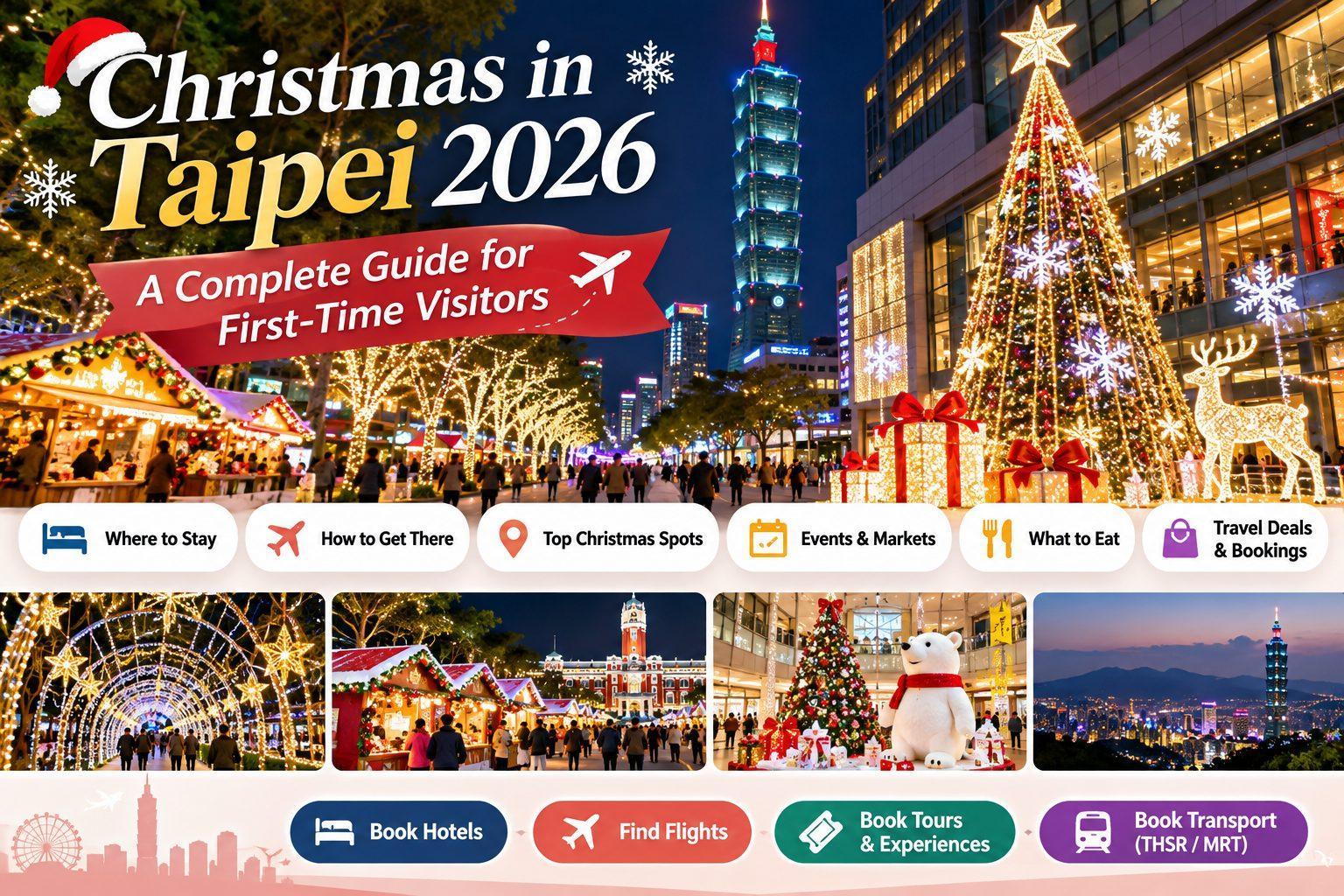
Christmas in Taipei 2026: A First-Timer’s Guide to Lights, Markets, Food & Where to Stay
A first-timer’s guide to Christmas in Taipei 2026: event dates for Christmasland, TaipeiXmas and Gongguan, airport transfers and MRT, a four-day itinerary, what to eat, where to stay, and a realistic budget.
This article was submitted by a member. Views and content are the author’s own and do not represent this site.
This article contains commercial links (affiliate or paid) that may earn the author a commission.
If you picture Christmas as snow-covered streets, wooden chalets and freezing temperatures, Taipei will offer a very different experience. December in Taiwan’s capital is usually cool rather than snowy. The festive atmosphere comes from illuminated shopping districts, seasonal installations, lively food streets and the contrast between modern skyscrapers and older neighbourhoods.
That difference is exactly why Taipei can be an appealing winter city break. You can spend one evening photographing Christmas displays around Taipei 101, another exploring a large seasonal festival in Banqiao, and a third tasting Taiwanese snacks at a night market. The city is also relatively straightforward to explore without renting a car.
This guide is written for international visitors who have never been to Taipei. It follows the decisions that make a trip easier: first understand the events and their dates, then work out transport and a realistic itinerary, prepare for the weather, explore local food, and only then choose the hotel area and budget. Event schedules, opening hours and prices can change, so check the official organiser or provider pages again before travelling.
1. Christmas Events in Taipei 2026: Dates, Locations & Highlights
New Taipei Christmasland: The Big Festive Experience
New Taipei Christmasland runs from November 13 to December 27, 2026, in Banqiao, New Taipei City. It is the largest dedicated Christmas attraction in the Taipei area and should be the priority if you want a purpose-built festive event rather than ordinary shopping-centre decorations.
The 2026 edition features Kanahei’s Small Animals, including Pisuke and Usagi, with a travel-themed concept. The event uses several public spaces around Banqiao, including New Taipei City Plaza, Banqiao Station Square, Wanping Metropolitan Park and Fuzhong Plaza. The layout is spread across more than one block, so wear comfortable shoes and allow time to move between zones.
The displays are free to walk around. You should budget separately for food, drinks, souvenirs and any paid activities. A visit focused on the main Banqiao areas can take around 90 minutes; allow longer if you want to include Fuzhong, browse market stalls and stop for dinner.
When to go and what to expect
The light displays are most effective after dark. If you arrive before sunset, you can see the area in daylight, find the main installations and then photograph the lights as they come on. Weekdays are usually more comfortable for visitors who prefer space to walk and take pictures. Weekends and special programme dates can be busier.
| Published programme | Date | Planning note |
|---|---|---|
| Christmas Flea Market | Nov 21 | Afternoon and evening market |
| Get Moving This Winter | Nov 22 | Daytime activity programme |
| Christmas Market x Asia Esports Championship | Nov 27–29 | Allow for event crowds |
| German Christmas Market | Dec 4–6 | Best choice for a market-focused visit |
| Superstar Christmas Concert | Dec 12–13 | Expect larger evening crowds |
| Wind Music Carnival | Dec 19 | Check performance details |
| A Magical Christmas Encounter | Dec 20 | Check organiser updates |
The published programme does not list a separate headline event on Christmas Eve or Christmas Day. The seasonal displays remain the reason to visit, but do not assume a special concert or market programme will take place on those dates. Check the organiser’s current schedule before making a date-specific plan.
Official information: https://christmasland.ntpc.gov.tw/en/event.php
TaipeiXmas: Christmas Lights in Xinyi
TaipeiXmas is scheduled for December 4, 2026 to January 3, 2027, in Xinyi District. The event brings together resources from major department stores and creates festive installations, illuminated decorations and skybridge displays around the City Hall area. The official tourism listing describes five large Christmas installations and activities across participating stores.
The main advantage is how easily TaipeiXmas fits into a wider evening. You can visit Taipei 101, browse the department stores, have dinner and then walk around the decorated streets. If your time is limited, this is one of the most efficient ways to combine a landmark attraction with a Christmas atmosphere.
Xinyi after dark: Taipei 101 above the department stores, Christmas lights along the skybridges, and dinner within a five-minute walk. This is the easiest Christmas evening to plan on a first visit.
Official event details: https://www.travel.taipei/en/event-calendar/details/66776
Taipei Christmas Infinite Love
Taipei’s official 2026 event calendar lists Christmas Infinite Love from December 3, 2026 to January 1, 2027. It is a separate seasonal listing from TaipeiXmas. Before travelling specifically for this event, check the latest organiser information for the exact installation locations, programme and operating hours. Do not assume the event occupies the same area as TaipeiXmas.
Gongguan Christmas Season
The official Taipei calendar lists Gongguan Christmas Season from December 5 to December 31, 2026. Gongguan offers a more local neighbourhood experience than Xinyi’s large department-store district. It can be paired with a visit to National Taiwan University, the surrounding food streets and the riverside area. Treat it as an optional addition rather than a substitute for Christmasland if you are looking for a large-scale Christmas festival.
Official event calendar: https://www.travel.taipei/en/event-calendar/2026
Taipei’s Christmas areas are not one walkable district. Christmasland is in Banqiao, TaipeiXmas is in Xinyi, and Gongguan is a separate neighbourhood outing. Plan them as three different evenings, not one long walk.
Which event should you choose?
| Your priority | Best fit | Why |
|---|---|---|
| Large themed installations and markets | New Taipei Christmasland | A dedicated festival spread across Banqiao public spaces |
| Christmas lights plus shopping | TaipeiXmas | Located in Xinyi near Taipei 101 and department stores |
| An extra seasonal stop | Christmas Infinite Love | A separate event listing; verify the venue first |
| A neighbourhood outing | Gongguan Christmas Season | Pairs well with university-area food and local exploration |
For a first visit of three or four days, prioritise Christmasland and Xinyi. Add Gongguan if you have an extra evening or want to explore beyond the main tourist districts.
How to choose the right event night
Choose an event by the kind of evening you want, not only by the number of decorations shown in photographs. Christmasland is the stronger choice when the event itself is the main destination: allow time to explore the wider installation, take photographs from more than one viewpoint and pause for food or a warm drink. Xinyi is better when you want a flexible city evening that combines lights with shopping, restaurants and Taipei 101. Gongguan can work as a neighbourhood outing if you prefer a less conventional route and want to combine the seasonal atmosphere with local food or a university-area walk. Before leaving the hotel, check the event's official page for the exact date, programme and any special performances. A festival's overall operating period does not mean every performance, market stall or themed activity runs every day. Check whether the activity you care about has a separate schedule, whether any area requires a ticket, and whether weather could affect an outdoor programme. Save the official page offline or take a screenshot of the relevant schedule so you can refer to it when mobile reception is slow. Arrive before the busiest evening period if photography matters to you. This gives you time to understand the layout and identify the displays you want to revisit after dark. If you are travelling with a group, agree on a meeting point outside the densest area. Do not use a single decorative installation as your only meeting point; it may be difficult to see or reach when crowds build.
A simple crowd-management strategy
Treat the event area as a walking route rather than trying to stop at every display in sequence. First walk through the site to understand its layout, then return to the installations that matter most. This avoids spending the entire evening in queues for photographs. Keep valuables secure and avoid placing phones or wallets in open outer pockets when standing close to other visitors. If the event is extremely crowded, step away from the central photo point and look for a wider angle from a public walkway, while respecting barriers and event staff instructions.
Plan your route through the event area
Before travelling, identify the nearest MRT station, the likely walking approach and the point where you want to start exploring. A large event area may have several entrances or display zones, and the most obvious entrance is not always the least crowded. If you are meeting friends, share a map pin and choose a fixed meeting point away from the busiest installation. Mobile calls and messages can be difficult to coordinate when everyone is moving through a dense crowd. Wear shoes suitable for standing on hard surfaces, and bring a light outer layer even if the afternoon feels comfortable. If you plan to take photographs, decide which displays matter most rather than trying to photograph everything. Take a few wide shots first to record the atmosphere, then move to details when there is space. Respect event barriers and staff directions; stepping into a restricted area for a photograph is not worth the risk or disruption to other visitors.
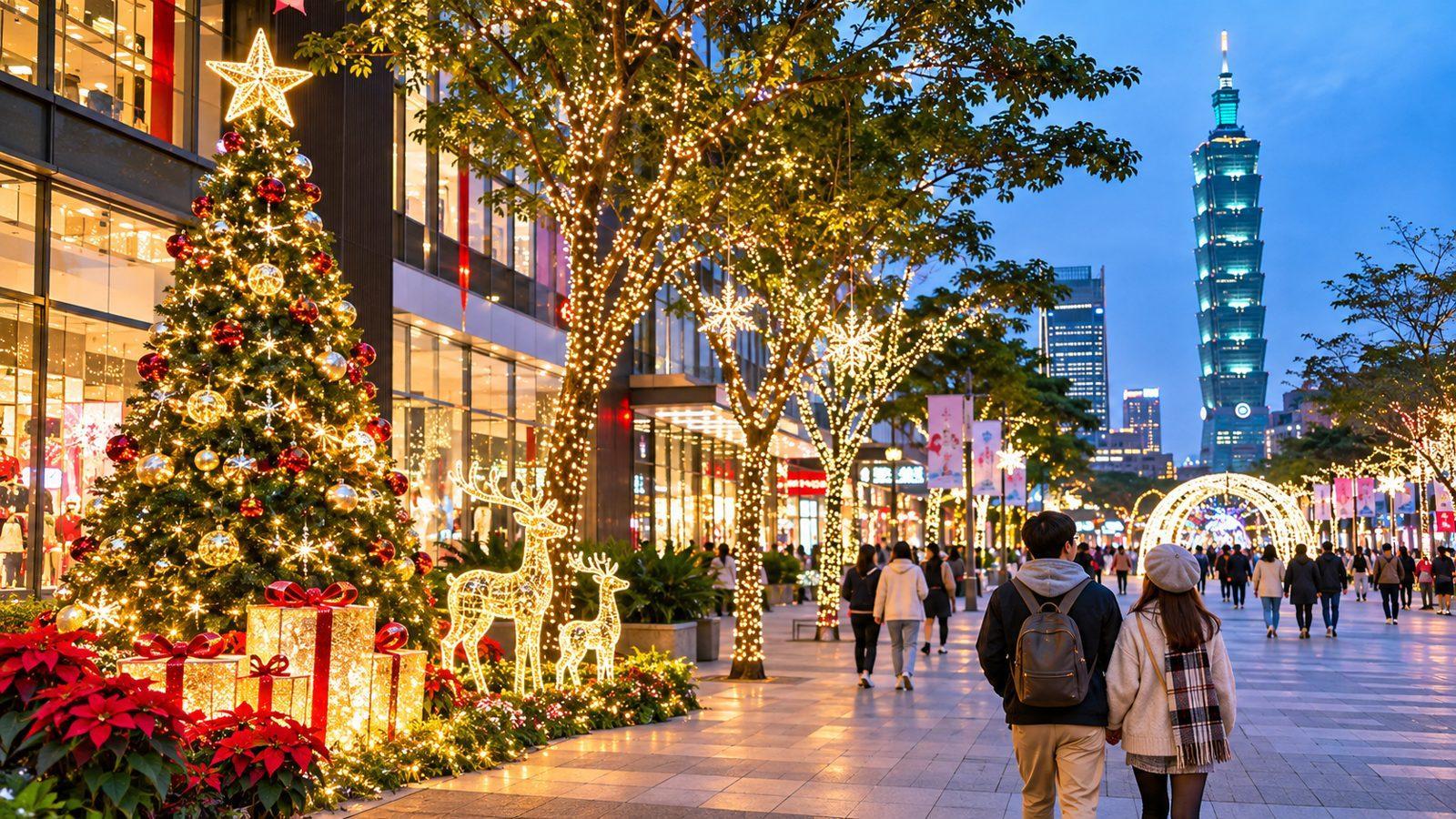
Xinyi after dark: Taipei 101 above the department stores, Christmas lights along the skybridges, and dinner within a short walk.
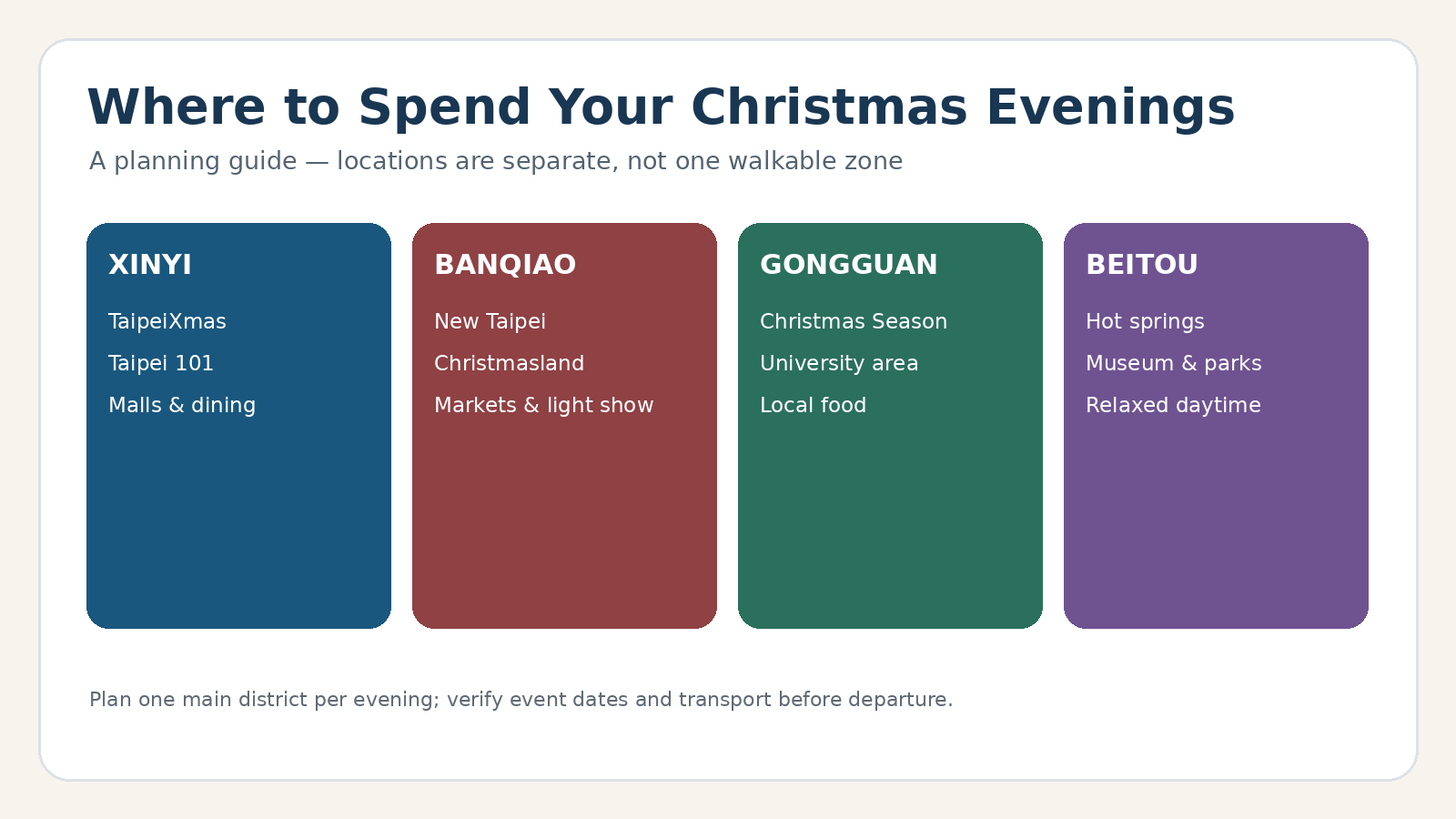
Taipei’s Christmas areas are separate districts. Plan Christmasland, Xinyi and Gongguan as different outings rather than one continuous walk.
2. Getting Around Taipei: Airport Transfers, MRT & Transport
Most international flights arrive at Taoyuan International Airport, outside central Taipei. The simplest transfer depends on your arrival time, luggage, group size and hotel location.
Airport MRT: Usually the easiest independent option
The Airport MRT links Taoyuan Airport with Taipei Main Station. It is a practical choice for many first-time visitors because it avoids road traffic and arrives at a major transport hub. Check whether the train you board is an express or commuter service, confirm the terminal station and check the last departure if you arrive late.
If your hotel is near Taipei Main Station, this is often the most straightforward option. If you are staying in Ximending, Xinyi or Banqiao, you may need to transfer to another MRT line or use a short taxi ride for the final leg. With heavy luggage, the number of transfers and station walking distance matter.
Airport bus: Useful for selected hotel locations
Airport buses can be convenient when a route stops close to your accommodation or when you prefer not to navigate rail transfers. The disadvantage is that journey time depends on road traffic, and the most suitable route varies by hotel location. Check the current route, stop name, timetable and luggage policy before relying on a bus.
Private transfer: Convenience for families and late arrivals
A pre-booked private transfer can be worth comparing if you arrive late, travel with children, carry several large suitcases or have a group that would otherwise need multiple taxis. Check the vehicle size, passenger and luggage limits, meeting-point instructions, waiting-time policy, child-seat availability and cancellation conditions. A low headline price is not useful if the vehicle cannot fit your luggage.
Arriving late, with children, or with several suitcases? Compare a private airport transfer for your exact flight time, group size and luggage, and check vehicle size, meeting point and waiting-time policy before you book.
Booking option: Check airport transfer options on Trip.com
| Option | Best suited to | Before confirming |
|---|---|---|
| Airport MRT | Most independent travellers | Last train, terminal and onward transfer |
| Airport bus | Hotels near a direct stop | Route, timetable and traffic |
| Private transfer | Families, groups and late arrivals | Vehicle size, luggage and meeting point |
Choose transport using your arrival conditions
Use a door-to-door comparison before deciding. For the Airport MRT, include the walk from the platform to the station exit and any transfer required to reach your hotel. For an airport bus, check the stop closest to the property and whether you will need to cross a large road with luggage. For a private transfer, compare the total price with the cost of public transport for everyone travelling, then consider how much you value a direct ride. The best choice can change between a solo traveller arriving in daylight and a family of four landing close to midnight.
Before departure, save the hotel address in both English and Chinese if the property provides it. Keep the booking confirmation, terminal information and driver contact instructions available without an internet connection. If you book a transfer, confirm the pickup location, flight monitoring, waiting-time allowance, vehicle size and luggage capacity. Passenger capacity alone does not guarantee that several large suitcases will fit. Tell the provider the number and approximate size of bags, and request child seats in advance if needed. If your flight is delayed, follow the supplier's stated delay procedure rather than assuming the driver will wait indefinitely. For public transport, check the service hours that apply to your actual arrival time. A transfer plan should include a backup: know which taxi rank or public transport option you would use if the pre- booked arrangement fails.
What to do after landing
After immigration and baggage collection, follow the airport signs for your chosen transport rather than accepting an unsolicited offer from someone approaching you in the terminal. Use official ticket counters, vending machines, designated bus platforms or the pre-arranged pickup point shown in your transfer confirmation. If you have booked a private driver, check the meeting instructions and vehicle registration details supplied by the provider. Do not assume the driver will be waiting directly outside the baggage hall. If you need cash or connectivity, decide whether to arrange it at the airport or after reaching the city. Keep enough payment capacity for the first journey and a backup option. Avoid exchanging more cash than you expect to use before comparing the rate and fees. For a mobile data plan, check whether your phone is unlocked and supports the selected SIM or eSIM before departure. Download the hotel address and transport instructions in advance so that you can still navigate if the connection is delayed. Families with strollers or travellers carrying several suitcases should consider the physical effort of transfers. A train journey may be inexpensive but can involve lifts, corridors and platform changes. A direct vehicle may be more comfortable, particularly after a long flight, but confirm the luggage capacity and child- seat requirements. Compare the whole arrival experience rather than choosing only by the advertised fare.
For a typical Taipei city break, you do not need to rent a car. The MRT connects many of the places in this guide, and English station signs make independent travel manageable. Use a route planner on the day because the fastest route can change depending on the station entrance, service disruptions and walking distance.
EasyCard and everyday transport
An EasyCard is a rechargeable contactless card used on many public transport services. It can make repeated MRT and bus journeys easier than buying a separate ticket each time. Confirm where cards can be purchased or topped up, what services accept them and whether any special tourist pass offers value for your planned number of journeys.
Do not buy a multi-day transport pass automatically. Estimate how many journeys you will actually make. If your itinerary concentrates on one district each day, a stored-value card may be more flexible than a pass that only pays off after frequent rides.
High Speed Rail for trips beyond Taipei
Taiwan High Speed Rail is useful if you are extending your holiday to Taichung, Tainan or Kaohsiung. For a four- day Christmas trip focused on Taipei, however, adding a distant city may create more packing and transit time than sightseeing time. Consider an extra night if you want to include another region.
Going beyond Taipei? Compare Taiwan transport tickets and High Speed Rail options for your exact dates, and check whether advance booking saves time on your route.
Booking option: Explore Taiwan transport passes on Trip.com
Plan around station exits and transfer time
Taipei's MRT network makes independent travel manageable, but journey planners can understate the effort involved in large stations. Allow extra time when transferring at Taipei Main Station, when travelling with children or older adults, or when carrying shopping bags. Check the station map for the correct exit before boarding, especially if your destination is a particular department store or event entrance. Choosing the wrong exit can add a long walk even when the station itself is close. An EasyCard is useful for repeated public-transport journeys and small everyday purchases at participating outlets, but do not assume every attraction, shop or restaurant accepts it. Keep another payment method available. If several people are travelling together, each person should have their own card where required by the transport system; do not assume one stored-value card can be used for an entire group on every service. Check the current rules for the specific transport mode before travelling. For a day trip outside Taipei, compare the High Speed Rail with conventional rail or a guided tour by looking at the complete route. A fast train may still require a local transfer at the destination, while a slower direct service may be simpler. Check the departure station, arrival station, seat reservation conditions and last return service before committing to an evening event in Taipei.
Taipei 101 and the Xinyi Evening
Taipei 101 is one of Taiwan’s best-known landmarks and a natural anchor for a first visit. The observatory on the 89th floor offers a 360-degree view of the city. The official website lists daily opening hours of 10:00–21:00, with last admission at 20:15; always recheck the official notice before your visit because operational arrangements can change.
A useful sequence is to visit the observatory in the late afternoon, spend time in the surrounding shopping district, have dinner and then walk through the Christmas displays after dark. This avoids making separate trips to the same neighbourhood. If the weather is cloudy or visibility is poor, consider whether the ticket’s value still makes sense for you.
Ticket option: Book Taipei 101 Observatory tickets on Trip.com
Official information: https://www.taipei-101.com.tw/en/observatory
Make the observatory visit weather-aware
The observatory is a timed attraction, so avoid placing it between two activities with little travel buffer. If visibility is the priority, check the weather close to the visit date and understand the ticket's change, cancellation and entry conditions before paying. Cloud, haze and rain can reduce the view even when the attraction is open. If the weather is poor, you can still enjoy the surrounding Xinyi district, department stores and seasonal displays without forcing the observatory visit into an unsuitable time slot. Plan the evening in a logical order. One option is to visit the observatory first and walk through the shopping district after sunset. Another is to have dinner before exploring the outdoor decorations. Leave enough time to reach the correct entrance and complete any ticket checks. If your group includes people who do not want to visit the observatory, agree on a nearby indoor meeting point and a clear return time. The surrounding commercial district offers alternatives, so the whole evening does not need to depend on one ticketed attraction.
Build a complete Xinyi evening
Xinyi is more enjoyable when you treat it as a district to explore rather than a single observatory visit. You can arrange the evening around Taipei 101, nearby department stores, public art, seasonal decorations and dinner. If the weather is clear, consider the observatory before sunset or after dark according to the view you prefer and the ticket times available. If the weather is poor, spend more time indoors and keep the outdoor displays as a flexible walk between buildings. Check the walking distance between the observatory entrance, the shopping areas and the seasonal installations. Large complexes can have several entrances and connected levels, so follow the signs rather than assuming two buildings that look close on a map are directly connected. If you plan to shop, consider leaving bulky purchases at the hotel or arranging a convenient return route. Carrying several shopping bags through a crowded display area can make the evening less comfortable. If you are travelling with people who have different interests, agree on a shared dinner time and meeting place. Some may want the observatory while others prefer shopping or cafés. Xinyi offers enough alternatives for the group to split briefly and reunite without making the whole evening depend on one activity.
3. Plan Your Taipei Christmas Trip: A Four-Day Itinerary
This itinerary assumes you are staying in central Taipei and travelling mainly by MRT. It is a framework rather than a fixed timetable. Adjust it to your flight arrival, weather, event dates and energy level.
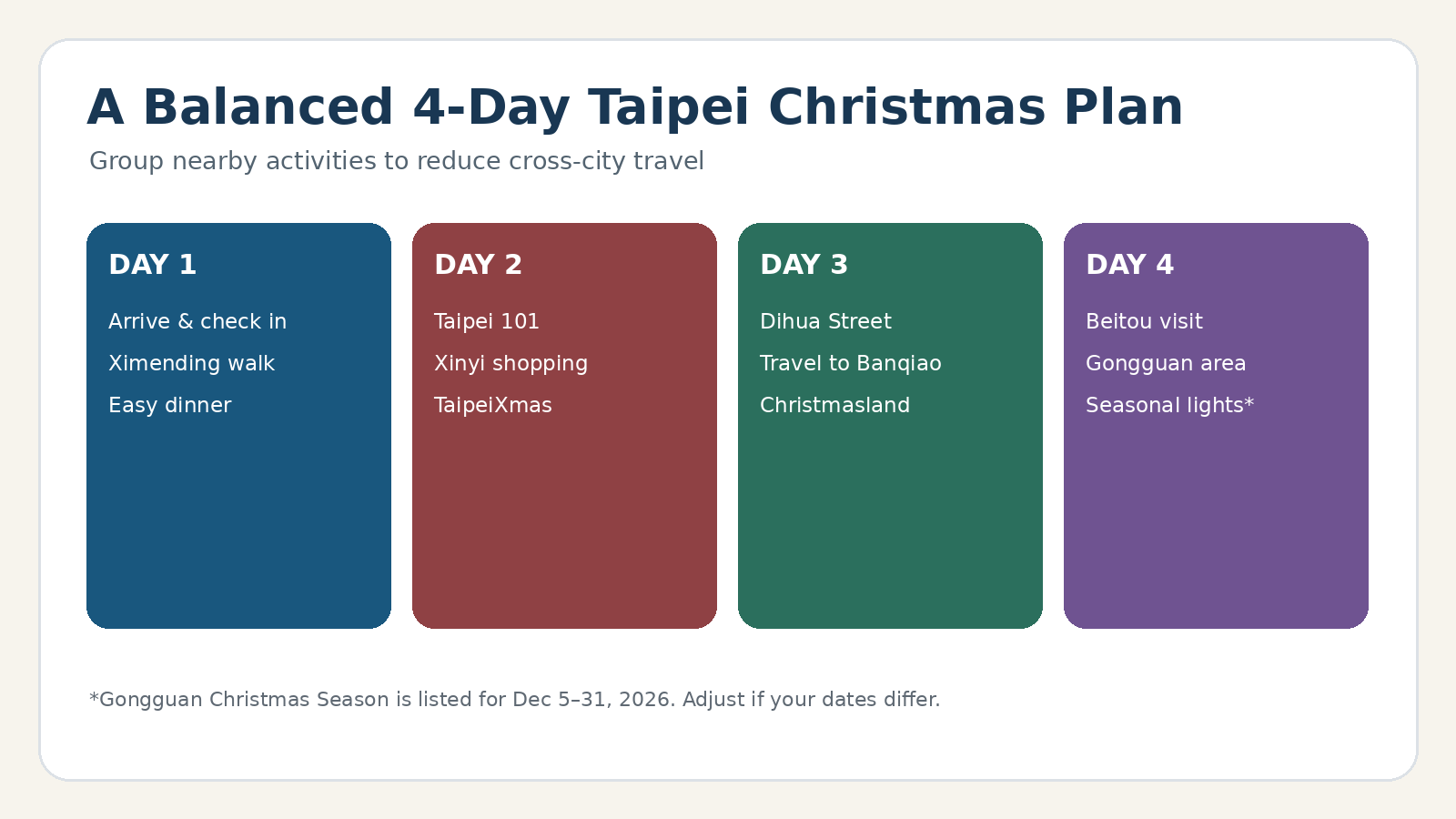
Four days, four districts, no backtracking. Gongguan on Day 4 is seasonal: include it only if your dates overlap December 5–31, 2026.
Day 1: Arrive, check in and explore Ximending
Keep arrival day light. After immigration and baggage collection, travel to your hotel, check in and rest. In the late afternoon or evening, walk through Ximending, browse shops and choose an easy dinner. If you still have energy, continue to a nearby night market; otherwise, save the longer outing for another night. The goal is to enjoy your first evening without turning it into a race against the clock.
Day 2: Taipei 101, Xinyi shopping and TaipeiXmas
Start with Taipei 101 and the observatory if visibility is reasonable. Have lunch in the area, then explore the department stores and shopping streets. Leave time to rest or have an early dinner before the evening lights. Visit TaipeiXmas after dark and photograph the installations at a relaxed pace. Staying in Xinyi is convenient, but travellers based elsewhere can return by MRT.
Day 3: Dadaocheng and New Taipei Christmasland
Spend the morning in Dadaocheng and Dihua Street. This historic area offers a contrast to Xinyi, with traditional shops, tea businesses and older architecture. Have lunch nearby, then travel to Banqiao in the afternoon. Explore the Christmasland zones, browse the markets and enjoy dinner in the area. Check the event map and programme before setting off so you know which zones matter most to you.
Day 4: Beitou or Gongguan, depending on your interests
Choose Beitou if you want a slower day with hot-spring culture and a change of scenery. Check the opening days and entry requirements for any museum or bathing facility you plan to visit. Choose Gongguan if you prefer food, university-area streets and the seasonal Christmas programme. The official listing gives Gongguan Christmas Season dates of December 5–31, 2026. If your visit falls outside those dates, enjoy the neighbourhood without expecting the seasonal installation.
Optional extra day: Consider a guided day trip to Jiufen and Shifen, or another northern Taiwan destination. A tour can reduce the effort of coordinating several transport legs, but compare the itinerary carefully: check how much free time is included, whether meals are included, the meeting point, group size and the cancellation policy.
Want Jiufen and Shifen without planning every transfer? Compare Taipei day tours by time at each stop, group size, language, inclusions and meeting point, and choose one that returns with enough margin before your evening plans.
Booking option: Explore Taipei and Northern Taiwan day tours on Trip.com
How to adapt the itinerary to your arrival and event dates
The four-day plan is a framework, not a fixed timetable. If your flight arrives late, treat the first day as an arrival day and move the neighbourhood walk to another morning. If you land early, leave your luggage at the hotel where possible, but do not assume the room will be ready before the stated check-in time. Keep the first activity close to the hotel so that a delayed flight or slow baggage collection does not create a chain of missed bookings. Place Christmasland on the day that best fits its operating dates and your energy level. If the event is the main reason for the trip, avoid pairing it with a long day tour. Keep the Xinyi evening separate where possible so that you can enjoy Taipei 101 and the seasonal displays without rushing across the city. Check the event calendar before finalising non-refundable tickets, because the festival period and the schedule of individual performances may differ. On departure day, work backwards from the airline's recommended airport arrival time. Add the journey to the airport, possible station walking time and a buffer for traffic or service disruption. Do not plan a distant attraction immediately before an international flight. If you have a late departure, choose a neighbourhood near your hotel or a location with convenient luggage storage.
A practical way to sequence each day
Group activities by district and avoid scheduling two distant locations with a narrow gap between them. On the Xinyi day, keep Taipei 101, shopping, dinner and TaipeiXmas together. On the Christmasland day, allow the afternoon and evening for Banqiao rather than adding another major attraction across town. This reduces unnecessary transfers and gives you more time at the event itself. If you want to visit Dadaocheng, Beitou or Gongguan, place the area that best matches your interests into the more flexible part of the itinerary. Use mornings for attractions that are easier to enjoy before crowds build, and reserve the evening for seasonal displays. This is only a general strategy: check the opening hours of each attraction and the specific event programme. Some museums close on particular weekdays, while performances and markets may operate only at selected times. Confirm the day before rather than relying on an old blog post or a search snippet. Keep one flexible block in the four-day plan. It can absorb bad weather, a delayed flight, an attraction you decide to skip or a neighbourhood you enjoy more than expected. A schedule with no spare time can look efficient on paper but becomes fragile when one train is delayed or a restaurant is full. First-time visitors usually benefit more from a realistic pace than from squeezing in every possible attraction.
4. What to Pack for Taipei in December
Pack layers rather than a full set of heavy winter clothing. A lightweight jacket, sweater, long trousers and comfortable walking shoes are useful for most visitors. Add a compact umbrella or waterproof layer because winter rain is possible. If you plan to spend several hours outdoors at Christmasland, bring a portable charger and a small bag for water, tissues and any personal medication.
Taiwan uses Type A and Type B electrical outlets and a standard voltage of 110V. Check your device labels before plugging in high-power appliances. Visitors from countries with different plug types may need an adapter; some devices also require a voltage converter.
Pack for changing indoor and outdoor temperatures
Use layers that can be removed easily. You may spend one part of the day outdoors in cool, damp weather and the next inside a heated or air-conditioned shopping centre. A light warm layer, a wind-resistant outer layer and comfortable walking shoes are more versatile than one heavy coat. Choose shoes that you have already worn comfortably; Christmas events involve standing as well as walking, and a blister can affect the rest of the trip. A compact umbrella or light waterproof jacket is useful because rain can change the comfort of an outdoor evening. Bring a small bag that keeps your phone, wallet and portable charger secure, and protect electronics from moisture. If you plan to take many photographs, check phone storage and battery capacity before leaving the hotel. A portable charger is particularly helpful when using navigation, translation and ticket apps throughout the day.
Check the voltage and plug requirements of any electrical device before packing it. Taiwan uses 110V household electricity; verify that chargers and appliances support the local supply and bring an appropriate plug adapter if necessary. Do not assume a travel adapter converts voltage.
Prepare a small day bag
For a full day outside, carry a compact umbrella or rain jacket, water, tissues, hand sanitiser, a portable charger and the booking details you may need. Keep the bag light enough to carry comfortably through stations and crowded event areas. A small foldable shopping bag can be useful if you plan to buy snacks or souvenirs, while a secure inner pocket helps protect your phone and wallet. If you use prescription medication, keep it in its original packaging where practical and carry enough for the trip plus a reasonable delay buffer. Check the entry rules for any medication that may be controlled or restricted before travelling. Keep important medication in your hand luggage rather than placing all of it in checked baggage. These preparations are especially important for travellers with long flight connections or a tight return schedule.
5. What to Eat in Taipei: Local Food and Night Markets
Taipei’s food scene is a major part of the trip. You do not need to book every meal. A good approach is to mix one sit-down meal with a night-market visit, where you can sample several smaller dishes.
Taiwanese beef noodle soup
Beef noodle soup is a classic comfort dish, usually served with beef, noodles and a savoury broth. Restaurants vary in broth style, cut of beef, noodle thickness and spice level. If you have dietary restrictions, ask about the broth and ingredients rather than assuming every bowl is the same.
Xiao long bao
Xiao long bao are steamed soup dumplings. The broth inside can be very hot, so place one on a spoon and allow it to cool slightly before eating. They are best enjoyed fresh from the steamer. If you are dining with a group, ordering a few baskets to share makes it easier to sample other dishes too.
Taiwanese fried chicken and bubble tea
Taiwanese fried chicken is available as large cutlets or bite-sized popcorn chicken, often seasoned with pepper, basil or other spices. Bubble tea is another familiar Taiwanese favourite. If you prefer less sweetness, ask for reduced sugar; sweetness levels and ice options vary by shop.
Three night markets to consider
Raohe Street Night Market is a manageable first choice, with a clear main route and a mix of stalls. Pepper buns are a popular snack, and Ciyou Temple near the entrance adds an interesting landmark. Shilin Night Market is larger and combines food, shopping and entertainment, but can feel crowded. Ningxia Night Market is a useful option when food is the priority and you want a more compact evening.
A practical strategy is to arrive hungry but not starving, buy small portions, share dishes and keep a little space for dessert. Carry some cash because smaller vendors may not accept every electronic payment method. Dispose of rubbish properly and follow local rules about eating and drinking on public transport.
Order confidently and manage dietary needs
At a busy food stall, decide what you want before reaching the counter. Menus may use photographs, Chinese names or short English translations, and the English description may not list every ingredient. If you have a serious allergy, prepare a clear written note in Chinese and show it before ordering. Ask about sauces, broth, seafood, peanuts and shared cooking surfaces when relevant. Do not rely only on removing a visible ingredient after the dish has been prepared. Night markets are easier to enjoy when you share several small portions rather than ordering a full meal at every stall. Carry tissues and hand sanitiser, keep drinks secure while walking and look for a place to stand aside before eating. Some stalls may accept cash only, while others support electronic payment; keep small notes available rather than assuming every vendor uses the same system. If queues are long, move on and return later instead of losing most of the evening at one stall. For visitors who prefer a quieter meal, choose a restaurant before the event and use the night market for dessert or snacks. This is especially useful for families, people with dietary restrictions and anyone who does not want to stand for long periods.
Make meals fit the day's route
Use food stops to support the itinerary instead of crossing the city for every famous dish. If you are visiting Xinyi, choose dinner in or near that district and save a separate food-focused outing for another day. If you are exploring Ximending, combine casual restaurants and snack shops with the neighbourhood walk. When visiting Banqiao for Christmasland, eat before the busiest period or plan a meal after the main displays rather than leaving the event area at peak time to find a restaurant elsewhere. For a first visit, try a mix of familiar and unfamiliar dishes. Beef noodle soup, xiao long bao, scallion pancakes, fried chicken and bubble tea are recognisable starting points, but menus and preparation vary by restaurant. Look for places with clear menus and a queue that moves steadily. A long queue can indicate popularity, but it does not guarantee that the food suits your taste or dietary needs. If a restaurant has a ticketing system, understand how to take a number before waiting. Keep some flexibility for breakfast. Many local breakfast shops are busiest in the morning and may have limited seating. If you have an early tour, choose a quick option near the hotel or ask whether breakfast can be taken away. If breakfast is included in your hotel rate, compare its value with the time you would spend travelling to a separate café. The best meal plan is one that leaves enough time for the attractions you came to see.
6. Where to Stay in Taipei: Choose a Hotel Based on Your Itinerary
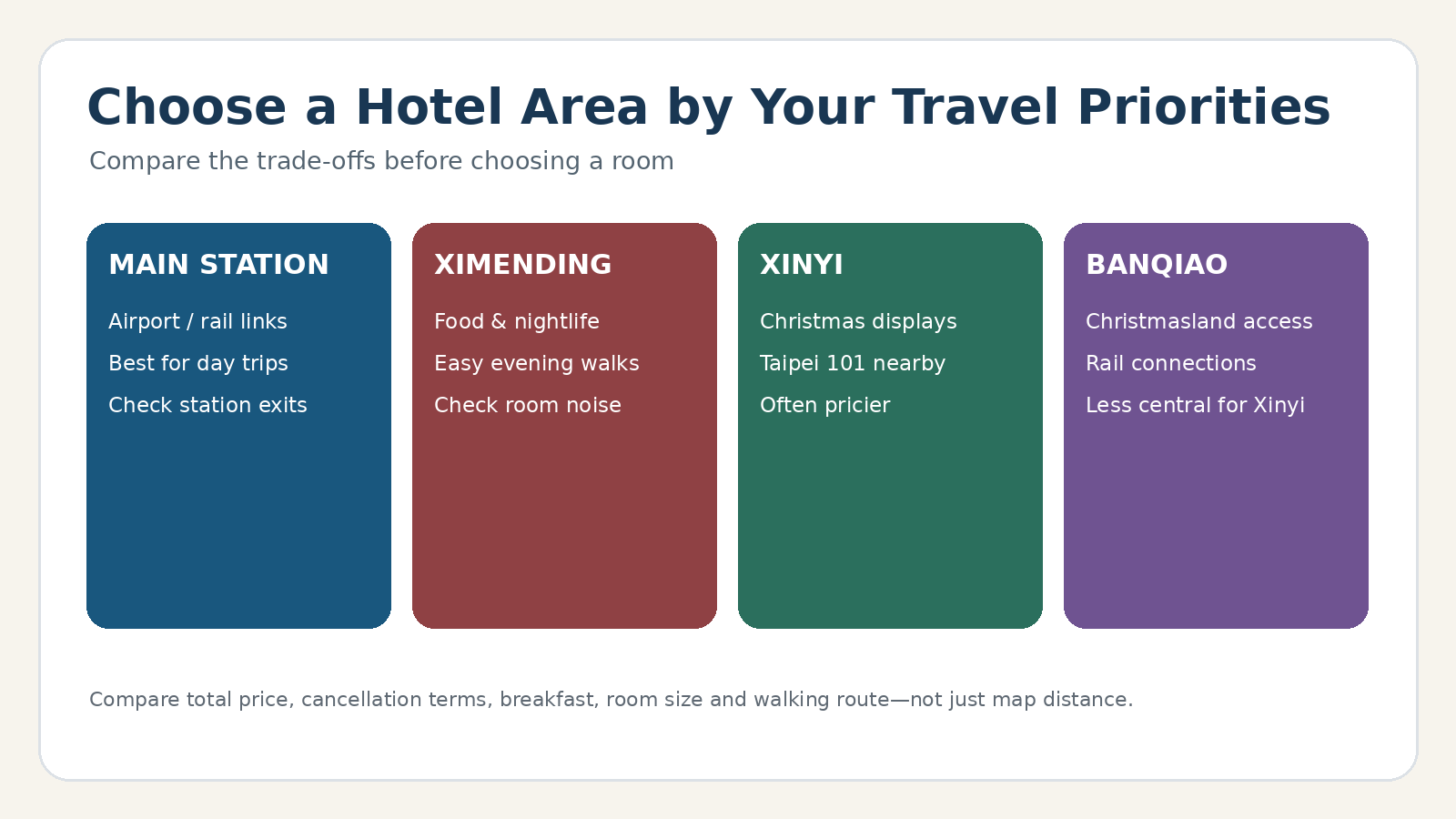
The best hotel is not necessarily the one with the lowest nightly price. In Taipei, a hotel near a useful MRT station can save time every day. Think about your arrival point, the Christmas events you want to attend, your preferred evening atmosphere and whether you plan to take day trips.
Taipei Main Station: Best for transport connections
Taipei Main Station is the most practical base for many first-time visitors. The area connects the Airport MRT, Taipei MRT, Taiwan Railway and High Speed Rail. It is especially useful if you arrive with luggage, plan to travel to another city, or want a central transport hub rather than a nightlife district.
The trade-off is that the station area is large and can feel confusing on the first visit. When comparing hotels, check which station exit is closest, whether the walking route has stairs, and whether you need to cross a major road. A hotel described as ‘near Taipei Main Station’ may still involve a longer walk than expected.
Best for a first stay if you want one base for airport, MRT and day trips. Compare live prices for Taipei Main Station hotels, check the station exit and luggage route, and choose a free-cancellation rate if your flights are not yet final.
Booking option: Find hotels near Taipei Main Station on Trip.com
Ximending: Best for food, shopping and evening energy
Ximending is a strong choice if you like to step outside your hotel and immediately find restaurants, shops, cafés and street activity. It suits younger travellers, couples and visitors who enjoy exploring on foot after dinner. Ximen MRT Station provides convenient access to the wider city.
The trade-off is noise. Some streets remain lively late into the evening, so light sleepers should read recent room reviews and check whether the hotel advertises soundproofing. Also check the actual route from the station to the hotel if you are carrying large suitcases.
Best if you want food and shopping steps from your door. Compare live prices for Ximending hotels, read recent reviews for noise and soundproofing, and check the walk from Ximen MRT Station with luggage.
Booking option: Find hotels in Ximending on Trip.com
Xinyi: Best for the Christmas atmosphere
Xinyi is the most convenient base if Taipei 101, shopping malls, restaurants and TaipeiXmas are the centre of your trip. Staying nearby makes it easier to enjoy the lights without worrying about a long journey back late at night.
The trade-off is price. Accommodation in this commercial district can cost more, particularly around Christmas and New Year. Compare the total stay cost, not just the first nightly rate, and check whether breakfast, taxes and cancellation flexibility are included.
Best if Taipei 101 and TaipeiXmas are the centre of your trip. Compare live prices for Xinyi hotels, check the total stay price including taxes and breakfast, and book early for Christmas Eve and Christmas Day.
Booking option: Find hotels in Xinyi District on Trip.com
Banqiao: Best for Christmasland
Banqiao is a practical choice if Christmasland is the main reason for your trip, especially if you want to return to your hotel quickly after a crowded evening. The area has rail and MRT connections, shopping centres and restaurants.
The trade-off is that Banqiao is less convenient than central Taipei if most of your other plans are around Xinyi, Dadaocheng or Beitou. It works best when you deliberately group Banqiao activities together or when you have a strong reason to stay near the festival.
Best if Christmasland is the main reason for your trip. Compare live prices for Banqiao hotels, check the walk to the Christmasland zones, and choose a hotel that makes the late-night return easy.
Booking option: Find hotels near Banqiao Station on Trip.com
Choose the area that makes your two or three most important evenings easiest, not the hotel closest to a single attraction.
A quick hotel decision
Use this quick match as a shortlist, then compare the actual route and room conditions: Taipei Main Station for airport and intercity connections; Ximending for food and evening activity; Xinyi for Taipei 101 and TaipeiXmas; Banqiao for Christmasland. Before booking, compare at least three properties in the same area and for the same dates. Review recent comments about noise, room size, bed configuration, check-in hours, cancellation deadline and maximum occupancy. For families, confirm the child policy and whether the displayed price includes every guest.
Compare the full journey, not just the station distance
A hotel described as being “near an MRT station” may still be inconvenient if the walk involves a long underground passage, several traffic crossings, stairs or an exit on the opposite side of a large road. When comparing properties, open the map and identify the station exit you are likely to use. Check the walking route with street-level photographs where available, and read recent reviews for comments about luggage access, noise and late-night surroundings. A five-minute walk on a flat, well-lit street can feel very different from a five-minute walk through a crowded shopping area while pulling two suitcases. For a Christmas-focused stay, compare the neighbourhood against your two or three most important evening activities. Xinyi reduces the journey home after TaipeiXmas and Taipei 101; Banqiao is convenient for Christmasland; Taipei Main Station is a practical base for airport and intercity connections; Ximending offers a lively evening environment and many casual food choices. No area is best for every traveller. If you plan to visit both Banqiao and Xinyi, choose the hotel that makes the rest of your itinerary easiest rather than trying to stay exactly between them. Check the final room details before payment: bed configuration, room area, window availability, breakfast, maximum occupancy, cancellation deadline and whether payment is charged immediately. A low headline price can become less attractive when the room is non-refundable or requires an extra bed. If your arrival is late, confirm the property's late check-in process directly.
Think about the first and last days as well as the sightseeing days. Taipei Main Station can be practical when you arrive by Airport MRT or plan to take intercity rail, because it reduces the number of transfers with luggage. Ximending can suit visitors who want restaurants, casual shopping and an active evening atmosphere within walking distance. Xinyi is convenient when the Christmas lights, Taipei 101 and department-store dining are central to the trip. Banqiao is worth comparing if Christmasland is a major priority or if you prefer to stay close to that event rather than return across the city late at night. The best location is not necessarily the one with the shortest map distance to one attraction. Consider how often you will travel to each area, how late you expect to return, and whether the route home requires a transfer. A hotel beside one event may be inconvenient for the rest of your itinerary. Write down your three most important destinations and compare the likely journey from each candidate hotel. This simple exercise often reveals whether a slightly more central property is worth the additional cost. Also check the immediate surroundings. A hotel beside a busy road may be convenient but noisy; a property on a quieter lane may require a longer walk with luggage. Read recent reviews for comments about sound insulation, construction, lift waiting time and the condition of bathrooms. If you are a light sleeper, request a quiet room away from lifts or major roads, while understanding that requests are not guaranteed until the property confirms them.
Understand cancellation and payment conditions
Compare the total price and the flexibility of the rate together. A refundable room may cost more, but it can be useful when flights, event dates or family arrangements are not final. Check the exact cancellation deadline and the local time zone used by the property. “Free cancellation” usually applies only until a stated date; after that, a penalty may apply. A prepaid non-refundable rate can be reasonable when plans are certain, but it should not be chosen solely because the first price shown is lower. Check whether the booking is pay-now or pay-at-property, which currency will be charged, and whether the card issuer may apply a foreign transaction fee. If the property requires a deposit or a card guarantee, read the conditions carefully. Keep a copy of the final confirmation showing the room type, guest count and cancellation terms. If the hotel listing and confirmation appear inconsistent, contact the property or platform before travelling rather than waiting until check-in.
7. How Much Does Christmas in Taipei Cost?
Travel prices vary by departure market, booking date, room type and availability. Instead of relying on a fixed budget that may become outdated, build a trip estimate using live quotes for your exact dates.
| Budget line | How to estimate it | Common oversight |
|---|---|---|
| Flights | Compare total fare for your dates | Checked baggage, seat and transit costs |
| Hotel | Total stay price divided by nights | Taxes, breakfast and cancellation |
| Airport transfer | Compare MRT, bus and private vehicle | Late-night service and luggage capacity |
| Local transport | Estimate actual daily journeys | Walking distance and transfer time |
| Food | Set a daily meal allowance | Drinks, snacks and market grazing |
| Attractions | List only the paid experiences you want | Timed entry and booking conditions |
| Tours | Compare inclusions and free time | Optional fees and meeting location |
| Insurance | Match coverage to your trip | Medical, delay and cancellation exclusions |
To keep costs under control, choose a hotel near an MRT station, group nearby attractions on the same day and use night markets for casual meals. Do not assume a non-refundable hotel is always the best deal. A flexible rate can be worth the difference if your flights or plans might change.
Build a realistic trip total
Create a simple budget with separate lines for flights, accommodation, airport transport, local transport, meals, attractions, day tours, shopping and contingency. Keep fixed costs separate from flexible spending. Flights and accommodation should be checked first because dates, room types and availability can change the total quickly. For meals, use the local price guide below to estimate a realistic daily range, then adjust it for your appetite, dining style and whether breakfast is included. For transport, list the journeys you expect to make rather than assuming you will buy an unlimited pass. For attractions and tours, use the final checkout price and read the ticket conditions; a discounted non-refundable ticket may be poor value if rain or low visibility could change your plans. Keep a contingency separate from planned spending for an unexpected taxi, delayed transfer, weather change or replacement item. The contingency is a safety buffer, not a target to spend. changed may be poor value if your itinerary is weather-dependent. Set aside a contingency for an unexpected taxi, a delayed transfer, a meal change or a necessary purchase. This is not money that must be spent; it is a buffer that allows you to make a sensible decision when plans change. Avoid converting every purchase into a strict daily limit, because some days involve more transport or paid activities than others.
Compare value rather than the lowest headline price
Compare value rather than the lowest headline price. For accommodation, calculate the total for all nights and guests, then compare properties with the same dates, room type and cancellation conditions. Include taxes, service charges, breakfast and the cost of reaching the places you plan to visit. For transport, compare public-transport fares with the occasional taxi you may realistically need; for tours, compare time at each stop, inclusions and the return time, not only the price per person. Do not use a single online daily average as a personal target: a solo traveller staying in a simple room has a different cost structure from a family booking a larger room and private transfers. Use the sample calculation below as a starting point, then replace every estimate with live prices for your own dates.
Indicative Taipei food and everyday prices
The ranges below are practical starting points for everyday spending, not official fixed prices or guaranteed menu prices. Actual prices vary by shop, portion size, location and season. Use them to estimate meals and short MRT journeys, then check current menus and fares before departure.
| Item | Indicative range (NT$) | Planning note |
|---|---|---|
| Traditional breakfast | 50–100 | A simple breakfast-shop meal; drinks and add-ons may cost extra. |
| Rice or noodle meal | 100–180 | A casual local lunch or dinner. |
| Beef noodle soup | 150–280 | Shop, cut of beef and portion size affect the price. |
| Night-market snack | 30–100 | Small snacks; several items make a full meal. |
| Bubble tea | 40–70 | Size, toppings and brand affect the final price. |
| Night-market dinner | 200–400+ | A modest meal; more dishes or drinks increase the total. |
| Taipei Metro single journey | 20–65 | Fare depends on distance; check the current fare for your route. |
For a simple four-day planning example, a visitor who buys a basic breakfast, a local lunch, a night-market dinner, one drink or snack and makes two to four MRT journeys might set aside roughly NT$500–1,000 per person per day for food and local transport. This is an illustrative allowance, not a quoted package price; it excludes flights, hotels, airport transfers, paid attractions, tours, shopping and travel insurance. Visitors who choose restaurant meals, taxis or several paid attractions should budget more. Couples should multiply per-person variable spending by two, then add the actual room cost once rather than counting accommodation twice.
A four-day sample budget: what is included and what is not
| Budget component | Illustrative amount | How to use it |
|---|---|---|
| Food and drinks | NT$1,500–3,000 per person | About NT$500–1,000 per day for a mix of local meals, snacks and drinks. |
| Taipei MRT | NT$160–1,040 per person | A broad planning allowance for several journeys; calculate actual route fares. |
| Accommodation | Use live hotel quotes | Compare the total for all nights, guests, room type, taxes and cancellation terms. |
| Airport transfer | Use your chosen option's live price | Compare Airport MRT, airport bus and private transfer for your arrival time and luggage. |
| Attractions and tours | Add only what you intend to book | Use final checkout prices for Taipei 101 and any day tour; check entry and cancellation rules. |
| Flights, insurance and shopping | Personal quote / allowance | These vary too widely to estimate responsibly without your departure city and preferences. |
For two adults sharing one room, calculate the room total once for the whole stay, then add each traveller's food, transport, attraction and shopping allowance. This keeps per-person and per-room costs separate and makes hotel comparisons more accurate.
8. Taipei Day Tours: When Is a Guided Trip Worth It?
A guided day tour is most useful when it solves a real transport or time problem. Jiufen and Shifen are often combined because the stops require separate local connections, and a guided option can reduce the work of coordinating those transfers. Independent travel may be better if you want to stay longer in one place, change plans around the weather or travel at your own pace. For a Christmas trip, do not place a full-day northern Taiwan tour on the same day as Christmasland or a timed Taipei 101 visit; allow time to return, eat and rest.
Before booking, inspect the actual itinerary rather than relying on the tour title. For a Jiufen-and-Shifen route, check the order of stops, the time allocated to the old street and waterfall areas, whether the schedule includes a return to Taipei, and how much time is spent travelling. Look for walking difficulty, stairs, meal arrangements, language, group size, pickup point and whether admission fees are included. Be cautious when a listing names several destinations but provides only brief photo stops. A longer list of stops does not necessarily mean a better day.
For families, consider whether the schedule allows toilet breaks and whether the vehicle provides an appropriate child seat if needed. For older travellers, check stair-heavy sections and walking distances. If the tour includes a coastal or mountain area, consider how rain or poor visibility might affect the experience.
Check the operator and the practical details
Before paying, confirm who operates the tour and how you will receive the final meeting instructions. Check whether the guide speaks the language you need, whether the vehicle has a fixed seat allocation and whether the tour is suitable for children or travellers with limited mobility. If the itinerary includes a mountain area or coastal viewpoint, ask whether the route changes in poor weather and whether any alternative stop is provided. Read the customer reviews for recurring operational details, not only the overall star rating. Useful comments mention punctuality, time spent at each stop, clarity of communication, vehicle comfort and whether the itinerary matched the listing. Be cautious if the advertised schedule appears to leave very little time for travel between distant locations. Save the operator's contact details and meeting-point map before the tour date, and arrive early enough to identify the correct group.
10. Frequently Asked Questions About Christmas in Taipei 2026
Is Taipei worth visiting at Christmas?
Yes, if you enjoy city lights, seasonal installations, food and shopping. Taipei offers a different atmosphere from a traditional snowy Christmas destination.
Does it snow in Taipei in December?
Snow is extremely uncommon in central Taipei. Expect cool weather and possible rain rather than a guaranteed white Christmas.
When is New Taipei Christmasland 2026?
The event is scheduled for November 13 to December 27, 2026.
Is New Taipei Christmasland free?
The public displays are free to visit. Food, drinks, shopping and some optional activities cost extra.
When is TaipeiXmas 2026?
The official Taipei tourism listing gives December 4, 2026 to January 3, 2027.
Where should first-time visitors stay?
Taipei Main Station is practical for transport, Ximending for food and nightlife, Xinyi for Taipei 101 and Christmas lights, and Banqiao for Christmasland.
How many days should I spend in Taipei?
Three days covers a basic city introduction. Four days gives more room for Christmas events, food and neighbourhoods without rushing.
Is Taipei easy to explore without a car?
Yes. The MRT and buses cover many visitor areas. Check routes and last services for your exact travel dates.
Is December 25 a public holiday in Taiwan?
Yes. December 25 is Constitution Day and a public holiday in Taiwan in 2026.
Should I book hotels early?
It is sensible to compare and book early for popular dates, especially Christmas Eve, Christmas Day and the final weekend of Christmasland. Choose a cancellation policy that suits your plans.
Is Taipei suitable for families?
Yes. Christmasland, Taipei 101, night markets and museums offer varied activities. Consider walking distances, crowds and late-night schedules.
Can I visit Jiufen and Shifen in one day?
Many visitors combine them in a day trip. Compare independent transport with guided tours and allow extra time for weekend crowds.
Which Christmas area is best for couples?
Xinyi is convenient for city views, shopping and illuminated streets. Christmasland is better for a larger themed festive experience.
What time should I visit Christmas lights?
After sunset is best for illuminated displays. Arriving before sunset can help you orient yourself and photograph both daylight and evening scenes.
Final Thoughts: Plan Your Christmas Trip to Taipei
Plan the districts first, then let the city surprise you. Pick one major festival evening at Christmasland, one easy evening in Xinyi, and one neighbourhood outing for food or local culture. Build the transport plan around those priorities, choose the hotel area that makes the most important evenings easy, and leave room for weather changes and spontaneous discoveries.
Before departure, check the official event pages and the latest transport and attraction notices. Once your dates are fixed, compare flights and accommodation, then book only the transfers, tickets and tours that genuinely improve your trip.
Official Information to Check Before Departure
New Taipei Christmasland – Event Programme: https://christmasland.ntpc.gov.tw/en/event.php
New Taipei Christmasland – Event Zones: https://christmasland.ntpc.gov.tw/en/zone.php
Taipei 2026 Event Calendar: https://www.travel.taipei/en/event-calendar/2026
TaipeiXmas 2026: https://www.travel.taipei/en/event-calendar/details/66776
Taipei 101 Observatory: https://www.taipei-101.com.tw/en/observatory/
Taipei Metro – Tickets and Travel Passes: https://english.metro.taipei/cp.aspx?n=BECC2E7AC426F659&s=0EE224E8BA770C16
Taiwan Tourism Administration: https://eng.taiwan.net.tw/
Indicative Taipei food-price references: https://www.taipeitourism.org/taipei-food-guide/
Affiliate Disclosure
This article contains affiliate links. If you make a booking through certain links, we may earn a commission at no additional cost to you. This helps support our travel guides and allows us to continue creating useful content.
Travel Disclaimer
Event schedules, transport services, opening hours, prices, hotel availability and booking conditions may change. Check the latest information with the relevant organiser or service provider before travelling.
Sources and notes
New Taipei Christmasland official event pages, Taipei 2026 event calendar, TaipeiXmas 2026, Taipei 101 Observatory, Taipei Metro, Taiwan Tourism Administration, Taipei Tourism food guide. Event details and prices may change; check official pages before travelling.
Verified on:2026-11-20
Comments (0)
No comments yet.
Comments are published first and reviewed afterwards; rule-breaking comments are hidden. Only signed-in members can comment.